Headlamps
Best headlamps, ranked on the watt-hours behind the lumens
Twelve headlamps compared on published ANSI FL 1 figures, with the energy arithmetic that decides how long any of them actually last.
By Scooter M. · Published · Updated
| # | Product | Best for | Output / weight | Price |
|---|---|---|---|---|
| 1 | 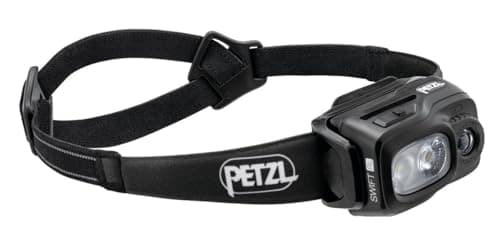 Petzl Swift RLTop pickThe best power-to-weight figure we could source: 1,200 lumens and 168 m from 92 grams, with reactive dimming that genuinely extends the burn. | Trail running and fast movement at night | 1,200 lm / 92 g | Check price#ad |
| 2 | 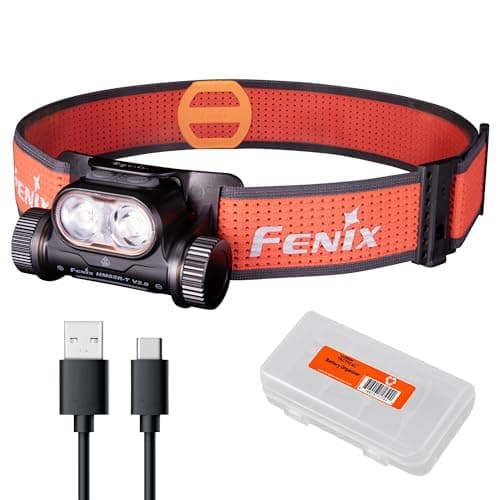 Fenix HM65R-T V2.01,600 lumens and 170 m from a magnesium body running a standard 18650, at 140 g. The removable cell is what separates it from the sealed-pack lamps. | Long nights where you want reach and a spare cell | 1,600 lm / 140 g (4.94 oz) | |
| 3 | 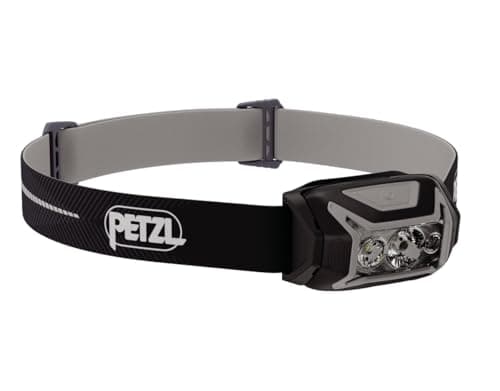 Petzl Actik CoreThe default outdoor headlamp: hybrid power, a published ANSI figure, and a beam shaped for walking rather than for a spec sheet. | Hiking and general outdoor use | 625 lm / 88 g | |
| 4 | 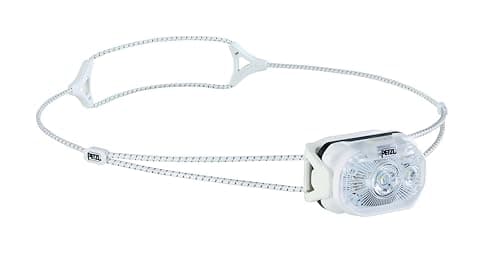 Petzl Swift LT43 grams with a real 380-lumen ANSI figure. The lightest lamp here that is still a lamp rather than a token. | Ultralight backpacking | 380 lm / 43 g | |
| 5 | 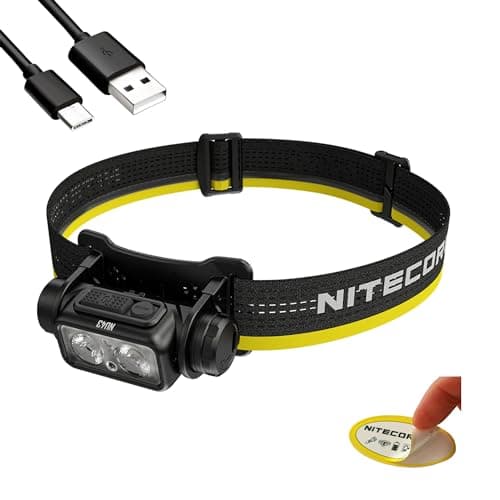 Nitecore NU431,400 lumens with a spotlight and floodlight pair, USB-C, and a price well under the European brands. | Bright output at low weight for the money | 1,400 lm | |
| 6 | 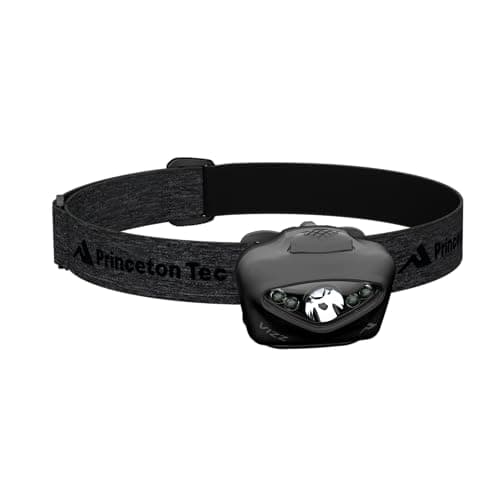 Princeton Tec Vizz550 lumens on three AAA cells with an IPX7 rating — immersion, not just rain. The only AAA lamp here rated for a dunking. | Getting wet | 550 lm / 92 g | |
| 7 | 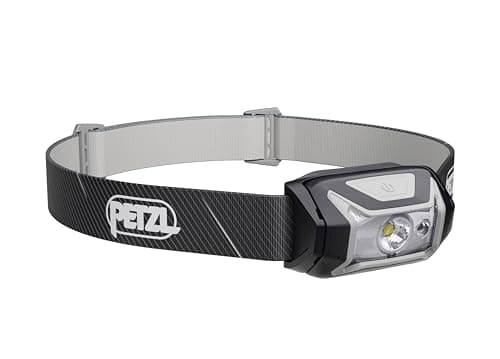 Petzl Tikka350 lumens, three AAA cells, a red mode, 94 grams. The unglamorous answer that covers most of what people actually do after dark. | A first headlamp, and the glovebox | 350 lm / 94 g | |
| 8 | 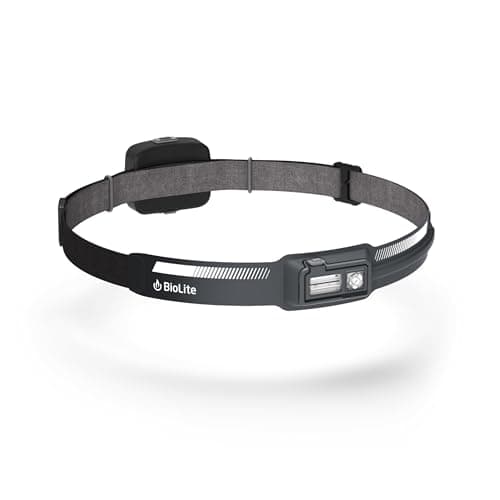 BioLite Dash 450450 lumens, 90 m of stated beam and 60 hours of stated runtime in BioLite's flat, no-bounce strap. | Road running, where the strap matters more than the beam | 450 lm |
We earn a commission if you buy through the links on this page, at no extra cost to you. It does not change what we recommend or the order they appear in. Full disclosure. Prices checked October 16, 2026.
A headlamp is bought on a lumen figure and lived with on a watt-hour figure. The number on the box is peak output for the first thirty seconds; the number that decides whether you get back to the car is the energy in the battery divided by the power the lamp is drawing. Almost nobody publishes the second one, so we compute it from the cell capacity every maker does publish.
That is what the ranking above is doing. Every lamp on it is sorted by whether its published output, its published weight and its published battery capacity make sense together — not by which one printed the biggest number.
How we picked
We compiled the ANSI/PLATO FL 1 figures each manufacturer publishes, converted battery capacity to watt-hours, and computed a runtime for each lamp at a realistic working output. Where a maker publishes a full per-mode table we used it. Where a maker publishes only a flattering maximum, we say so in the entry rather than treating the gap as if it were data. Nothing here has been tested by us and we have not handled any of these lamps — the full method, including every formula, is on our methodology page.
Energy, not lumens: the table nobody prints
Here is every lamp in this roundup whose maker publishes a battery capacity, converted to watt-hours and divided by weight. The last column is the one to read: it tells you how much energy each gram on your head is actually buying.
| Lamp | Battery | Watt-hours | Weight | Wh per 100 g |
|---|---|---|---|---|
| Fenix HM75R | 18650 + 21700 | 30.2 | 321 g | 9.4 |
| Fenix HM65R-T V2.0 | 3,400 mAh 18650 | 12.2 | 140 g | 8.7 |
| Petzl NAO RL | 3,200 mAh | 11.8 | 145 g | 8.2 |
| Petzl Swift RL | 2,250 mAh | 8.5 | 92 g | 9.2 |
| Fenix HL18R-T V2.0 | 1,900 mAh | 6.8 | 103 g | 6.6 |
| Petzl Swift LT | 880 mAh | 3.3 | 43 g | 7.6 |
| Petzl Actik Core | 1,250 mAh CORE | 4.5 | 88 g | 5.1 |
| Fenix HM50R V2.0 | 800 mAh 16340 | 2.9 | 78 g | 3.7 |
Two things fall out of that table. First, the Swift RL and the HM65R-T are carrying their weight better than anything else here — around 9 Wh per 100 g. Second, the Actik Core and the HM50R are paying a real penalty in energy density for their hybrid and compact designs respectively, and buying either on its lumen headline will disappoint you. See our runtime guide for how to turn these figures into hours.
What the beam distance figures actually mean
ANSI FL 1 defines beam distance as the point at which the light falling on a surface drops to 0.25 lux — roughly the illumination of a full moon. That is a detection threshold, not a working one. At the rated distance you can tell that there is something there. To identify it you need to be at about a third of that number.
So a Petzl Swift RL rated at 168 m gives you a genuinely usable 55 to 60 m of trail, and a Petzl Actik Core rated at 115 m gives you around 38 m. That is the honest way to read the column, and it is why we do not treat a 200-meter difference between two lamps as decisive. Lumens versus candela explains where these distances come from.
Hybrid power is the most underrated feature in the category
Three lamps here run on either a rechargeable pack or disposable cells: the Petzl Actik Core and Tikka on AAA, and the Fenix HL18R-T on AAA. The Fenix HM65R-T takes a standard 18650 or two CR123A primaries.
This matters more than any 500-lumen difference. A sealed-cell lamp that dies at hour four of a night walk is finished; a hybrid lamp is a two-minute battery change. If you are going to be genuinely far from a socket, put this above output in your ranking.
Ingress ratings, and why most of this category is worse than you think
IPX4 means splashing water from any direction. It does not mean rain for four hours, it does not mean immersion, and it is what most of the running and hiking lamps here carry, including every Petzl in this roundup.
| Rating | What it actually covers | Lamps here |
|---|---|---|
| IPX4 | Splashing water from any direction | Petzl Actik Core, Swift RL, Swift LT, Tikka, Tikkina; Streamlight Bandit Pro; BioLite Dash 450 |
| IP66 | Dust tight; powerful water jets | Fenix HL18R-T V2.0 |
| IPX7 | Immersion to 1 m for 30 minutes | Princeton Tec Vizz |
| IP68 | Dust tight; sustained immersion | Fenix HM65R-T V2.0 |
If your lamp will be out in genuine weather, the Fenix HM65R-T and the Princeton Tec Vizz are the only two here with a published rating that covers it.
What we would not buy
We left several popular lamps off this list because their makers publish nothing we can check. A 3,000-lumen headlamp with no published runtime, no beam distance, no weight and no IP rating is a number on a box, and the number is always the peak burst before thermal step-down. If you cannot find a runtime table on the maker's own site, assume the runtime is the weak point.
We would also avoid buying a headlamp for its maximum output. No head-mounted light can sustain 2,000 lumens: the constraint is heat against your forehead, not the emitter. Every lamp in this class steps down within a few minutes, and the setting you will actually live on is somewhere between 100 and 300 lumens.
Choosing by what you are doing
- Running on trail — weight and beam stability decide it, not peak output. Start at running headlamps.
- Hiking and general outdoor use — hybrid power and a red mode matter more than lumens. See hiking headlamps.
- Hunting — the light color is the decision, not the brightness. See hunting headlamps.
- Work and trades — color accuracy, a hard-hat-compatible strap and all-shift runtime. See work headlamps.
- Camping — a red mode and replaceable cells beat everything else. See camping headlamps.
- Backpacking — grams, and only grams. See backpacking headlamps.
- HVAC, plant and machine work — close-range beam shape, hard-hat fit and dust resistance, which is a different problem from general site work. See headlamps for HVAC and the mechanical trades.
- Reviewed in full — the Petzl Actik Core, the most completely documented lamp we cover, the Petzl Swift LT at 43 grams, the Petzl Tikka, which publishes a full runtime table for both of its power sources, the Fenix HL18R-T and its two color temperatures, the Streamlight Bandit Pro at 45 grams, the Fenix HM65R-T, the Fenix HM75R for its 30.2 watt-hours, and the Princeton Tec Vizz, the only lamp here pairing an immersion rating with replaceable cells, and the Coast XPH34R, which publishes one figure and nothing else.
Rechargeable or replaceable
Rechargeable lamps are cheaper to run, lighter for the same energy, and useless when flat with no power for two days. Replaceable-cell lamps cost more over time and never leave you stranded. The honest answer for most people is a hybrid, which is why three of our top picks are hybrids. If you want the full argument, rechargeable headlamps covers it, and 18650 vs 21700 covers the cell formats underneath.
The picks, in full
Top pick · Trail running and fast movement at night
Petzl Swift RL
The best power-to-weight figure we could source: 1,200 lumens and 168 m from 92 grams, with reactive dimming that genuinely extends the burn.
8.47 watt-hours across 92 grams is the whole argument. That works out to 13.0 lumens per gram at peak and 0.092 Wh of stored energy per gram carried, the best combination of the two figures in this roundup.
Reactive lighting is the runtime strategy, not a gimmick. The lamp meters reflected light and cuts output when you look at your own hands or a pale trail. Petzl's 7-hour minimum at medium is quoted in that mode, and it is the number to plan around.
168 m of throw is more than a runner can use below about 8 minutes per kilometer. What you actually notice is how little the beam sags once the pack drops under half.
What works
- 1,200 lm and 168 m at 92 g, the best power-to-weight in this set on published figures
- Reactive dimming extends the burn instead of just cutting output in bright patches
- Five-level charge gauge, so you know what you have before you start
What does not
- IPX4, in a category where running in rain is the normal case
- Charging cable not included at this price
- Reactive mode takes a few outings to trust
Skip this ifyou mostly walk. You are paying for a reactive sensor and a 2,250 mAh pack to solve a problem hikers do not have.
Published specification
- Output
- 1,200 lmANSI FL 1 standardPetzl Swift RL — manufacturer spec page (retrieved September 1, 2026)
- Peak intensity
- not published(Petzl publishes distance, not peak intensity)
- Beam distance
- 168 mPetzl Swift RL — manufacturer spec page (retrieved September 1, 2026)
- Runtime
- 7 h minimum at medium, in reactive modePetzl Swift RL — manufacturer spec page (retrieved September 1, 2026)
- Battery
- 2,250 mAh / 3.85 V / 8.47 Wh Li-ion, USB-CPetzl Swift RL — manufacturer spec page (retrieved September 1, 2026)
#ad · how this is funded · price as of October 16, 2026
Pick 2 · Long nights where you want reach and a spare cell
Fenix HM65R-T V2.0
1,600 lumens and 170 m from a magnesium body running a standard 18650, at 140 g. The removable cell is what separates it from the sealed-pack lamps.
A 3,400 mAh 18650 at a nominal 3.6 V is 12.2 watt-hours. That is more energy than a Petzl NAO RL carries, in a lamp 5 g lighter, because a bare 18650 is a more efficient package than a molded pack.
It is also the only headlamp in this set whose battery you can replace at a checkpoint for three dollars, because 18650 is a standard cell and not a proprietary brick.
IP68 rather than IPX4 is the second real difference. This one survives being dropped in water; most of the running lamps here do not.
What works
- Standard 18650 cell: swappable, cheap, and available everywhere
- IP68 and 2 m impact rating, the toughest specification in this roundup
- Dual emitters, one white and one warm white, so it works for close tasks as well as reach
What does not
- 140 g is at the heavy end for a running lamp
- Charging works only with Fenix ARB-L18 series cells, which limits the swap-any-18650 advantage
- No published candela figure
Skip this ifyou count grams. A Swift LT does the camp job at 43 g; you are carrying 97 g extra for reach and a removable cell.
Published specification
- Peak intensity
- not published(Fenix publishes distance, not peak intensity)
- Runtime
- 300 h maximumLowest mode. The turbo figure is far shorter and Fenix publishes it per-mode.Fenix HM65R-T V2.0 — manufacturer spec page (retrieved September 1, 2026)
- Battery
- 3,400 mAh 18650 Li-ion (included), or 2 x CR123AFenix HM65R-T V2.0 — manufacturer spec page (retrieved September 1, 2026)
- Weight
- 140 g (4.94 oz)Including battery and headbandFenix HM65R-T V2.0 — manufacturer spec page (retrieved September 1, 2026)
- Ingress
- IP68Dust tight and immersion rated; 2 m impact resistanceFenix HM65R-T V2.0 — manufacturer spec page (retrieved September 1, 2026)
#ad · how this is funded · price as of October 16, 2026
Pick 3 · Hiking and general outdoor use
Petzl Actik Core
The default outdoor headlamp: hybrid power, a published ANSI figure, and a beam shaped for walking rather than for a spec sheet.
625 lumens and 115 meters is a walking beam, not a searching beam. The FL1 definition puts illuminance at 115 m down to 0.25 lux, which is enough to tell that something is there and not enough to identify it. In practice you run the middle level and see 30 to 60 m of usable trail.
4.5 watt-hours matters more than the lumen figure. A lamp drawing a regulated 2 W empties that pack in a bit over two hours. The 400-hour number Petzl quotes is a reserve-mode visibility claim, not 400 hours of light you can walk by.
The hybrid design is the real feature. When the CORE pack dies three hours into a night descent, three AAA cells from a gas station bring the lamp back. Very little else at this price does that.
What works
- Runs on the rechargeable pack or three AAA cells, which is a genuine field fix rather than a marketing bullet
- Petzl publishes the full ANSI FL 1 table, including a distance for every mode
- 88 g is light enough that you stop noticing it
What does not
- IPX4 only: rain is fine, a dropped-in-the-creek recovery is not
- No published peak candela, so the 115 m claim cannot be checked against the intensity
- The maker's own site and its own Amazon listing disagree about peak output
Skip this ifyou need reach. 115 m is short by 2026 standards, and the 625-lumen headline does not change the shape of the beam.
Published specification
- Output
- 625 lmANSI/PLATO FL 1. Petzl's US product page states 625; the brand's own Amazon listing says 650. We use the maker's own site.Petzl Actik Core — manufacturer spec page (retrieved September 1, 2026)
- Peak intensity
- not published(Petzl publishes distance, not peak intensity)
- Beam distance
- 115 mMaximum, on the CORE rechargeable batteryPetzl Actik Core — manufacturer spec page (retrieved September 1, 2026)
- Runtime
- 2 h at 625 lm / 7 h at 100 lm / 100 h at 7 lm, on the CORE packPetzl publishes a full per-mode table for both power sources. On 3 x AAA the same levels run 2 h / 10 h / 100 h, with peak output capped at 450 lm. Its separate strobe figure, visible at 700 m for 400 h, is a be-seen claim and not a working runtime.Petzl Actik Core — manufacturer spec page (retrieved September 19, 2026)
- Battery
- CORE 1250 mAh / 3.6 V / 4.5 Wh, or 3 x AAAPetzl Actik Core — manufacturer spec page (retrieved September 1, 2026)
- Ingress
- IPX4Weather resistant. Not immersion rated.Petzl Actik Core — manufacturer spec page (retrieved September 1, 2026)
$87.95 · 6% off
#ad · how this is funded · price as of October 16, 2026
Pick 4 · Ultralight backpacking
Petzl Swift LT
43 grams with a real 380-lumen ANSI figure. The lightest lamp here that is still a lamp rather than a token.
3.27 watt-hours is a small tank. Run it at a genuine 100 lumens, roughly 0.5 W at the emitter once losses are counted, and the arithmetic lands near five hours. That is a night of camp chores or one pre-dawn start, not a week.
43 g is 45 g under an Actik Core and 102 g under a NAO RL. Across a multi-day trip that saving is the only reason to accept the smaller battery.
70 m of throw is honest for the size. This is a camp-and-trail beam and it does not pretend otherwise.
What works
- 43 g with a published ANSI figure rather than a vague ultralight claim
- USB-C, which by 2026 should be standard and still is not
- Small enough to live permanently in a pack lid
What does not
- 3.27 Wh means planning recharges on anything longer than an overnight
- No AAA fallback: when it is flat, it is flat
- IPX4
Skip this ifgrams are not your binding constraint. For the same money a heavier lamp buys two to three times the watt-hours.
Published specification
- Output
- 380 lmANSI/PLATO FL 1Petzl Swift LT — manufacturer spec page (retrieved September 1, 2026)
- Peak intensity
- not published
- Runtime
- 2 h at 380 lm / 6 h at 100 lm / 60 h at 7 lmPetzl publishes output, beam distance and runtime for every level. The standard level adds a 2 h reserve; red runs 25 h at 2 lm, and the 200 h figure Petzl lists is the red strobe rather than a working runtime.Petzl Swift LT — manufacturer spec page (retrieved September 27, 2026)
- Battery
- 880 mAh / 3.7 V / 3.27 Wh Li-ion, USB-CPetzl Swift LT — manufacturer spec page (retrieved September 1, 2026)
#ad · how this is funded · price as of October 16, 2026
Pick 5 · Bright output at low weight for the money
Nitecore NU43
1,400 lumens with a spotlight and floodlight pair, USB-C, and a price well under the European brands.
1,400 lumens at this price is the whole pitch, and it is a real pitch: nothing from Petzl at the same money publishes a number that high.
A spot and a flood emitter together is the right architecture for a general-purpose lamp. One beam shape never covers both map-reading and trail-finding.
Everything except output and charging is unpublished in the source we could reach, which is why this sits below the Fenix and Petzl picks despite the bigger headline.
What works
- The highest published output per dollar in this roundup
- Separate spot and flood emitters
- USB-C
What does not
- No sourced runtime, weight, beam distance or IP rating
- A 1,400-lumen headline on an unstated battery tells you nothing about how long it holds
- Built-in cell
Skip this ifthe runtime matters more than the peak. Without a published runtime table you cannot plan a night around it, and we will not estimate one for you.
Published specification
- Peak intensity
- not published
- Beam distance
- not published
- Runtime
- not published
- Battery
- USB-C rechargeableNitecore NU43 — the brand's own listing on Amazon.com (retrieved September 1, 2026)
- Weight
- not published
- Ingress
- not published
#ad · how this is funded · price as of October 16, 2026
Pick 6 · Getting wet
Princeton Tec Vizz
550 lumens on three AAA cells with an IPX7 rating — immersion, not just rain. The only AAA lamp here rated for a dunking.
IPX7 on AAA cells is the specification that makes this interesting. Almost everything else in the AAA class is IPX4, which means rain and nothing more.
Three lithium AAA cells hold roughly 4.5 Wh and shrug off cold in a way alkalines do not. On this lamp that combination is worth more than another 500 lumens.
Princeton Tec publishes an output and a runtime for each of its four modes, plus an 85 m beam distance and a 92 g weight - not a single flattering maximum. The 85 m works back to about 1,806 candela, or 3.3 candela per lumen, which says the 550 lumens buys width rather than reach.
What works
- IPX7 immersion rating on replaceable cells
- A published runtime spread across modes and chemistries
- Digital lockout, so it does not drain itself in a pack
What does not
- No candela figure, so the 85 m distance cannot be cross-checked
- Bulkier than the modern rechargeable lamps
- No rechargeable option
Skip this ifweight is your constraint. The AAA carriage that makes it robust also makes it bigger than the Li-ion competition.
Published specification
- Output
- 550 lmSpot high. Spot low 150 lm, flood high 30 lm, red high 10 lm.Princeton Tec Vizz — manufacturer spec page (retrieved October 15, 2026)
- Peak intensity
- not published(Princeton Tec publishes distance, not peak intensity)
- Runtime
- 1 h 30 min on spot highFour published pairs: spot 150 lm/40 h, flood 30 lm/90 h, red 10 lm/135 h. The headline 90 h is the flood figure.Princeton Tec Vizz — manufacturer spec page (retrieved October 15, 2026)
- Battery
- 3 x AAA alkaline or lithiumPrinceton Tec Vizz — manufacturer spec page (retrieved October 15, 2026)
- Ingress
- IPX7Withstands immersion to one meterPrinceton Tec Vizz — manufacturer spec page (retrieved October 15, 2026)
#ad · how this is funded · price as of October 16, 2026
Pick 7 · A first headlamp, and the glovebox
Petzl Tikka
350 lumens, three AAA cells, a red mode, 94 grams. The unglamorous answer that covers most of what people actually do after dark.
Three alkaline AAA cells hold roughly 3.9 Wh between them at a modest draw. That is comparable to the Swift LT's entire battery, for a couple of dollars, available in any gas station in the country.
The red mode is the feature people end up using most. It preserves night adaptation and does not wake a tent.
350 lumens looks modest next to a 3,000-lumen listing. On a footpath at walking pace it is more light than you need, and it will still be running when the 3,000-lumen light has stepped down twice.
What works
- AAA cells: replaceable anywhere, storable for years, no charge cycle to manage
- A red mode you can reach without a mode-cycling ordeal
- Cheap enough to own two
What does not
- No rechargeable pack in the box
- 70 m throw identifies nothing at distance
- IPX4
Skip this ifyou want one lamp for everything including work. There is no real flood mode and no high-CRI option.
Published specification
- Output
- 350 lmANSI/PLATO FL 1Petzl Tikka — manufacturer spec page (retrieved September 1, 2026)
- Peak intensity
- not published
- Beam distance
- 70 mOn three AAA cells; 75 m on the CORE rechargeable accessoryPetzl Tikka — manufacturer spec page (retrieved September 1, 2026)
- Runtime
- 2 h at 350 lm / 12 h at 100 lm / 110 h at 7 lm, on AAAOn the CORE pack the same levels run 2.5 h at 450 lm / 7 h at 100 lm / 110 h at 7 lm. AAA gives less peak output and more mid-level runtime. The 400 h figure Petzl lists is the red strobe, not a working runtime.Petzl Tikka — manufacturer spec page (retrieved September 27, 2026)
- Battery
- 3 x AAA (included), or the CORE rechargeable packPetzl Tikka — manufacturer spec page (retrieved September 1, 2026)
#ad · how this is funded · price as of October 16, 2026
Pick 8 · Road running, where the strap matters more than the beam
BioLite Dash 450
450 lumens, 90 m of stated beam and 60 hours of stated runtime in BioLite's flat, no-bounce strap.
BioLite's listing publishes more than most: output, beam distance, maximum runtime and an IP rating. That is why this one earns a place despite the modest headline.
450 lumens and 90 m is a road-running beam. On tarmac at 5 minutes per kilometer it is enough; on technical singletrack it is not.
The flat front profile is the actual product. A headlamp that does not bounce is worth more to a runner than another 300 lumens that does.
What works
- One of the few non-European brands here to publish beam distance and IP rating
- Low-profile strap that stays put at pace
- 60-hour low mode is a real number, not a reserve-visibility claim
What does not
- 450 lumens is modest for trail use
- No published weight
- IPX4 rather than a proper rain rating
Skip this ifyou run technical trail. 90 m of reach at 450 lumens does not give you time to read the ground at speed.
Published specification
- Peak intensity
- not published
- Beam distance
- 90 mBioLite Dash 450 — the brand's own listing on Amazon.com (retrieved September 1, 2026)
- Runtime
- 60 h maximumLowest modeBioLite Dash 450 — the brand's own listing on Amazon.com (retrieved September 1, 2026)
- Battery
- Rechargeable, built inBioLite Dash 450 — the brand's own listing on Amazon.com (retrieved September 1, 2026)
- Weight
- not published
#ad · how this is funded · price as of October 16, 2026
Questions people actually ask
How many lumens do I need in a headlamp?
For walking on a path, 100 to 200 lumens is genuinely enough. For trail running at pace, 300 to 500 sustained. Above that you are buying burst output you cannot sustain, because a head-mounted light is limited by heat against your forehead rather than by the emitter. How many lumens do I need works through the numbers.
Why does my headlamp get dimmer after a couple of minutes?
Thermal step-down. The driver reduces output to keep the emitter and the housing within their temperature limits. It is not a fault and every lamp in this class does it. The ANSI FL 1 runtime figure is measured from 30 seconds after switch-on until output falls to 10 percent of that value, which is why a lamp can honestly claim both a high peak and a long runtime.
Is a rechargeable headlamp better than one that takes AAA batteries?
For regular use, yes: cheaper to run and lighter for the same energy. For emergency or occasional use, no: a lithium AAA cell holds its charge for a decade in a drawer while a Li-ion pack self-discharges. A hybrid lamp that accepts both is the answer for most people, and the Petzl Actik Core, Tikka and Fenix HL18R-T all offer it.
What does IPX4 actually protect against?
Splashing water from any direction, per IEC 60529. It does not cover immersion and it is not a promise about four hours of driving rain. If you need more, look for IPX7 (immersion to one meter) or IP68 (dust tight plus sustained immersion). In this roundup only the Princeton Tec Vizz and the Fenix HM65R-T carry those.
Do I need a red light mode?
If you share a tent, a hide or a bedroom, yes. Red light preserves dark adaptation, so you can use it and still see afterwards, and it does not wake other people the way a white beam does. It is the mode most headlamp owners end up using most often.
Why do you not publish a score out of ten for each headlamp?
Because we have not tested any of them. A score implies a measurement we did not make. What we publish instead is the manufacturer's own figures, the arithmetic that connects them, and a plain statement of which lamp we would buy for which job.
How much does it cost to run a headlamp for a year?
A rechargeable lamp used 200 hours a year at an average 2 W draws about 0.4 kWh, which at the US average residential rate is a few cents. A AAA lamp at the same usage burns through roughly 30 to 40 alkaline cells. The running cost difference is real; the electricity cost is not.
Sources
Every figure on this page came from one of the documents below, read on the date shown. We do not cite other review sites, forum posts or video reviews as sources of fact.
- Petzl — ANSI/PLATO FL 1 technical information for its headlamp range
- Petzl Actik Core — manufacturer spec page (retrieved September 1, 2026)
- Petzl Swift RL — manufacturer spec page (retrieved September 1, 2026)
- Petzl Swift LT — manufacturer spec page (retrieved September 1, 2026)
- Petzl NAO RL — manufacturer spec page (retrieved September 1, 2026)
- Fenix HM65R-T V2.0 — manufacturer spec page (retrieved September 1, 2026)
- Fenix HL18R-T V2.0 — manufacturer spec page (retrieved September 1, 2026)
- Fenix HM75R — manufacturer spec page (retrieved September 1, 2026)
- Princeton Tec Vizz — manufacturer spec page (retrieved September 1, 2026)
- Streamlight Bandit Pro — manufacturer spec page (retrieved September 1, 2026)
- ANSI/PLATO FL 1 flashlight performance standard — definitions of lumens, peak beam intensity, beam distance, runtime, impact and water resistance
- IEC 60529 — the IP (ingress protection) rating system
Read next
Princeton Tec Vizz review
A specification-first review of the Princeton Tec Vizz: the per-mode runtimes, the arithmetic that shows which mode to actually use, what 85 meters says about the beam, and the one figure Princeton Tec still will not state.

Petzl Actik Core review
A specification-first review of the Petzl Actik Core: the full per-mode table, what the AAA fallback actually costs you, and who should buy something else.

Petzl Swift LT review
A specification-first review of the Petzl Swift LT: what 43 grams and 3.27 watt-hours actually cover, and the three things that weight costs you.
Petzl Tikka review
A specification-first review of the Petzl Tikka: two full published runtime tables, a genuinely useful red mode, and what the hybrid battery actually trades.
Fenix HL18R-T V2.0 review
A specification-first review of the Fenix HL18R-T V2.0: dual color temperatures, a published IP66, and the per-mode figures Fenix still charts instead of printing.
Streamlight Bandit Pro review
A specification-first review of the Streamlight Bandit Pro: 45.4 grams, a published runtime for both levels, a diffused close-range beam, and the two-year warranty that goes with it.
Best headlamps for HVAC and mechanical trades
Headlamps for HVAC, machinists and night maintenance, ranked on close-range beam shape, hard-hat compatibility and what each maker actually publishes.
Fenix HM75R review
A specification-first review of the Fenix HM75R: what 30.2 watt-hours and a rear battery case actually buy, and who should wear something lighter.
The brightest headlamps, and what the lumens actually buy
Nine of the highest-output headlamps we cover, ranked on published lumens with the reach and runtime figures that contradict the ranking.
Best headlamps under $50
Seven headlamps in the sub-$50 bracket, ranked on what their makers actually publish, with the gaps named and live prices on every pick.
Headlamp brands, ranked on what they tell you
Every headlamp brand we cover, ranked on specification disclosure — from the one publishing watt-hours to the three publishing only a lumen figure.
Best headlamps for running
Running headlamps ranked on weight, stored energy and beam stability rather than on peak output.
Best headlamps for hiking
Hiking headlamps ranked on hybrid power, published runtime and weight — not on peak output.
Flashlight runtime, computed
How runtime is defined, why thermal step-down happens, and the arithmetic to compute a real figure yourself.
Lumens vs candela
The distinction that decides reach, with the conversion formula and a table of real published figures.
How to choose a headlamp
A decision guide built on watt-hours, weight, beam distance, ingress rating and red-mode access.
Flashlight vs headlamp
Handheld against head-mounted on aiming, shadows, hands-free use and battery capacity.
Found a number that is wrong? Tell us and we will fix it and say so. Our methodology shows every formula on this page.