Work Lights
Best work lights, ranked on beam shape rather than brightness
A work light is judged on where the light goes and what color it is. Above about 1,000 lumens at arm's length, extra output is glare.
By Scooter M. · Published · Updated
| # | Product | Best for | Output | Price |
|---|---|---|---|---|
| 1 | 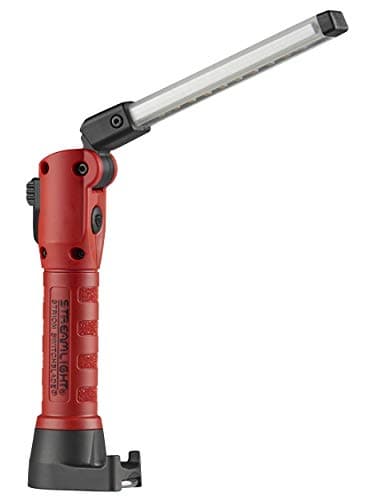 Streamlight Strion SwitchbladeTop pick500 lumens cool white, or 400 at a published 90 CRI, in a folding bar. The color accuracy is the specification that matters on a wiring loom, and it is the only one here with a number behind it. | Color-critical work under the hood | 500 lm | |
| 2 | 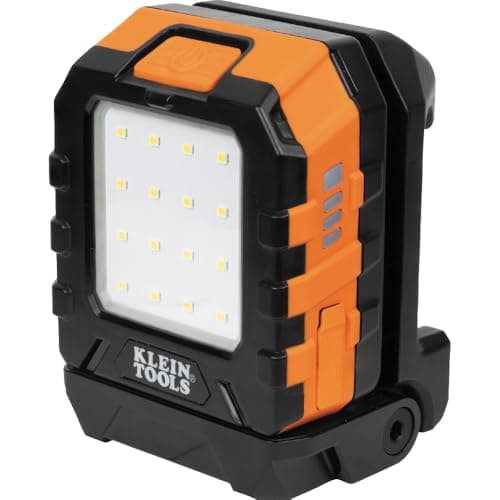 Klein Tools 56416 Rechargeable Work Light1,000 lumens, three modes, 360-degree rotation and a magnet. Built to be put down and aimed rather than held. | A magnetic work light with a kickstand | 1,000 lm | |
| 3 | 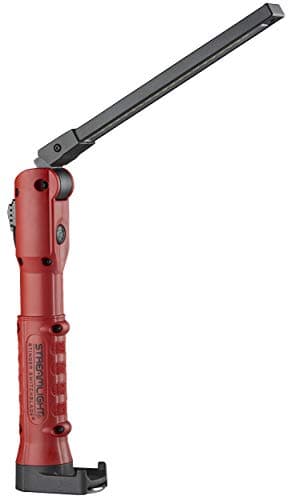 Streamlight Stinger Switchblade800 lumens in the same folding bar format, USB rechargeable, with multiple modes. | A brighter folding work bar | 800 lm | |
| 4 | 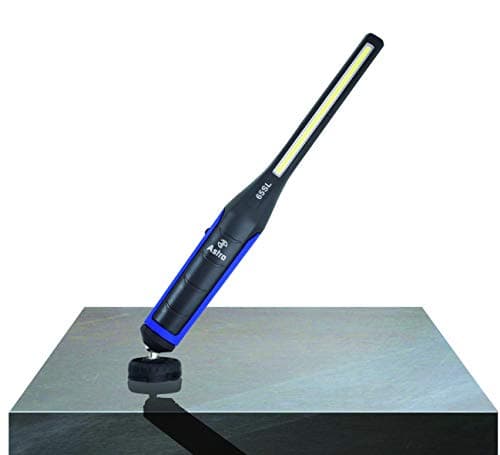 Astro Pneumatic 65SL Slim Light650 lumens in a body thin enough to slide between an engine and a fender, with a separate top-mounted spot. | Working in a gap too narrow for anything else | 650 lm | |
| 5 | 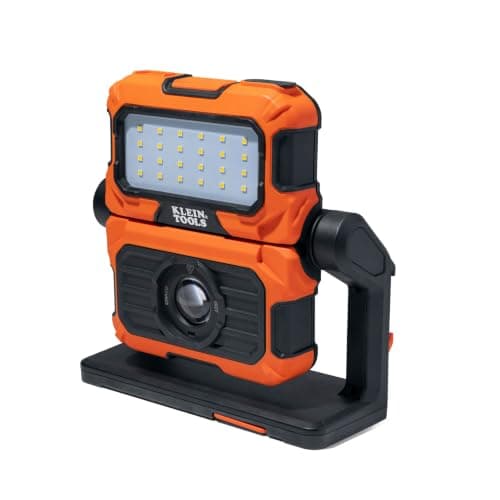 Klein Tools 56417 Rechargeable Work Light3,000 lumens with six modes and 360-degree rotation. The area-lighting version of the same idea. | Lighting a whole work area | 3,000 lm | |
| 6 | 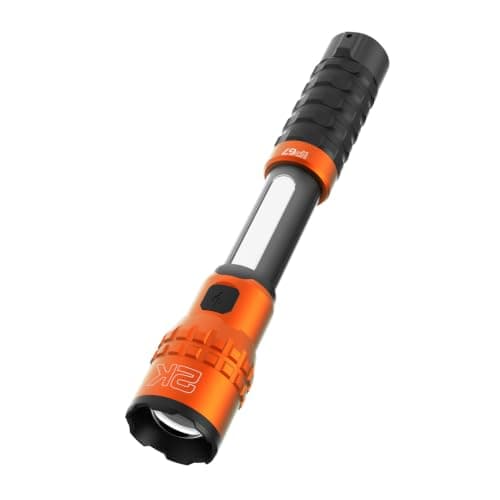 Nebo Slyde King 2KA 2,000-lumen spot at one end and a 500-lumen COB work light along the slide. Two lights, one body. | One tool that is both a flashlight and a work light | 2,000 lm spot / 500 lm COB work light | |
| 7 | 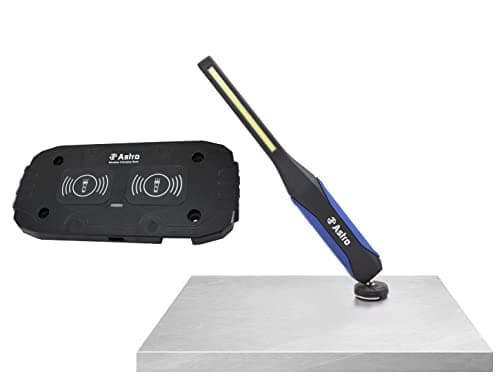 Astro Pneumatic 90SLC Slim Light900 lumens in the same slim body, with a quick-charge pad so it goes back on the bench rather than on a cable. | A slim light that charges on a pad | 900 lm | |
| 8 | 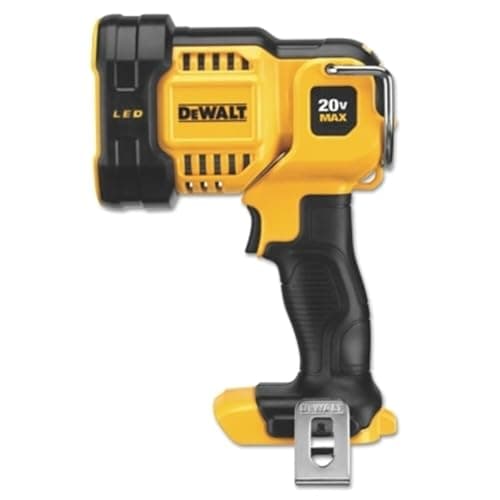 DeWalt DCL043 Jobsite Spotlight1,500 lumens and 464 m of stated reach, running off the same 20V MAX pack as everything else on the truck. | Sites already standardized on 20V MAX batteries | 1,500 lm high / 500 lm low |
We earn a commission if you buy through the links on this page, at no extra cost to you. It does not change what we recommend or the order they appear in. Full disclosure. Prices checked October 16, 2026.

Work lighting is the category where the lumen race is most obviously the wrong race. At arm's length inside an engine bay or an electrical panel, 3,000 lumens is not three times as useful as 1,000 — it is glare bouncing back off painted metal into your eyes.
What actually decides a work light is where the light goes, what color it is, and whether the thing stays where you put it.
How we picked
Beam shape first, then any published color-accuracy claim, then mounting, then output. This category publishes less than any other on the site — most makers state a lumen figure and nothing else — and where that is the case we say so rather than filling in the table. See our methodology.
Beam shape: bar, spot, or both
| Type | Light quality | Best for | Examples here |
|---|---|---|---|
| COB bar | Wide, even, almost shadowless | Panels, engine bays, wiring | Streamlight Strion and Stinger Switchblade, Astro slim lights |
| Reflector spot | Hotspot with spill | Finding a fastener, lighting across a bay | DeWalt DCL043 |
| Combination | Both, selectable | One tool for everything | Nebo Slyde King 2K |
A chip-on-board strip produces light along a line rather than from a point, which means very soft shadows and almost no hotspot. That is exactly right at close range, where a hotspot creates a bright patch surrounded by darkness and a glare bounce off anything shiny.
A reflector spot is the opposite tool: it is for finding the dropped socket under the bench, or lighting the far side of a yard. The DeWalt DCL043's published 464 meters — about 53,800 candela — is a genuine spotlight, not a work light with a reflector.
Color rendering is the trades specification
Under a cool-white LED at a color rendering index around 70, a brown wire and a red wire look similar. So do coolant and brake fluid on a dark floor. So do a rusted fastener and a painted one.
This is not an aesthetic preference. It is the single most consequential specification for anyone doing color-coded work, and almost nobody in this category publishes a CRI figure. Streamlight does, on both of its Switchblade bars: 90 CRI at 4,000 K on the Strion Switchblade's Color-Rite mode, which runs at 400 lumens rather than its headline 500, and 90 CRI on the Stinger Switchblade's second side at 600 lumens against its headline 800. Those are the only color numbers on this page.
Mounting: the difference between a work light and a torch
A work light you have to hold is not working. Every light on this page has at least one hands-free option and the good ones have several.
- Magnet. The most useful single feature in this category. Sticks to a hood, a bench, a beam, a toolbox.
- Kickstand or foot. Lets you aim from a set-down position rather than balancing the light on its side.
- Hook. For hanging in a wheel arch or off a bonnet stay.
- 360-degree rotation. Set the body once, aim the head. The difference between a good work light and a torch lying down.
- Clip. For a slim light in a pocket or clipped to a hat brim.
The runtime problem in this category
Six of the eight lights on this page publish no runtime at all. Klein's 56048 headlamp listing uses the phrase all-day runtime, which is a marketing claim rather than a figure, and we will not convert it into one.
This matters more here than almost anywhere else, because a work light runs continuously for hours rather than in bursts. Without a published figure there is no way for a buyer to know whether a 3,000-lumen portable lasts a morning or twenty minutes, and the difference is the entire value of the tool.
Battery platforms
The DeWalt DCL043 runs off the 20V MAX packs that a site may already own by the half dozen. If your van is standardized on a platform, a light that shares it has no charging problem at all — the packs come off the charger every morning regardless.
The cost is that the light is useless on any other site, and the packs are expensive bought individually. Buy into a platform for the tools, then add the light; never the other way round.
What we would not buy
A high-output work light with no published runtime and no published battery capacity. That combination is common in this category and it means the two numbers that decide whether the tool is useful are both missing.
We would also avoid buying maximum lumens for close work. Above about 1,000 lumens at arm's length you are adding glare rather than visibility, and every experienced trade user ends up running these lights on a middle setting.
Where to go next
- Automotive — work lights for mechanics.
- Electrical — work lights for electricians.
- Charging strategy — rechargeable work lights.
- Area lighting — work lights with stands and tripods.
- The color problem — why color accuracy matters on a jobsite.
- Mobile service — work lights for a service truck.
- Construction sites — work lights for construction.
- Painting and decorating — work lights for painting.
- On a budget — the best work lights under $100.
- Reviewed in full — the DeWalt DCL043 jobsite spotlight, the only work light here that publishes a beam distance, the Streamlight Strion Switchblade, whose maker publishes a color rendering index, and the Klein Tools 56417, which publishes an output and a runtime for all six of its modes.
The picks, in full
Top pick · Color-critical work under the hood
Streamlight Strion Switchblade
500 lumens cool white, or 400 at a published 90 CRI, in a folding bar. The color accuracy is the specification that matters on a wiring loom, and it is the only one here with a number behind it.
Color accuracy is the whole reason this exists. Under a cool-white work light, a brown wire and a red wire look the same, and that is not a cosmetic problem.
Streamlight calls it Color-Rite and does publish the number: 90 CRI at 4,000 K. That makes this the only work light we cover whose maker states a color rendering index, and the figure applies to the 400 lm mode rather than the 500 lm one - so color accuracy costs 20 percent of the output, which is a good price for it.
The folding bar shape puts a wide, even flood along a panel rather than a hotspot in the middle of it.
What works
- A published 90 CRI at 4,000 K - the only work light here with a color figure
- Bar shape floods a panel evenly, and a UV mode for dye-traced leaks
- Streamlight's trade distribution makes service easy
What does not
- No ingress rating of any kind, on a light sold for engine bays
- No candela or beam distance, and no runtime for the Color-Rite or UV modes
- 500 lumens is modest if you need to light a whole bay
Skip this ifyou need area lighting. It is a close-range color-accurate tool, not a floodlight.
Published specification
- Output
- 500 lmCool white. The Color-Rite mode is 400 lm; a third mode is UV.Streamlight Strion Switchblade — manufacturer spec page (retrieved October 10, 2026)
- Peak intensity
- not published
- Beam distance
- not published(A flood bar; Streamlight publishes neither beam figure)
- Runtime
- 3 h on highNo runtime published for the Color-Rite or UV modes.Streamlight Strion Switchblade — manufacturer spec page (retrieved October 10, 2026)
- Battery
- Li-ion, 4 h rechargeUSB or an existing Strion charger. Capacity not published.Streamlight Strion Switchblade — manufacturer spec page (retrieved October 10, 2026)
- Weight
- 181 g6.40 oz.Streamlight Strion Switchblade — manufacturer spec page (retrieved October 10, 2026)
- Ingress
- not published(No IP or IPX code stated; a 2 m impact rating is)
- CRI
- 90 CRIAt 4,000 K, in the 400 lm Color-Rite mode - not the 500 lm cool-white one.Streamlight Strion Switchblade — manufacturer spec page (retrieved October 10, 2026)
#ad · how this is funded · price as of October 16, 2026
Pick 2 · A magnetic work light with a kickstand
Klein Tools 56416 Rechargeable Work Light
1,000 lumens, three modes, 360-degree rotation and a magnet. Built to be put down and aimed rather than held.
The magnet and the kickstand are the product. A work light you have to hold is a work light that is not working.
360-degree rotation means you set the body once and aim the head, which is the difference between a good work light and a torch on its side.
1,000 lumens is the sweet spot for a bay: enough to see, not so much that it glares back off metal.
What works
- Magnet plus kickstand plus rotation, so it goes anywhere
- 1,000 lumens is well matched to close work
- Trade distribution
What does not
- No candela or beam distance published
- No published CRI, on a light that would benefit from one
- Built-in cell
Skip this ifyou need to light a whole room. It is a task light, and a 3,000-lumen area light is a different tool.
Published specification
- Output
- 1,000 lmHigh. Medium is 425 lm, low 300 lm.Klein Tools 56416 — manufacturer spec page (retrieved October 11, 2026)
- Peak intensity
- not published
- Beam distance
- not published(Klein publishes neither beam figure)
- Runtime
- 9 h at 1,000 lmAlso 425 lm/14 h and 300 lm/21 h.Klein Tools 56416 — manufacturer spec page (retrieved October 11, 2026)
- Battery
- Li-ion, USB-CKlein Tools 56416 — manufacturer spec page (retrieved October 11, 2026)
- Weight
- 549 g19.36 oz.Klein Tools 56416 — manufacturer spec page (retrieved October 11, 2026)
- Ingress
- IP66Dust-tight and waterproof. 3 m drop rating.Klein Tools 56416 — manufacturer spec page (retrieved October 11, 2026)
$64.98 · 8% off
#ad · how this is funded · price as of October 16, 2026
Pick 3 · A brighter folding work bar
Streamlight Stinger Switchblade
800 lumens in the same folding bar format, USB rechargeable, with multiple modes.
800 lumens spread along a bar is a genuinely different quality of light from 800 lumens in a spot: no hotspot, no harsh shadow edge, no glare bouncing back off a painted panel.
The pivoting head is what makes it work in an engine bay — you set the bar down and aim the light without moving the light.
Streamlight's page for this one did not give us a runtime, which is the figure a work light most needs.
What works
- 800 lumens of bar-shaped flood
- USB rechargeable
- Multi-mode with a pivoting head
What does not
- No candela or beam distance published
- The 90 CRI side costs 200 lumens against the cool-white side
- IPX4 and a 1 m impact rating are the weakest of any Streamlight here
Skip this ifcolor matters more than output. The Strion Switchblade drops to 400 lumens for its published 90 CRI mode, so it trades half the output of this light for color accuracy - usually the better trade.
Published specification
- Output
- 800 lmCool white. A separate 90 CRI side runs 600 lm; a UV side is rated 500 mW.Streamlight Stinger Switchblade — manufacturer spec page (retrieved October 11, 2026)
- Peak intensity
- not published
- Beam distance
- not published
- Runtime
- 3 h 45 min at 800 lmSame 3 h 45 min on the 600 lm 90 CRI side; 15 h on UV.Streamlight Stinger Switchblade — manufacturer spec page (retrieved October 11, 2026)
- Battery
- Li-ion, 8 h chargeUSB or a Stinger charger.Streamlight Stinger Switchblade — manufacturer spec page (retrieved October 11, 2026)
- Weight
- 485 g17.1 oz.Streamlight Stinger Switchblade — manufacturer spec page (retrieved October 11, 2026)
- Ingress
- IPX4Water-resistant only; 1 m impact rating.Streamlight Stinger Switchblade — manufacturer spec page (retrieved October 11, 2026)
- CRI
- 90 CRIAt 4,000 K, on the 600 lm side - not the 800 lm cool-white side.Streamlight Stinger Switchblade — manufacturer spec page (retrieved October 11, 2026)
#ad · how this is funded · price as of October 16, 2026
Pick 4 · Working in a gap too narrow for anything else
Astro Pneumatic 65SL Slim Light
650 lumens in a body thin enough to slide between an engine and a fender, with a separate top-mounted spot.
The slim format is the entire specification. Thickness decides whether a light fits where the work is, and no lumen figure compensates for a body that does not.
A top-mounted spot alongside the main flood turns one tool into two: wide light for the area, narrow light for the fastener.
Astro sells to mechanics through tool trucks, which is why this shape exists and why hiking brands do not make it.
What works
- Thin enough for genuinely tight access
- Separate flood and spot from one body
- Designed for the trade rather than adapted from an outdoor light
What does not
- No sourced runtime, weight or IP rating
- No published CRI
- 650 lumens is modest for the size
Skip this ifaccess is not your problem. A magnetic work light gives more light for the money if it fits.
Published specification
- Output
- 650 lmAstro Pneumatic 65SL — the brand's own listing on Amazon.com (retrieved September 1, 2026)
- Peak intensity
- not published
- Beam distance
- not published
- Runtime
- not published
- Battery
- RechargeableAstro Pneumatic 65SL — the brand's own listing on Amazon.com (retrieved September 1, 2026)
- Weight
- not published
- Ingress
- not published
#ad · how this is funded · price as of October 16, 2026
Pick 5 · Lighting a whole work area
Klein Tools 56417 Rechargeable Work Light
3,000 lumens with six modes and 360-degree rotation. The area-lighting version of the same idea.
3,000 lumens from a portable light is enough to work by without a second source, which is the threshold that matters on a jobsite.
The six modes are not brightness steps on one emitter. There are two beams - a spot and a flood - that run alone or together, and Klein publishes an output and a runtime for each of the six combinations.
Runtime is the figure that decides whether a 3,000-lumen portable is a tool or a toy, and Klein publishes all six of them: 3 hours with both beams at 3,000 lumens, out to 12 hours on the 250-lumen flood. That is the most complete runtime disclosure of any work light on this site.
What works
- 3,000 lumens is genuine area lighting
- Magnetic mount and full rotation
- Six modes cover most jobsite needs
What does not
- No candela or beam distance, so the spot beam cannot be checked against anything
- 998 g and the largest body here - a set-down light, not a carry light
- No published CRI, on a light sold into color-coded trades
Skip this ifyou mostly work in panels and engine bays. At close range 3,000 lumens is glare, not visibility.
Published specification
- Output
- 3,000 lmBoth beams together. Spot and flood also run independently.Klein Tools 56417 — manufacturer spec page (retrieved October 11, 2026)
- Peak intensity
- not published
- Beam distance
- not published(Klein publishes neither beam figure)
- Runtime
- 3 h at 3,000 lmSix published pairs: spot 1,400 lm/5 h and 475 lm/9.5 h; flood 1,400 lm/8 h, 700 lm/10 h and 250 lm/12 h.Klein Tools 56417 — manufacturer spec page (retrieved October 11, 2026)
- Battery
- Li-ion, 12 h rated lifeUSB-C charge in, USB-A out to charge other kit. Capacity not published.Klein Tools 56417 — manufacturer spec page (retrieved October 11, 2026)
- Weight
- 998 g2.2 lb.Klein Tools 56417 — manufacturer spec page (retrieved October 11, 2026)
- Ingress
- IP65Dust-tight, water resistant. 3 m drop rating.Klein Tools 56417 — manufacturer spec page (retrieved October 11, 2026)
#ad · how this is funded · price as of October 16, 2026
Pick 6 · One tool that is both a flashlight and a work light
Nebo Slyde King 2K
A 2,000-lumen spot at one end and a 500-lumen COB work light along the slide. Two lights, one body.
The sliding body is a genuinely good mechanism: pull it open and a COB strip appears, close it and you have a spot with a 4x zoom.
A COB strip and a reflector produce completely different light. Having both means you stop choosing between seeing the area and seeing the detail.
Magnetic base, as every work light should have.
What works
- A spot and a COB flood in one body
- Magnetic base and a hands-free stance
- 4x zoom on the spot side
What does not
- No sourced runtime, weight or IP rating
- Two light engines in one body means a shorter run on either
- Zoom optics lose output
Skip this ifyou already carry a proper flashlight. As a work light alone, a dedicated bar puts out better light.
Published specification
- Output
- 2,000 lm spot / 500 lm COB work lightNebo Slyde King 2K — the brand's own listing on Amazon.com (retrieved September 1, 2026)
- Peak intensity
- not published
- Beam distance
- not published
- Runtime
- not published
- Battery
- USB rechargeableNebo Slyde King 2K — the brand's own listing on Amazon.com (retrieved September 1, 2026)
- Weight
- not published
- Ingress
- not published
#ad · how this is funded · price as of October 16, 2026
Pick 7 · A slim light that charges on a pad
Astro Pneumatic 90SLC Slim Light
900 lumens in the same slim body, with a quick-charge pad so it goes back on the bench rather than on a cable.
The charging pad matters more than the extra 250 lumens. A work light that lives on a pad is always charged; a work light with a cable is flat by Thursday.
900 lumens in a slim body is at the top of what the format can dissipate without getting hot to hold.
Same caveat as the rest of the trade-tool brands: nothing beyond output and charging is published.
What works
- Charging pad removes the cable from the routine
- 900 lumens in a slim body
- Top flashlight alongside the main flood
What does not
- No sourced runtime, weight or IP rating
- No published CRI
- Costs meaningfully more than the corded-charge version
Skip this ifyou do not have a fixed bench. The pad is the reason to pay the premium and it needs somewhere to live.
Published specification
- Output
- 900 lmAstro Pneumatic 90SLC — the brand's own listing on Amazon.com (retrieved September 1, 2026)
- Peak intensity
- not published
- Beam distance
- not published
- Runtime
- not published
- Battery
- Rechargeable, with a quick-charge padAstro Pneumatic 90SLC — the brand's own listing on Amazon.com (retrieved September 1, 2026)
- Weight
- not published
- Ingress
- not published
#ad · how this is funded · price as of October 16, 2026
Pick 8 · Sites already standardized on 20V MAX batteries
DeWalt DCL043 Jobsite Spotlight
1,500 lumens and 464 m of stated reach, running off the same 20V MAX pack as everything else on the truck.
464 m from 1,500 lumens implies about 53,800 candela. That is a proper spotlight, not a work light with a reflector.
The battery platform is the real argument. If your van already carries six 20V MAX packs, a light that shares them has no charging routine at all.
Runtime genuinely cannot be published here, because it depends entirely on which pack you fit. That is one of the few unpublished figures on this site with a legitimate reason.
What works
- Shares the 20V MAX platform, so the battery problem is already solved
- 464 m of published reach
- Pivoting head for aiming from a set-down position
What does not
- Battery not included, and the packs are not cheap on their own
- No sourced weight or IP rating
- Useless if your site runs a different battery platform
Skip this ifyou are not already on DeWalt 20V MAX. Buying into a battery platform for one light is the wrong way round.
Published specification
- Output
- 1,500 lm high / 500 lm lowDeWalt publishes both brightness settingsDeWalt DCL043 20V MAX Jobsite LED Spotlight — manufacturer spec page (retrieved September 13, 2026)
- Peak intensity
- not published
- Beam distance
- 464 mDeWalt states 508 yards / 1,525 feet; converted to metersDeWalt DCL043 20V MAX Jobsite LED Spotlight — manufacturer spec page (retrieved September 13, 2026)
- Runtime
- not published(Depends on which 20V MAX pack is fitted)
- Battery
- DeWalt 20V MAX (sold separately)DeWalt DCL043 — the brand's own listing on Amazon.com (retrieved September 1, 2026)
- Weight
- not published
- Ingress
- not published
#ad · how this is funded · price as of October 16, 2026
Questions people actually ask
How many lumens does a work light need?
For close work in a panel or an engine bay, 500 to 1,000 is the useful range — above that you are creating glare off metal and paint rather than seeing better. For lighting a whole bay or a room, 2,000 to 5,000, ideally from a light on a stand rather than in your hand.
What is a COB work light?
Chip-on-board: many small LED dies mounted directly on a substrate, producing light along a strip rather than from a point. The result is very soft shadows and almost no hotspot, which is exactly what close work needs.
Why does color accuracy matter in a work light?
Because a lot of trade work is color coded. Under a color rendering index around 70, brown and red wire insulation look similar, and so do different fluids on a dark floor. High-CRI light fixes that at a cost of roughly 10 to 20 percent of the output.
Should a work light be magnetic?
Almost always. A work light you have to hold is not doing its job. A magnet plus a kickstand plus rotation is the combination that lets one light work in most positions.
How long do work lights run?
Most makers in this category do not say, which is our main complaint about it. As a rough guide, a work light drawing 30 watts from a 20 watt-hour pack runs about 40 minutes; one drawing 10 watts runs two hours. Without a published capacity you cannot do that sum.
Is a battery-platform work light a good idea?
If your site is already standardized on that platform, yes — the packs are already charged and already there. If it is not, you are buying into an expensive battery system for one tool, which is the wrong way round.
Can I use a headlamp instead of a work light?
For close work with both hands, a headlamp is often better because the light follows your eyes. For lighting an area, or for anything where you need to see into a shadow you are casting, a set-down work light is the right tool. Many trades carry both — see work headlamps.
Sources
Every figure on this page came from one of the documents below, read on the date shown. We do not cite other review sites, forum posts or video reviews as sources of fact.
- Streamlight Strion Switchblade — manufacturer spec page (retrieved October 10, 2026)
- Streamlight Stinger Switchblade — manufacturer spec page (retrieved September 1, 2026)
- Fenix HM75R — manufacturer spec page (retrieved September 1, 2026)
- ANSI/PLATO FL 1 flashlight performance standard — definitions of lumens, peak beam intensity, beam distance, runtime, impact and water resistance
- IEC 60529 — the IP (ingress protection) rating system
Read next

Klein Tools 56417 review
A specification-first review of the Klein Tools 56417: six published mode-and-runtime pairs, IP65, a 3 m drop rating, and the one piece of arithmetic that tells you which mode to actually use.
Streamlight Strion Switchblade review
A specification-first review of the Streamlight Strion Switchblade: the published 90 CRI figure, the 100 lumens it costs you, the UV mode nobody mentions, and what Streamlight still will not state.
DeWalt DCL043 review
A specification-first review of the DeWalt DCL043 jobsite spotlight: what 508 yards works out to, what the platform battery actually costs, and the figures DeWalt does not publish.
Best work lights under $100
Eight work lights under $100, ranked on beam shape, mounting and published figures, with the category's disclosure gaps named.
Best work lights for a construction site
Work lights for construction, ranked on published ingress rating, power source and area coverage, with the gaps named.
Best work lights for painting
Lighting for painting, ranked on published color rendering and on the beam placement that actually reveals a missed spot.
Best work lights for a service truck
Work lights for mobile service work, ranked on power source, beam coverage and mounting — with every published figure sourced.
Best work lights for mechanics
Automotive work lights ranked on access, color rendering and mounting rather than output.
Best work lights for electricians
Electrical work lights ranked on color rendering and glare control rather than raw output.
Why color accuracy matters on a jobsite
What color rendering does to trade work, and how to choose when almost no maker publishes a CRI figure.
Best headlamps for work
Work headlamps ranked on shift runtime, color rendering and hard-hat compatibility.
CRI explained
What CRI measures, the R9 problem, the output cost, and how CRI differs from color temperature.
Best rechargeable work lights
Rechargeable work lights compared on charging strategy, battery platform and published runtime.
Found a number that is wrong? Tell us and we will fix it and say so. Our methodology shows every formula on this page.