Work Lights
Best rechargeable work lights
The whole question in this category is how long it runs, and it is the question the category answers least often.
By Scooter M. · Published · Updated
| # | Product | Best for | Output | Price |
|---|---|---|---|---|
| 1 | 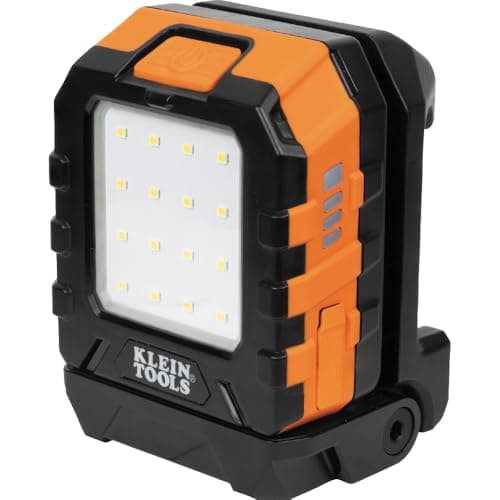 Klein Tools 56416 Rechargeable Work LightTop pick1,000 lumens, three modes, 360-degree rotation and a magnet. Built to be put down and aimed rather than held. | A magnetic work light with a kickstand | 1,000 lm | |
| 2 | 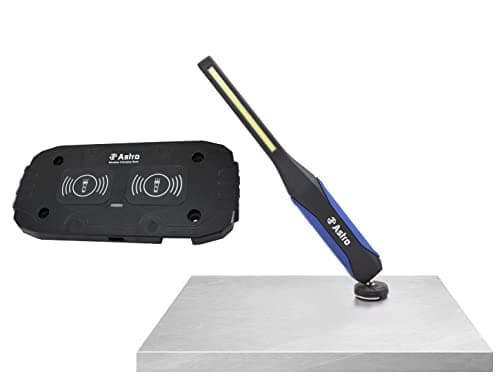 Astro Pneumatic 90SLC Slim Light900 lumens in the same slim body, with a quick-charge pad so it goes back on the bench rather than on a cable. | A slim light that charges on a pad | 900 lm | |
| 3 | 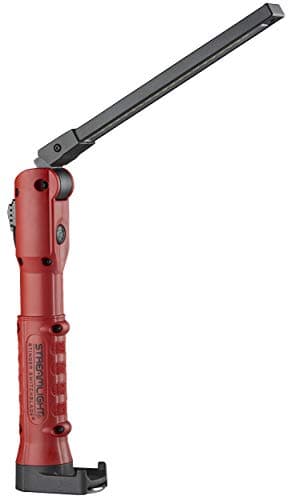 Streamlight Stinger Switchblade800 lumens in the same folding bar format, USB rechargeable, with multiple modes. | A brighter folding work bar | 800 lm | |
| 4 | 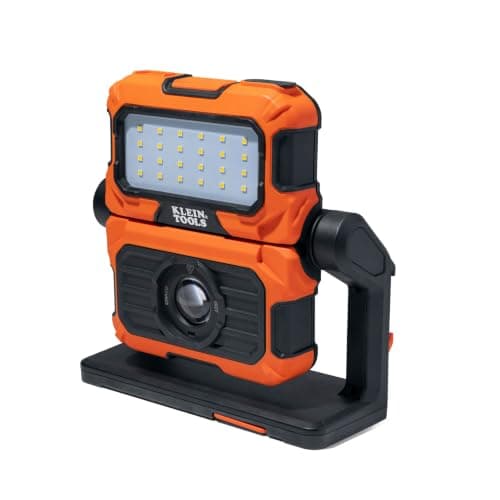 Klein Tools 56417 Rechargeable Work Light3,000 lumens with six modes and 360-degree rotation. The area-lighting version of the same idea. | Lighting a whole work area | 3,000 lm | |
| 5 | 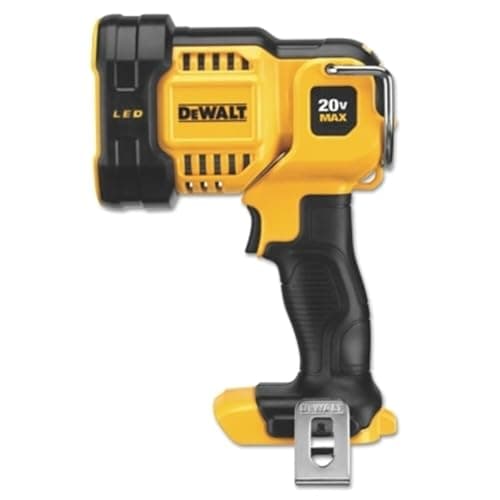 DeWalt DCL043 Jobsite Spotlight1,500 lumens and 464 m of stated reach, running off the same 20V MAX pack as everything else on the truck. | Sites already standardized on 20V MAX batteries | 1,500 lm high / 500 lm low |
We earn a commission if you buy through the links on this page, at no extra cost to you. It does not change what we recommend or the order they appear in. Full disclosure. Prices checked October 16, 2026.
A work light runs continuously for hours, unlike a flashlight that runs in bursts. That makes runtime the defining specification, and it makes the fact that most makers in this category do not publish one genuinely surprising.
How we picked
Charging strategy first, then any published runtime or capacity, then mounting and beam shape. We have named every gap rather than estimating across it. See our methodology.
The three charging strategies
| Light | Strategy | What it means in practice |
|---|---|---|
| Klein 56416 / 56417 | Built-in cell, USB charging | Charge overnight; nothing to swap mid-shift |
| Astro Pneumatic 90SLC | Built-in cell plus a quick-charge pad | Lives on the pad between jobs and is always full |
| Streamlight Stinger Switchblade | USB rechargeable | Standard, simple, needs remembering |
| DeWalt DCL043 | 20V MAX tool battery | No charging routine at all if the site owns the platform |
The pad and the tool-platform approaches are the two that solve the real problem, which is not charging speed but remembering. A light that lives on a pad is always charged; a light that needs a cable is flat by Thursday.
Battery platforms, weighed honestly
If your van already carries several 20V MAX or equivalent packs, a light that shares them is the obvious answer: the packs come off the charger every morning as part of the existing routine, and runtime becomes a matter of which pack you grab.
The caveat is that buying into a platform for one light is expensive and pointless. Buy the platform for the tools, then add the light.
What we can and cannot tell you about runtime
Of the lights on this page, only the DeWalt has a computable runtime, and only because its power source is a documented tool pack rather than a sealed cell. Klein, Astro and Streamlight all publish output figures and no capacity.
We could estimate. We are not going to, because an estimate presented next to sourced figures reads as if it were one, and the whole point of this site is that you can tell the difference.
Charging in the cold
A van in winter is below freezing overnight, and lithium-ion cells must not be charged below about zero degrees Celsius — doing so plates metallic lithium onto the anode and permanently reduces capacity.
Most modern packs and lights refuse to charge when cold, which looks like a fault and is the protection working. Bring the light inside, or accept that a cold charger is doing nothing.
What we would not buy
A 3,000-lumen rechargeable work light with no published capacity. At that output the draw is likely around 30 watts, and without knowing the pack you cannot tell whether that is a morning or forty minutes. The maker can tell you and has chosen not to.
We would also avoid micro-USB on a work light. The port lives in a dusty pocket and gets charged wet-handed; USB-C is more robust and reversible, and there is no reason to accept less in 2026.
The picks, in full
Top pick · A magnetic work light with a kickstand
Klein Tools 56416 Rechargeable Work Light
1,000 lumens, three modes, 360-degree rotation and a magnet. Built to be put down and aimed rather than held.
The magnet and the kickstand are the product. A work light you have to hold is a work light that is not working.
360-degree rotation means you set the body once and aim the head, which is the difference between a good work light and a torch on its side.
1,000 lumens is the sweet spot for a bay: enough to see, not so much that it glares back off metal.
What works
- Magnet plus kickstand plus rotation, so it goes anywhere
- 1,000 lumens is well matched to close work
- Trade distribution
What does not
- No candela or beam distance published
- No published CRI, on a light that would benefit from one
- Built-in cell
Skip this ifyou need to light a whole room. It is a task light, and a 3,000-lumen area light is a different tool.
Published specification
- Output
- 1,000 lmHigh. Medium is 425 lm, low 300 lm.Klein Tools 56416 — manufacturer spec page (retrieved October 11, 2026)
- Peak intensity
- not published
- Beam distance
- not published(Klein publishes neither beam figure)
- Runtime
- 9 h at 1,000 lmAlso 425 lm/14 h and 300 lm/21 h.Klein Tools 56416 — manufacturer spec page (retrieved October 11, 2026)
- Battery
- Li-ion, USB-CKlein Tools 56416 — manufacturer spec page (retrieved October 11, 2026)
- Weight
- 549 g19.36 oz.Klein Tools 56416 — manufacturer spec page (retrieved October 11, 2026)
- Ingress
- IP66Dust-tight and waterproof. 3 m drop rating.Klein Tools 56416 — manufacturer spec page (retrieved October 11, 2026)
$64.98 · 8% off
#ad · how this is funded · price as of October 16, 2026
Pick 2 · A slim light that charges on a pad
Astro Pneumatic 90SLC Slim Light
900 lumens in the same slim body, with a quick-charge pad so it goes back on the bench rather than on a cable.
The charging pad matters more than the extra 250 lumens. A work light that lives on a pad is always charged; a work light with a cable is flat by Thursday.
900 lumens in a slim body is at the top of what the format can dissipate without getting hot to hold.
Same caveat as the rest of the trade-tool brands: nothing beyond output and charging is published.
What works
- Charging pad removes the cable from the routine
- 900 lumens in a slim body
- Top flashlight alongside the main flood
What does not
- No sourced runtime, weight or IP rating
- No published CRI
- Costs meaningfully more than the corded-charge version
Skip this ifyou do not have a fixed bench. The pad is the reason to pay the premium and it needs somewhere to live.
Published specification
- Output
- 900 lmAstro Pneumatic 90SLC — the brand's own listing on Amazon.com (retrieved September 1, 2026)
- Peak intensity
- not published
- Beam distance
- not published
- Runtime
- not published
- Battery
- Rechargeable, with a quick-charge padAstro Pneumatic 90SLC — the brand's own listing on Amazon.com (retrieved September 1, 2026)
- Weight
- not published
- Ingress
- not published
#ad · how this is funded · price as of October 16, 2026
Pick 3 · A brighter folding work bar
Streamlight Stinger Switchblade
800 lumens in the same folding bar format, USB rechargeable, with multiple modes.
800 lumens spread along a bar is a genuinely different quality of light from 800 lumens in a spot: no hotspot, no harsh shadow edge, no glare bouncing back off a painted panel.
The pivoting head is what makes it work in an engine bay — you set the bar down and aim the light without moving the light.
Streamlight's page for this one did not give us a runtime, which is the figure a work light most needs.
What works
- 800 lumens of bar-shaped flood
- USB rechargeable
- Multi-mode with a pivoting head
What does not
- No candela or beam distance published
- The 90 CRI side costs 200 lumens against the cool-white side
- IPX4 and a 1 m impact rating are the weakest of any Streamlight here
Skip this ifcolor matters more than output. The Strion Switchblade drops to 400 lumens for its published 90 CRI mode, so it trades half the output of this light for color accuracy - usually the better trade.
Published specification
- Output
- 800 lmCool white. A separate 90 CRI side runs 600 lm; a UV side is rated 500 mW.Streamlight Stinger Switchblade — manufacturer spec page (retrieved October 11, 2026)
- Peak intensity
- not published
- Beam distance
- not published
- Runtime
- 3 h 45 min at 800 lmSame 3 h 45 min on the 600 lm 90 CRI side; 15 h on UV.Streamlight Stinger Switchblade — manufacturer spec page (retrieved October 11, 2026)
- Battery
- Li-ion, 8 h chargeUSB or a Stinger charger.Streamlight Stinger Switchblade — manufacturer spec page (retrieved October 11, 2026)
- Weight
- 485 g17.1 oz.Streamlight Stinger Switchblade — manufacturer spec page (retrieved October 11, 2026)
- Ingress
- IPX4Water-resistant only; 1 m impact rating.Streamlight Stinger Switchblade — manufacturer spec page (retrieved October 11, 2026)
- CRI
- 90 CRIAt 4,000 K, on the 600 lm side - not the 800 lm cool-white side.Streamlight Stinger Switchblade — manufacturer spec page (retrieved October 11, 2026)
#ad · how this is funded · price as of October 16, 2026
Pick 4 · Lighting a whole work area
Klein Tools 56417 Rechargeable Work Light
3,000 lumens with six modes and 360-degree rotation. The area-lighting version of the same idea.
3,000 lumens from a portable light is enough to work by without a second source, which is the threshold that matters on a jobsite.
The six modes are not brightness steps on one emitter. There are two beams - a spot and a flood - that run alone or together, and Klein publishes an output and a runtime for each of the six combinations.
Runtime is the figure that decides whether a 3,000-lumen portable is a tool or a toy, and Klein publishes all six of them: 3 hours with both beams at 3,000 lumens, out to 12 hours on the 250-lumen flood. That is the most complete runtime disclosure of any work light on this site.
What works
- 3,000 lumens is genuine area lighting
- Magnetic mount and full rotation
- Six modes cover most jobsite needs
What does not
- No candela or beam distance, so the spot beam cannot be checked against anything
- 998 g and the largest body here - a set-down light, not a carry light
- No published CRI, on a light sold into color-coded trades
Skip this ifyou mostly work in panels and engine bays. At close range 3,000 lumens is glare, not visibility.
Published specification
- Output
- 3,000 lmBoth beams together. Spot and flood also run independently.Klein Tools 56417 — manufacturer spec page (retrieved October 11, 2026)
- Peak intensity
- not published
- Beam distance
- not published(Klein publishes neither beam figure)
- Runtime
- 3 h at 3,000 lmSix published pairs: spot 1,400 lm/5 h and 475 lm/9.5 h; flood 1,400 lm/8 h, 700 lm/10 h and 250 lm/12 h.Klein Tools 56417 — manufacturer spec page (retrieved October 11, 2026)
- Battery
- Li-ion, 12 h rated lifeUSB-C charge in, USB-A out to charge other kit. Capacity not published.Klein Tools 56417 — manufacturer spec page (retrieved October 11, 2026)
- Weight
- 998 g2.2 lb.Klein Tools 56417 — manufacturer spec page (retrieved October 11, 2026)
- Ingress
- IP65Dust-tight, water resistant. 3 m drop rating.Klein Tools 56417 — manufacturer spec page (retrieved October 11, 2026)
#ad · how this is funded · price as of October 16, 2026
Pick 5 · Sites already standardized on 20V MAX batteries
DeWalt DCL043 Jobsite Spotlight
1,500 lumens and 464 m of stated reach, running off the same 20V MAX pack as everything else on the truck.
464 m from 1,500 lumens implies about 53,800 candela. That is a proper spotlight, not a work light with a reflector.
The battery platform is the real argument. If your van already carries six 20V MAX packs, a light that shares them has no charging routine at all.
Runtime genuinely cannot be published here, because it depends entirely on which pack you fit. That is one of the few unpublished figures on this site with a legitimate reason.
What works
- Shares the 20V MAX platform, so the battery problem is already solved
- 464 m of published reach
- Pivoting head for aiming from a set-down position
What does not
- Battery not included, and the packs are not cheap on their own
- No sourced weight or IP rating
- Useless if your site runs a different battery platform
Skip this ifyou are not already on DeWalt 20V MAX. Buying into a battery platform for one light is the wrong way round.
Published specification
- Output
- 1,500 lm high / 500 lm lowDeWalt publishes both brightness settingsDeWalt DCL043 20V MAX Jobsite LED Spotlight — manufacturer spec page (retrieved September 13, 2026)
- Peak intensity
- not published
- Beam distance
- 464 mDeWalt states 508 yards / 1,525 feet; converted to metersDeWalt DCL043 20V MAX Jobsite LED Spotlight — manufacturer spec page (retrieved September 13, 2026)
- Runtime
- not published(Depends on which 20V MAX pack is fitted)
- Battery
- DeWalt 20V MAX (sold separately)DeWalt DCL043 — the brand's own listing on Amazon.com (retrieved September 1, 2026)
- Weight
- not published
- Ingress
- not published
#ad · how this is funded · price as of October 16, 2026
Questions people actually ask
How long does a rechargeable work light last?
Most makers in this category do not publish a figure, which is our main complaint. As a guide, a light drawing 15 watts from a 20 watt-hour cell runs about 80 minutes; the same light on a 100 watt-hour tool pack runs most of a day.
Is a tool-battery work light better than a built-in one?
If you already own the platform, substantially — a 5 amp-hour 20V pack holds around 100 watt-hours, roughly five times a typical built-in cell, and it is already charged as part of your existing routine. If you do not own the platform, no.
What is the best charging method for a work light?
A charging pad or a shared tool platform, because both remove the step people forget. A cable works and requires somebody to remember; on a busy site that is the failure mode.
Why will my work light not charge in the van?
Probably temperature. Lithium-ion cells must not be charged below about freezing, and most modern chargers refuse to try. That is the protection working. Bring the light indoors first.
Should a work light have USB-C?
Yes. The port lives in a dusty pocket and gets handled with wet hands, and micro-USB is mechanically far weaker and not reversible. It is the most common failure point on a rechargeable light.
How many lumens should a rechargeable work light have?
500 to 1,000 for close work, 2,000 and up for lighting an area. The higher figure is only useful if the light can sustain it, which is exactly the question an unpublished runtime leaves open.
Sources
Every figure on this page came from one of the documents below, read on the date shown. We do not cite other review sites, forum posts or video reviews as sources of fact.
Read next

Best work lights under $100
Eight work lights under $100, ranked on beam shape, mounting and published figures, with the category's disclosure gaps named.
Best work lights for a service truck
Work lights for mobile service work, ranked on power source, beam coverage and mounting — with every published figure sourced.
Best work lights, ranked on beam shape rather than brightness
The work-light ranking: beam shape, color rendering, mounting and runtime, with every published figure sourced.
Best work lights with stands and tripods
Stand-mounted and area work lights, with the illuminance math for sizing output to a space.
Best rechargeable flashlights
Rechargeable flashlights sorted by cell strategy, with the capacity arithmetic and the lifespan trade set out.
Flashlight runtime, computed
How runtime is defined, why thermal step-down happens, and the arithmetic to compute a real figure yourself.
Best work lights for mechanics
Automotive work lights ranked on access, color rendering and mounting rather than output.
Found a number that is wrong? Tell us and we will fix it and say so. Our methodology shows every formula on this page.