EDC Flashlights
Best rechargeable flashlights
Rechargeable means three different things depending on whether the cell comes out, and the difference decides how long you own the light.
By Scooter M. · Published · Updated
| # | Product | Best for | Output | Price |
|---|---|---|---|---|
| 1 | 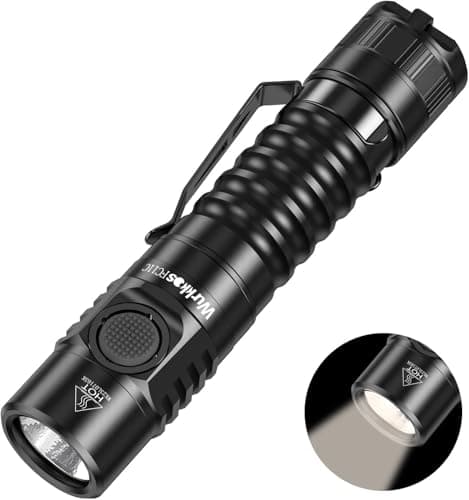 Wurkkos FC11CTop pick1,200 lumens at a stated CRI of 90 for a budget price. Color rendering is the spec that changes how a light feels, and this is the cheapest way to get it. | High color accuracy for the least money | 1,200 lm | |
| 2 | No image Streamlight MacroStream USB500 lumens, 2,000 candela, 90 m and two hours on high — every figure published per mode by the maker. That is the reason it leads. | The best-documented small EDC light here | 500 lm | Check price#ad |
| 3 | 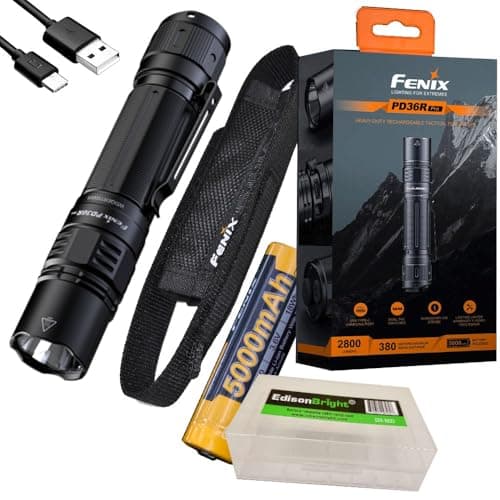 Fenix PD36R Pro2,800 lumens from a 21700 cell holding 18 watt-hours, at 169 grams. The biggest energy store in the tactical set. | The most output and energy in a tactical body | 2,800 lm | |
| 4 | 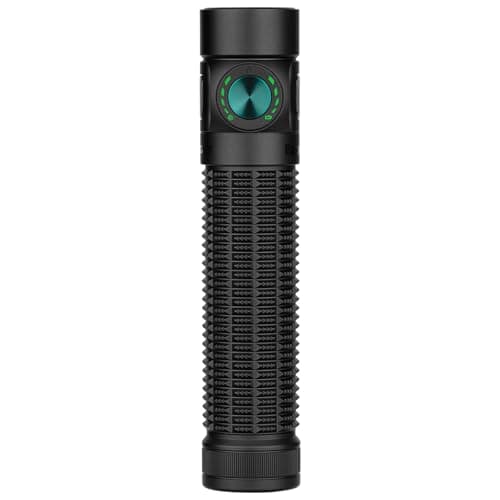 Olight Baton 4 Pro1,600 lumens from something the size of a lipstick tube. The output is real and the runtime at that output is not the point. | The most output in a pocket-sized body | 1,600 lm | |
| 5 | 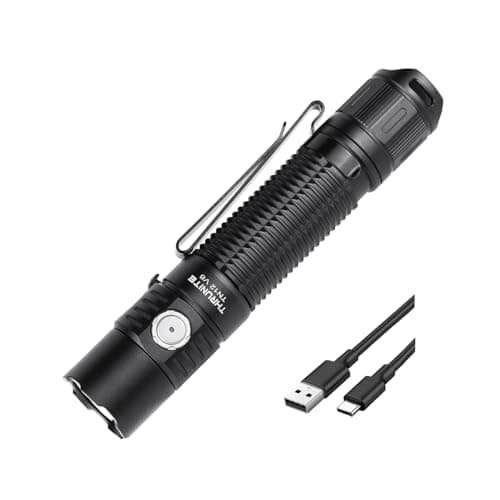 ThruNite TN12 V6259 m of published reach and a 3,400 mAh 18650 for well under the duty brands, with an IPX8 rating and a Turbo mode ThruNite admits lasts sixty seconds. | Reach per dollar on a cell you can replace | 1,950 lm |
We earn a commission if you buy through the links on this page, at no extra cost to you. It does not change what we recommend or the order they appear in. Full disclosure. Prices checked October 15, 2026.
Almost every flashlight sold now is rechargeable, which has made the word almost meaningless. What matters is whether the cell comes out, and there are three answers.
- Standard removable cell. Takes a bare 18650 or 21700 you can buy anywhere. Effectively immortal — when the cell tires, you replace it for a few dollars. Examples: Wurkkos FC11C, Fenix PD36R Pro.
- Proprietary removable pack. Comes out, but only the maker's version fits. Fine while the maker exists.
- Sealed. The cell stays in. Lightest and simplest, and the light has a finite life. Examples: Streamlight MacroStream, Olight Baton 4 Pro.
How we picked
Removable standard cells first, published capacity second, charging method third. Every figure is sourced and we have handled none of these lights. See our methodology.
What a sealed cell costs you
Capacity: the number to compare
| Light | Cell | Watt-hours | Removable? |
|---|---|---|---|
| Fenix PD36R Pro | 5,000 mAh 21700 | 18.0 | Yes, standard |
| Wurkkos FC11C | 18650 | 12.2 typical | Yes, standard |
| Fenix E18R V2.0 | 16340 | 2.9 typical | Yes, standard |
| Streamlight MacroStream | Sealed Li-ion | not published | No |
| Olight Baton 4 Pro | Sealed Li-ion | not published | No |
Note the pattern: the makers with removable standard cells tell you what you are getting, because the cell is a known commodity. The sealed-cell makers mostly do not, and there is no way for a buyer to find out.
Charging methods, ranked
- USB-C on the light — the right default. Reversible, robust, one cable for everything you own.
- Magnetic contact — mechanically the best, with no port to fill with grit. The cost is a proprietary cable you must not lose.
- USB-C on the cell itself — convenient and means the light can charge outside the light, but the port on a bare cell is a weak point.
- Cradle or dock — right for a duty light that lives in a vehicle, wrong for a pocket light.
- Micro-USB — obsolete. Fragile, not reversible, and a real failure point.
Charging safety, briefly
Do not charge a lithium-ion cell below freezing. Charging a cold cell plates metallic lithium onto the anode, which permanently reduces capacity and creates a genuine hazard. Most modern lights refuse to charge when cold; that is the protection working, not a fault.
Do not store cells at full charge in heat either. A cell kept at 100 percent in a hot car ages several times faster than one stored at around 40 percent in a drawer.
What we would not buy
A sealed high-output light with no published capacity. You are being asked to accept both an unknown runtime and a finite lifespan on trust, and there is no reason to.
We would also avoid unprotected bare cells from unbranded sellers. A protected cell from a known manufacturer costs a few dollars more and includes the overcurrent and overdischarge protection that keeps a lithium-ion cell from becoming a problem. 18650 versus 21700 covers cell selection.
The picks, in full
Top pick · High color accuracy for the least money
Wurkkos FC11C
1,200 lumens at a stated CRI of 90 for a budget price. Color rendering is the spec that changes how a light feels, and this is the cheapest way to get it.
CRI 90 versus the CRI 70 typical of a cheap cool-white emitter is the single most noticeable upgrade in a flashlight, and it is nothing to do with brightness. Reds stop looking brown. Wire insulation colors become distinguishable.
The cost of high CRI is output: the same emitter family loses roughly 10 to 20 percent of its lumens for the better phosphor. A 1,200-lumen high-CRI light is doing well.
18650 is the right cell format here — replaceable, standard, and enough energy to hold a useful level.
What works
- CRI 90 at a price where CRI is usually not mentioned at all
- Standard 18650, replaceable anywhere
- USB-C on the light itself
What does not
- No sourced runtime, candela, beam distance or IP rating
- High CRI costs output; treat the 1,200 figure as generous
- A budget brand with a thin published spec table
Skip this ifyou need maximum reach per dollar. High-CRI emitters throw less than the cool-white ones they replace.
Published specification
- Peak intensity
- not published
- Beam distance
- not published
- Runtime
- not published
- Battery
- 18650, USB-C rechargeableWurkkos FC11C — the brand's own listing on Amazon.com (retrieved September 1, 2026)
- Weight
- not published
- Ingress
- not published
- CRI
- 90Stated as '90 High CRI' on the listingWurkkos FC11C — the brand's own listing on Amazon.com (retrieved September 1, 2026)
$35.99 · 20% off
#ad · how this is funded · price as of October 15, 2026
image
Pick 2 · The best-documented small EDC light here
Streamlight MacroStream USB
500 lumens, 2,000 candela, 90 m and two hours on high — every figure published per mode by the maker. That is the reason it leads.
2,000 candela and 90 m are consistent with each other, which is a better sign than it sounds. The FL1 beam distance is the square root of candela divided by 0.25 lux: the square root of 2,000 over 0.25 is 89.4 m. Streamlight's published figures check out to within a meter.
Two hours on high for 500 lumens implies roughly 2.5 watt-hours of usable energy, which is about right for a light this size. Nothing here is being oversold.
62 grams is pocketable in a way that a 21700 light is not, and that is the trade you are making against a bigger cell.
What works
- Every headline figure published per mode, and internally consistent
- 62 g with a real clip
- The arithmetic between its candela and its distance actually reconciles
What does not
- IPX4, so splash-resistant and no more
- Built-in cell rather than a replaceable 18650
- 500 lumens is modest against the 1,600-lumen headlines nearby
Skip this ifyou want reach. 2,000 candela is a close-range beam and no setting will change that.
Published specification
- Output
- 500 lmHigh. Low is 50 lm.Streamlight MacroStream USB — manufacturer spec page (retrieved September 1, 2026)
- Peak intensity
- 2,000 cdHigh. 220 cd on low.Streamlight MacroStream USB — manufacturer spec page (retrieved October 15, 2026)
- Beam distance
- 90 mHigh. 30 m on low.Streamlight MacroStream USB — manufacturer spec page (retrieved September 1, 2026)
- Runtime
- 2 h on high, 8 h on lowStreamlight MacroStream USB — manufacturer spec page (retrieved September 1, 2026)
- Battery
- Built-in Li-ion, charges in 4 hStreamlight MacroStream USB — manufacturer spec page (retrieved September 1, 2026)
- Weight
- 62.4 g (2.2 oz)Streamlight MacroStream USB — manufacturer spec page (retrieved September 1, 2026)
- Ingress
- IPX41 m impact resistance testedStreamlight MacroStream USB — manufacturer spec page (retrieved September 1, 2026)
#ad · how this is funded · price as of October 15, 2026
Pick 3 · The most output and energy in a tactical body
Fenix PD36R Pro
2,800 lumens from a 21700 cell holding 18 watt-hours, at 169 grams. The biggest energy store in the tactical set.
A 5,000 mAh 21700 at 3.6 V is 18.0 watt-hours — nearly three times what the ProTac HL-X carries. That is the case for the 21700 format in one number.
380 m of reach on 2,800 lumens works back to about 36,100 candela, almost identical to the ProTac's 35,000 from 1,300 lumens. The Fenix is spending its extra output on spill, not on distance.
169 g including the cell is only 7 g more than a ProTac on CR123A, for nearly triple the energy. That is what four years of cell development buys.
What works
- 18 Wh of stored energy, the most in the tactical set
- 2,800 lumens with 380 m of published reach
- Standard 21700 cell, USB-C on the light
What does not
- Waterproofing stated as 2 m submersion, with no IP code to compare against
- No published candela, so the throw figure cannot be cross-checked
- 2,800 lumens will step down quickly in a body this size
Skip this ifyou need a shelf-stable light. A rechargeable cell self-discharges; for a drawer light, CR123A primaries are the right answer.
Published specification
- Peak intensity
- not published
- Beam distance
- 380 mFenix states 1,247 feet (380 m)Fenix PD36R Pro — manufacturer spec page (retrieved September 17, 2026)
- Runtime
- 3 h 30 min on Turbo / 42 h maximumTurbo is measured to 10% output under ANSI FL 1, so it includes step-down; 42 h is the lowest mode. Other modes are published as a chart imageFenix PD36R Pro — manufacturer spec page (retrieved September 1, 2026)
- Battery
- 5,000 mAh 21700 Li-ion (included), USB-CFenix PD36R Pro — manufacturer spec page (retrieved September 1, 2026)
- Weight
- 169 g (5.96 oz)Including batteryFenix PD36R Pro — manufacturer spec page (retrieved September 1, 2026)
- Ingress
- Waterproof underwater to 2 mFenix states this without giving an IP codeFenix PD36R Pro — manufacturer spec page (retrieved September 17, 2026)
#ad · how this is funded · price as of October 15, 2026
Pick 4 · The most output in a pocket-sized body
Olight Baton 4 Pro
1,600 lumens from something the size of a lipstick tube. The output is real and the runtime at that output is not the point.
1,600 lumens in a body this small is a thermal problem, not an optical one. Every light in this class steps down within a minute or two, and the honest way to read the number is as a burst.
Olight's magnetic charging is the best-executed version of the idea: no port to flood, no cable to thread, and the light sits on a dock.
We could only reach the brand's retail listing, so output and charging are the only figures we assert.
What works
- The highest published output in the pocket class
- Magnetic charging with no exposed port
- Genuinely small
What does not
- No sourced runtime, candela, beam distance or IP rating
- Proprietary charger to lose
- 1,600 lumens is a burst figure in a body this size
Skip this ifyou want to know how long it holds high. Without a published step-down table, the headline is unverifiable.
Published specification
- Output
- 1,600 lmOlight Baton 4 Pro — the brand's own listing on Amazon.com (retrieved September 1, 2026)
- Peak intensity
- not published
- Beam distance
- not published
- Runtime
- not published
- Battery
- Rechargeable, magnetic chargingOlight Baton 4 Pro — the brand's own listing on Amazon.com (retrieved September 1, 2026)
- Weight
- not published
- Ingress
- not published
#ad · how this is funded · price as of October 15, 2026
Pick 5 · Reach per dollar on a cell you can replace
ThruNite TN12 V6
259 m of published reach and a 3,400 mAh 18650 for well under the duty brands, with an IPX8 rating and a Turbo mode ThruNite admits lasts sixty seconds.
259 m works back to roughly 16,770 candela, about 8.6 candela per lumen — a moderately wide beam that still reaches further than several lights with more output. The candela figure is ours, not ThruNite's.
ThruNite states the 1,950-lumen Turbo lasts 60 seconds. That is the most honest line on the page: most makers quote a headline and leave you to discover the step-down. Treat the working output as whatever High turns out to be, which ThruNite does not publish.
The 3,400 mAh 18650 computes to 12.2 watt-hours, the same store as a Fenix HM65R-T, and it is a standard removable cell rather than a sealed pack. Firefly at 0.5 lumens for 41 days is the figure that earns it a place in an outage kit.
What works
- 259 m of published reach, and an IPX8 rating at this price
- Standard 3,400 mAh 18650, included, charging over USB-C
- Publishes that Turbo is a 60-second burst instead of implying it is sustained
What does not
- No runtime published for Low, Medium or High — the levels you would actually use
- No candela and no weight, so the beam figure is derived and the carry weight is unknown
- Six modes with strobe in the cycle, on a light aimed partly at emergency use
Skip this ifyou want a light that sits in a drawer for a year and still works. A rechargeable cell self-discharges; the Streamlight PolyTac runs on lithium primaries that keep for roughly a decade.
Published specification
- Output
- 1,950 lmTurbo, which ThruNite states runs for 60 seconds. Firefly is 0.5 lm.ThruNite TN12 V6 — manufacturer spec page (retrieved October 3, 2026)
- Peak intensity
- not published
- Beam distance
- 259 mThruNite TN12 V6 — manufacturer spec page (retrieved October 3, 2026)
- Runtime
- 60 s on Turbo / 41 days on FireflyThruNite publishes only these two. Low, Medium and High are not given a runtime.ThruNite TN12 V6 — manufacturer spec page (retrieved October 3, 2026)
- Battery
- 3,400 mAh 18650 (included), USB-CThruNite TN12 V6 — manufacturer spec page (retrieved October 3, 2026)
- Weight
- not published
- Ingress
- IPX81.5 m impact resistanceThruNite TN12 V6 — manufacturer spec page (retrieved October 3, 2026)
#ad · how this is funded · price as of October 15, 2026
Questions people actually ask
How long does a rechargeable flashlight battery last?
Lithium-ion cells are typically specified to about 80 percent of original capacity after 300 to 500 full cycles, and continue declining after that. On a removable-cell light this is a few-dollar fix; on a sealed light it is the end of the light.
Is USB-C better than magnetic charging?
USB-C means one cable for everything you own. Magnetic charging is mechanically more robust because there is no port to fill with grit, at the cost of a proprietary cable. Both beat micro-USB, which is fragile and should not appear on anything sold in 2026.
Can I use any 18650 battery in my flashlight?
Mechanically usually, electrically not always. High-output lights need cells rated for the current they draw, some lights only charge their own brand of protected cell, and unprotected cells from unbranded sellers are a genuine risk. Buy protected cells from a known manufacturer.
Why will my flashlight not charge?
The most common cause is temperature: most protection circuits refuse to charge below about freezing, because charging a cold lithium cell plates lithium onto the anode. Warm the light up first. After that, check the port for lint.
Should I store my flashlight fully charged?
No. Lithium-ion cells age fastest at full charge and in heat. If a light is going into storage, leave it at roughly 40 to 60 percent and keep it somewhere cool.
Are rechargeable flashlights good for emergency kits?
Less good than people assume. A Li-ion cell self-discharges and may be flat when you need it, whereas a lithium primary cell holds its charge for a decade. For a drawer light, a CR123A or lithium-AA light is the safer choice — see emergency flashlights.
Sources
Every figure on this page came from one of the documents below, read on the date shown. We do not cite other review sites, forum posts or video reviews as sources of fact.
Read next

Streamlight MacroStream USB review
A specification-first review of the Streamlight MacroStream USB — the only small EDC light we cover that publishes output, candela, reach, runtime, weight and an ingress rating together.
The longest-running EDC flashlights, on published figures
EDC lights ranked on published runtime, with the mode each figure applies to and the stored energy behind it.

Best EDC flashlights, ranked on what they actually hold
The full EDC ranking: cell format, stored energy, color rendering and beam shape, every figure sourced.
18650 vs 21700, and every other cell format
Cell formats compared on capacity, current rating and dimensions, with the safety rules that matter.
Best rechargeable headlamps
Rechargeable headlamps sorted by cell strategy: sealed, swappable standard cell, or hybrid.
Best flashlights for power outages
Outage lighting ranked on shelf life, area coverage and findability rather than on output.
Flashlight runtime, computed
How runtime is defined, why thermal step-down happens, and the arithmetic to compute a real figure yourself.
Found a number that is wrong? Tell us and we will fix it and say so. Our methodology shows every formula on this page.