EDC Flashlights
Streamlight MacroStream USB review
The most completely documented pocket light on this site. That is the reason to consider it, and the documentation is also what tells you when to buy something else.
By Scooter M. · Published · Updated
| # | Product | Best for | Output | Price |
|---|---|---|---|---|
| 1 | 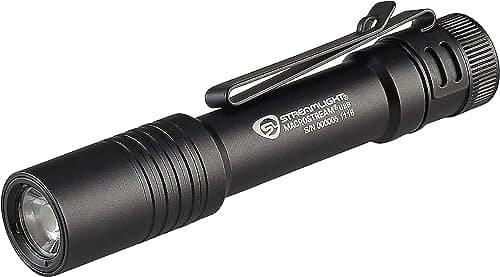 Streamlight MacroStream USBTop pick500 lumens, 2,000 candela, 90 m and two hours on high — every figure published per mode by the maker. That is the reason it leads. | The best-documented small EDC light here | 500 lm |
We earn a commission if you buy through the links on this page, at no extra cost to you. It does not change what we recommend or the order they appear in. Full disclosure. Prices checked September 13, 2026.
We have not tested this flashlight. We own none of the products on this site and have no laboratory. What follows is every figure Streamlight publishes for the MacroStream, the arithmetic those figures allow, and a plain statement of what they do not cover.
That approach suits this light unusually well, because the MacroStream's strongest claim is not its output. It is that Streamlight publishes six specifications where most makers of pocket lights publish one, and every one of them can be checked.
The published specification
| Specification | Published figure |
|---|---|
| Output | 500 lm |
| Peak beam intensity | 2,000 cd |
| Beam distance | 90 m |
| Runtime | 2 h on high, 8 h on low |
| Battery | Built-in Li-ion, charges in 4 h |
| Weight | 62.4 g (2.2 oz) |
| Ingress protection | IPX4 |
Compare that against the rest of the pocket category. The Fenix E18R V2.0 publishes 1,200 lumens and a cell format. The Nitecore TINI 3 publishes 600 lumens. The Olight Baton 4 Pro publishes 1,600 lumens. None of those three publishes a beam distance, a runtime, a weight or an ingress rating — so there is no way to tell what any of them actually does beyond the headline.
The figures check out against each other
The MacroStream publishes both candela and beam distance, which is rare and useful, because the two are linked by a fixed definition. That means they can be tested against one another.
Divide the intensity by the output and you get 4 candela per lumen. That is a pure flood — one of the lowest concentrations on this site — and it is the most important thing the spec sheet tells you about how this light behaves.
The runtime table, and why it is the real feature
Streamlight publishes 2 hours on high and 8 hours on low. Two numbers rather than one, and that difference matters more than it looks.
The usual pattern in this category is a single maximum — Fenix publishes 42 hours for the PD36R Pro, which describes its lowest setting and tells you nothing about the 2,800 lumens on the box. A per-mode table lets you plan: two hours of genuinely useful light, or an evening of low. It is the difference between a specification and a slogan.
What Streamlight does not publish is the cell capacity. So unlike a Fenix or a Petzl product, the watt-hour arithmetic this site normally runs cannot be applied here — you can see the hours but not check them against the energy behind them. How runtime is defined sets out the computation where the inputs exist.
Weight, and what 62.4 grams means in practice
62.4 g is light enough to forget in a trouser pocket, which is the single property that decides whether an EDC light is carried or left in a drawer. For comparison the Streamlight ProTac HL-X publishes 162 g and the Fenix PD36R Pro 169 g — both close to three times this, and both lights you notice.
The built-in cell is what buys that weight, and it is a genuine trade rather than a free win. There is nothing to swap when it is flat, and when the cell degrades — typically to about 80 percent of capacity after a few hundred cycles — the light is finished rather than a few dollars from new. A removable-cell light like the ProTac HL-X can be refreshed indefinitely.
Where the specification is genuinely weak
Two things, and the first is the reason most people should think twice.
- IPX4 is the weakest ingress rating we would accept on a carry light. It covers splashing water from any direction — rain, a wet worktop — and it does not cover immersion. Dropping this in a sink, a puddle or a stream is not something Streamlight has rated it for. The ThruNite Archer 2A V3 and Olight i3T 2 EOS both publish IPX8 at lower prices, and the ProTac HL-X publishes IP68.
- No published cell capacity. Streamlight states how long the light runs but not what is in it, so the runtime figures have to be taken on trust rather than checked. Fenix and Petzl both publish capacity; Streamlight does not, on any product we cover.
Who should buy something else
Skip it if you need reach. 90 m is short, and that is a design choice rather than a shortcoming — but if you want to identify something at distance, the ThruNite Archer 2A Pro publishes 365 m on AA cells for less money.
Skip it if the light will get properly wet. IPX4 is rain and nothing more. This is the clearest single reason to buy a different light, and it applies to a lot of people who carry a torch for work.
Skip it if you want to swap cells. A sealed light is a light with an end date. If you want something you can keep running forever, a light taking an 18650, a AA or a CR123A is the better long-term purchase — see best AA flashlights.
Skip it if you want maximum output per dollar. 500 lumens is modest in 2026; several pocket lights publish two or three times that. What none of them publishes is the rest of the sheet, which is the entire argument for this one.
The verdict, stated as what it commits to
The MacroStream is the pocket light we would recommend to someone who wants to know exactly what they are buying. It publishes output, intensity, reach, both runtimes, weight and an ingress rating, and its two beam figures reconcile with each other — which, across this entire category, essentially nothing else does.
It is not the brightest, it does not throw, it is not waterproof beyond rain, and its cell cannot be replaced. Every one of those is visible in the specification before you spend anything, which is precisely the point. A light that tells you its weaknesses is more useful than one that tells you only its best number. For the wider field ranked on stored energy rather than documentation, see EDC flashlights.
The picks, in full
Top pick · The best-documented small EDC light here
Streamlight MacroStream USB
500 lumens, 2,000 candela, 90 m and two hours on high — every figure published per mode by the maker. That is the reason it leads.
2,000 candela and 90 m are consistent with each other, which is a better sign than it sounds. The FL1 beam distance is the square root of candela divided by 0.25 lux: the square root of 2,000 over 0.25 is 89.4 m. Streamlight's published figures check out to within a meter.
Two hours on high for 500 lumens implies roughly 2.5 watt-hours of usable energy, which is about right for a light this size. Nothing here is being oversold.
62 grams is pocketable in a way that a 21700 light is not, and that is the trade you are making against a bigger cell.
What works
- Every headline figure published per mode, and internally consistent
- 62 g with a real clip
- The arithmetic between its candela and its distance actually reconciles
What does not
- IPX4, so splash-resistant and no more
- Built-in cell rather than a replaceable 18650
- 500 lumens is modest against the 1,600-lumen headlines nearby
Skip this ifyou want reach. 2,000 candela is a close-range beam and no setting will change that.
Published specification
- Output
- 500 lmHigh. Low is 50 lm.Streamlight MacroStream USB — manufacturer spec page (retrieved September 1, 2026)
- Peak intensity
- 2,000 cdStreamlight MacroStream (500 lm, 2,000 cd) — the brand's own listing on Amazon.com (retrieved September 1, 2026)
- Beam distance
- 90 mHigh. 30 m on low.Streamlight MacroStream USB — manufacturer spec page (retrieved September 1, 2026)
- Runtime
- 2 h on high, 8 h on lowStreamlight MacroStream USB — manufacturer spec page (retrieved September 1, 2026)
- Battery
- Built-in Li-ion, charges in 4 hStreamlight MacroStream USB — manufacturer spec page (retrieved September 1, 2026)
- Weight
- 62.4 g (2.2 oz)Streamlight MacroStream USB — manufacturer spec page (retrieved September 1, 2026)
- Ingress
- IPX41 m impact resistance testedStreamlight MacroStream USB — manufacturer spec page (retrieved September 1, 2026)
#ad · how this is funded · price as of September 13, 2026
Questions people actually ask
Is the Streamlight MacroStream worth it?
If you value knowing what you are buying, yes — it is the only small EDC light we cover that publishes output, candela, beam distance, per-mode runtime, weight and an ingress rating together, and its candela and distance figures reconcile. If you want maximum output per dollar, or anything more than rain resistance, buy something else.
How far does the Streamlight MacroStream shine?
Streamlight publishes 90 m, alongside 2,000 candela. Those two reconcile exactly through the ANSI FL 1 definition: the square root of 2,000 divided by 0.25 is 89.4 m. At 4 candela per lumen it is a wide flood, so 90 m is short by design rather than by accident.
How long does the MacroStream run?
Streamlight publishes 2 hours on high and 8 hours on low, and states a 4-hour charge time. A figure for each mode is unusual in this category — most makers publish a single maximum that describes their lowest setting. Streamlight does not publish the cell capacity, so those hours cannot be checked against the energy behind them.
Is the Streamlight MacroStream waterproof?
It publishes IPX4, which is protection against splashing water from any direction. That covers rain and a wet worktop; it does not cover immersion. If you need a light that survives being dropped in water, the ThruNite Archer 2A V3 publishes IPX8 and the Streamlight ProTac HL-X publishes IP68.
Can you replace the battery in a MacroStream?
No — the cell is built in and charges over USB. That is what keeps it at 62.4 g, and it is a real trade: when the cell degrades, typically to around 80 percent of capacity after a few hundred cycles, the light reaches the end of its life rather than taking a new cell.
MacroStream or ProTac HL-X?
Different jobs. The MacroStream is 500 lumens, 90 m, 62.4 g and IPX4 — a pocket flood you forget you are carrying. The ProTac HL-X is 1,300 lumens, 374 m, 162 g and IP68, runs on a pack or CR123A primaries, and publishes three runtimes. Carry weight favors the MacroStream; everything demanding favors the ProTac.
Is 500 lumens enough for everyday carry?
For most everyday use, comfortably. 500 lumens lights a room, a path or an engine bay, and above roughly 1,000 lumens at arm's length extra output is mostly glare reflecting back at you. The more useful question is beam shape, and at 4 candela per lumen this is a flood rather than a thrower.
Sources
Every figure on this page came from one of the documents below, read on the date shown. We do not cite other review sites, forum posts or video reviews as sources of fact.
- Streamlight MacroStream USB — manufacturer spec page (retrieved September 1, 2026)
- Streamlight PolyTac — manufacturer spec page (retrieved September 1, 2026)
- ANSI/PLATO FL 1 flashlight performance standard — definitions of lumens, peak beam intensity, beam distance, runtime, impact and water resistance
- IEC 60529 — the IP (ingress protection) rating system
Read next

Best EDC flashlights, ranked on what they actually hold
The full EDC ranking: cell format, stored energy, color rendering and beam shape, every figure sourced.
How to carry an EDC flashlight
Clip orientation, pocket choice and holsters — the practical side of actually carrying a light every day.
Best AA flashlights
AA and AAA flashlights ranked on published reach, CRI and ingress rating, with the arithmetic behind each and the gaps named.
The longest-running EDC flashlights, on published figures
EDC lights ranked on published runtime, with the mode each figure applies to and the stored energy behind it.
Flashlight runtime, computed
How runtime is defined, why thermal step-down happens, and the arithmetic to compute a real figure yourself.
Throw vs flood
How reflector geometry produces throw or flood, what each suits, and where the middle ground lives.
Found a number that is wrong? Tell us and we will fix it and say so. Our methodology shows every formula on this page.