Learn
Flashlight runtime, computed
Published runtimes are technically true and routinely misleading. Here is how to work out the real one from figures every maker publishes.
By Scooter M. · Published · Updated
| # | Product | Best for | Output | Price |
|---|---|---|---|---|
| 1 | 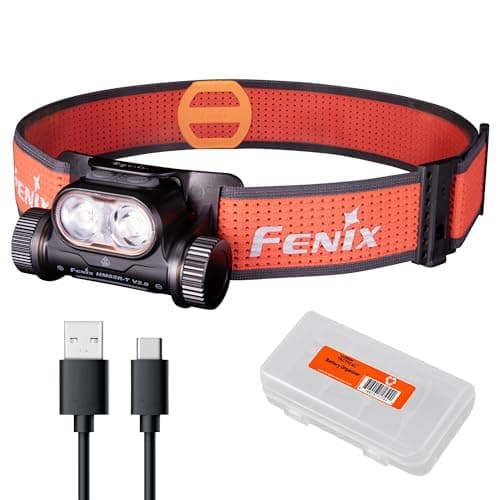 Fenix HM65R-T V2.0Top pick1,600 lumens and 170 m from a magnesium body running a standard 18650, at 140 g. The removable cell is what separates it from the sealed-pack lamps. | Long nights where you want reach and a spare cell | 1,600 lm | |
| 2 | 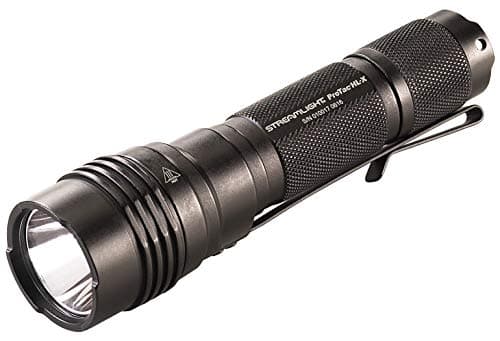 Streamlight ProTac HL-X1,300 lumens, 35,000 candela, 374 m, 1.5 hours, IP68, on either a rechargeable pack or two CR123A cells. Every figure published per mode. | Duty use, and the best-documented light on this site | 1,300 lm | |
| 3 | 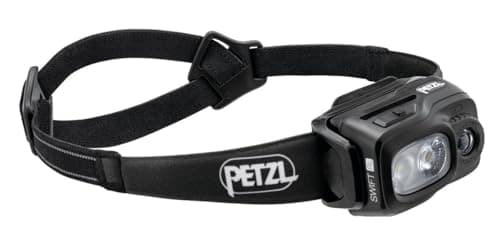 Petzl Swift RLThe best power-to-weight figure we could source: 1,200 lumens and 168 m from 92 grams, with reactive dimming that genuinely extends the burn. | Trail running and fast movement at night | 1,200 lm | Check price#ad |
We earn a commission if you buy through the links on this page, at no extra cost to you. It does not change what we recommend or the order they appear in. Full disclosure. Prices checked October 16, 2026.
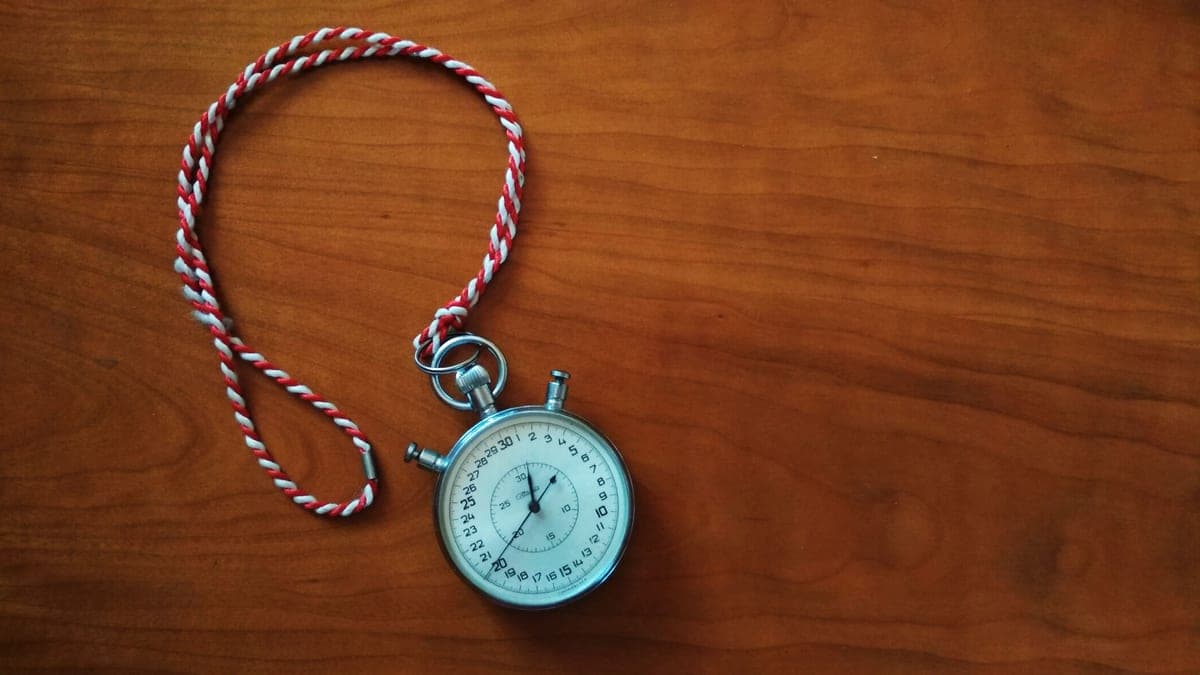
Runtime is the specification that decides whether a light does the job, and it is the specification most vulnerable to being technically true and practically useless. This page explains why, and shows you how to compute a figure you can actually plan around.
How the standard defines it
ANSI FL 1 measures runtime from 30 seconds after switch-on until output falls to 10 percent of that initial reading. Both halves of that matter.
Thermal step-down: why your light dims
An LED converts something like 30 to 40 percent of its input power into light. The rest becomes heat in a die a few millimeters across, and it has to get out through the board, the body and the air.
In a pocket-sized light the body cannot shed that heat fast enough, so the driver reduces current to hold the junction temperature within limits. That is thermal step-down. It is not a fault, it is the light protecting itself and your hand.
| Body | Typical step-down onset | Why |
|---|---|---|
| Small aluminum (16340 class) | 30 to 60 seconds | Very little thermal mass |
| Full-size aluminum (18650/21700) | 1 to 3 minutes | More mass and more surface area |
| Polymer body | Sooner and further | Polymer is a poor conductor of heat |
| Headlamp | 1 to 2 minutes | Limited by what a forehead tolerates, not by the emitter |
Computing a real runtime
Two steps, both from figures manufacturers publish.
Worked examples from lights we cover
| Light | Watt-hours | At 200 lm (2 W) | At 500 lm (6 W) |
|---|---|---|---|
| Fenix HM75R | 30.2 | 15.1 h | 5.0 h |
| Fenix PD36R Pro | 18.0 | 9.0 h | 3.0 h |
| Fenix HM65R-T V2.0 | 12.2 | 6.1 h | 2.0 h |
| Petzl NAO RL | 11.8 | 5.9 h | 2.0 h |
| Petzl Swift RL | 8.5 | 4.2 h | 1.4 h |
| Petzl Actik Core | 4.5 | 2.3 h | 0.8 h |
| Petzl Swift LT | 3.3 | 1.6 h | 0.5 h |
These are estimates from published capacities, not measurements, and they assume constant draw and no step-down. They are deliberately conservative and they are close enough to plan a night around — which is more than a headline figure gives you.
Where the estimate goes wrong
- Cold. Lithium-ion loses a substantial part of its usable capacity below freezing, and alkalines lose more. Reduce the estimate by a third in genuinely cold weather.
- Age. A cell at 400 cycles holds roughly 80 percent of its original capacity, and keeps declining.
- Drive level. Emitter efficiency falls as current rises, so a turbo mode is disproportionately wasteful. The estimate is most accurate at moderate output.
- Regulation. A well-regulated light holds output and then drops off a cliff. An unregulated one fades gradually and runs longer by the FL 1 definition while being dimmer throughout.
Reserve modes and the misleading long numbers
Petzl publishes figures like visible at 700 meters for 400 hours. That is a be-seen claim, not a see-by claim: it says the lamp remains detectable at that range, not that you can walk by its light for 400 hours.
It is not dishonest, and it is not comparable to a working runtime. Whenever a runtime figure looks impossible for the battery capacity, look for the mode it applies to — it is almost always a reserve or moonlight mode.
What good runtime publishing looks like
Streamlight's ProTac HL-X entry is the model: 1,300 lumens for 1.5 hours, 420 for 3.75, 70 for 25, with separate figures for the rechargeable pack and for CR123A cells. That is enough for a reader to plan against, and it is what we would like every maker to publish.
The picks, in full
Top pick · Long nights where you want reach and a spare cell
Fenix HM65R-T V2.0
1,600 lumens and 170 m from a magnesium body running a standard 18650, at 140 g. The removable cell is what separates it from the sealed-pack lamps.
A 3,400 mAh 18650 at a nominal 3.6 V is 12.2 watt-hours. That is more energy than a Petzl NAO RL carries, in a lamp 5 g lighter, because a bare 18650 is a more efficient package than a molded pack.
It is also the only headlamp in this set whose battery you can replace at a checkpoint for three dollars, because 18650 is a standard cell and not a proprietary brick.
IP68 rather than IPX4 is the second real difference. This one survives being dropped in water; most of the running lamps here do not.
What works
- Standard 18650 cell: swappable, cheap, and available everywhere
- IP68 and 2 m impact rating, the toughest specification in this roundup
- Dual emitters, one white and one warm white, so it works for close tasks as well as reach
What does not
- 140 g is at the heavy end for a running lamp
- Charging works only with Fenix ARB-L18 series cells, which limits the swap-any-18650 advantage
- No published candela figure
Skip this ifyou count grams. A Swift LT does the camp job at 43 g; you are carrying 97 g extra for reach and a removable cell.
Published specification
- Peak intensity
- not published(Fenix publishes distance, not peak intensity)
- Runtime
- 300 h maximumLowest mode. The turbo figure is far shorter and Fenix publishes it per-mode.Fenix HM65R-T V2.0 — manufacturer spec page (retrieved September 1, 2026)
- Battery
- 3,400 mAh 18650 Li-ion (included), or 2 x CR123AFenix HM65R-T V2.0 — manufacturer spec page (retrieved September 1, 2026)
- Weight
- 140 g (4.94 oz)Including battery and headbandFenix HM65R-T V2.0 — manufacturer spec page (retrieved September 1, 2026)
- Ingress
- IP68Dust tight and immersion rated; 2 m impact resistanceFenix HM65R-T V2.0 — manufacturer spec page (retrieved September 1, 2026)
#ad · how this is funded · price as of October 16, 2026
Pick 2 · Duty use, and the best-documented light on this site
Streamlight ProTac HL-X
1,300 lumens, 35,000 candela, 374 m, 1.5 hours, IP68, on either a rechargeable pack or two CR123A cells. Every figure published per mode.
35,000 candela and 374 m reconcile exactly: the square root of 35,000 divided by 0.25 is 374.2 m. Streamlight's numbers are internally consistent across all three modes, which is the strongest signal of a maker publishing real measurements rather than marketing figures.
1.5 hours at 1,300 lumens implies roughly 6 to 7 watt-hours of usable energy — consistent with a single 18650-class pack and with the CR123A alternative.
IP68 with 2 m impact resistance is the toughest rating in this roundup, and the reason this light shows up on so many duty belts.
What works
- Full ANSI FL1 table published per mode, and it reconciles
- Runs on a rechargeable pack or on shelf-stable CR123A lithium cells
- IP68 and 2 m impact rating
What does not
- The programming interface takes reading the manual to understand
- 162 to 176 g is heavy for pocket carry
- CR123A cells are expensive if you use it hard
Skip this ifyou want a pocket light. It is a duty-belt tool and the weight and length are built for a holster.
Published specification
- Output
- 1,300 lmHigh. Medium 420 lm, low 70 lm.Streamlight ProTac HL-X — manufacturer spec page (retrieved September 1, 2026)
- Peak intensity
- 35,000 cdHigh. 11,000 cd medium, 1,800 cd low.Streamlight ProTac HL-X — manufacturer spec page (retrieved September 1, 2026)
- Beam distance
- 374 mHigh. 210 m medium, 85 m low.Streamlight ProTac HL-X — manufacturer spec page (retrieved September 1, 2026)
- Runtime
- 1.5 h high / 3.75 h medium / 25 h lowOn the SL-B26 pack. On CR123A: 1.25 h / 3 h / 20 h.Streamlight ProTac HL-X — manufacturer spec page (retrieved September 1, 2026)
- Battery
- SL-B26 rechargeable Li-ion pack, or 2 x CR123A lithiumStreamlight ProTac HL-X — manufacturer spec page (retrieved September 1, 2026)
- Weight
- 162 g with CR123A, 176 g with the packStreamlight ProTac HL-X — manufacturer spec page (retrieved September 1, 2026)
- Ingress
- IP68Dust tight, waterproof to 2 m; 2 m impact resistance testedStreamlight ProTac HL-X — manufacturer spec page (retrieved September 1, 2026)
#ad · how this is funded · price as of October 16, 2026
Pick 3 · Trail running and fast movement at night
Petzl Swift RL
The best power-to-weight figure we could source: 1,200 lumens and 168 m from 92 grams, with reactive dimming that genuinely extends the burn.
8.47 watt-hours across 92 grams is the whole argument. That works out to 13.0 lumens per gram at peak and 0.092 Wh of stored energy per gram carried, the best combination of the two figures in this roundup.
Reactive lighting is the runtime strategy, not a gimmick. The lamp meters reflected light and cuts output when you look at your own hands or a pale trail. Petzl's 7-hour minimum at medium is quoted in that mode, and it is the number to plan around.
168 m of throw is more than a runner can use below about 8 minutes per kilometer. What you actually notice is how little the beam sags once the pack drops under half.
What works
- 1,200 lm and 168 m at 92 g, the best power-to-weight in this set on published figures
- Reactive dimming extends the burn instead of just cutting output in bright patches
- Five-level charge gauge, so you know what you have before you start
What does not
- IPX4, in a category where running in rain is the normal case
- Charging cable not included at this price
- Reactive mode takes a few outings to trust
Skip this ifyou mostly walk. You are paying for a reactive sensor and a 2,250 mAh pack to solve a problem hikers do not have.
Published specification
- Output
- 1,200 lmANSI FL 1 standardPetzl Swift RL — manufacturer spec page (retrieved September 1, 2026)
- Peak intensity
- not published(Petzl publishes distance, not peak intensity)
- Beam distance
- 168 mPetzl Swift RL — manufacturer spec page (retrieved September 1, 2026)
- Runtime
- 7 h minimum at medium, in reactive modePetzl Swift RL — manufacturer spec page (retrieved September 1, 2026)
- Battery
- 2,250 mAh / 3.85 V / 8.47 Wh Li-ion, USB-CPetzl Swift RL — manufacturer spec page (retrieved September 1, 2026)
#ad · how this is funded · price as of October 16, 2026
Questions people actually ask
How is flashlight runtime measured?
ANSI FL 1 measures from 30 seconds after switch-on until output falls to 10 percent of that initial value. Both details matter: the peak before 30 seconds is excluded, and the light is still counted as running at a tenth of its starting brightness.
Why does my flashlight get dimmer after a minute?
Thermal step-down. An LED turns most of its input power into heat, and a small body cannot shed it fast enough, so the driver reduces current to protect the emitter. Every high-output light in a small body does it.
How do I calculate flashlight runtime myself?
Convert the cell to watt-hours — milliamp-hours divided by 1,000, times nominal voltage — then divide by the light's power draw. Estimate draw as lumens divided by about 100 lumens per watt. A 12.2 watt-hour cell at 200 lumens gives roughly six hours.
Can a manufacturer's runtime figure be misleading without being false?
Easily. A light running 1,600 lumens for two minutes, 400 for four hours and 160 for another hour can publish five hours and be fully compliant, because the clock only stops at 10 percent of the initial reading.
What does 'visible at 700 m for 400 hours' mean?
It is a reserve-mode visibility claim: the lamp remains detectable from 700 meters for that long. It is not 400 hours of light you can see by, and it is not comparable to a working runtime.
How much does cold reduce flashlight runtime?
Substantially. Lithium-ion loses a large fraction of usable capacity below freezing and alkalines lose more; lithium primaries are barely affected. Reduce any runtime estimate by roughly a third in genuinely cold conditions.
Does a regulated flashlight run longer?
Not necessarily by the FL 1 measure. A regulated light holds output and then falls off quickly; an unregulated one fades gradually and can post a longer number while being dimmer for most of it. Regulated is better to use; unregulated often looks better on paper.
Sources
Every figure on this page came from one of the documents below, read on the date shown. We do not cite other review sites, forum posts or video reviews as sources of fact.
- ANSI/PLATO FL 1 flashlight performance standard — definitions of lumens, peak beam intensity, beam distance, runtime, impact and water resistance
- Streamlight ProTac HL-X — manufacturer spec page (retrieved September 1, 2026)
- Fenix HM65R-T V2.0 — manufacturer spec page (retrieved September 1, 2026)
- Petzl Swift RL — manufacturer spec page (retrieved September 1, 2026)
- Petzl — ANSI/PLATO FL 1 technical information for its headlamp range
Read next
The longest-running EDC flashlights, on published figures
EDC lights ranked on published runtime, with the mode each figure applies to and the stored energy behind it.
Flashlight specifications, explained
The reference section: lumens, candela, runtime, CRI, IP ratings and cell formats, all brand-neutral.
The ANSI FL 1 standard, explained
What the ANSI/PLATO FL 1 standard specifies, measurement by measurement, and the self-reporting problem at its center.
18650 vs 21700, and every other cell format
Cell formats compared on capacity, current rating and dimensions, with the safety rules that matter.
How many lumens do I need?
A task-by-task lumen chart derived from illuminance requirements rather than from marketing.
Best rechargeable headlamps
Rechargeable headlamps sorted by cell strategy: sealed, swappable standard cell, or hybrid.
Best rechargeable flashlights
Rechargeable flashlights sorted by cell strategy, with the capacity arithmetic and the lifespan trade set out.
Found a number that is wrong? Tell us and we will fix it and say so. Our methodology shows every formula on this page.