Work Lights
Best work lights with stands and tripods
Area lighting is a different problem from task lighting, and the arithmetic that sizes it is the inverse square law.
By Scooter M. · Published · Updated
| # | Product | Best for | Output | Price |
|---|---|---|---|---|
| 1 | 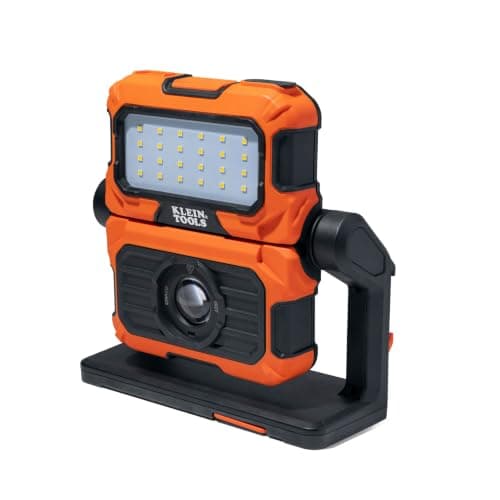 Klein Tools 56417 Rechargeable Work LightTop pick3,000 lumens with six modes and 360-degree rotation. The area-lighting version of the same idea. | Lighting a whole work area | 3,000 lm | |
| 2 | 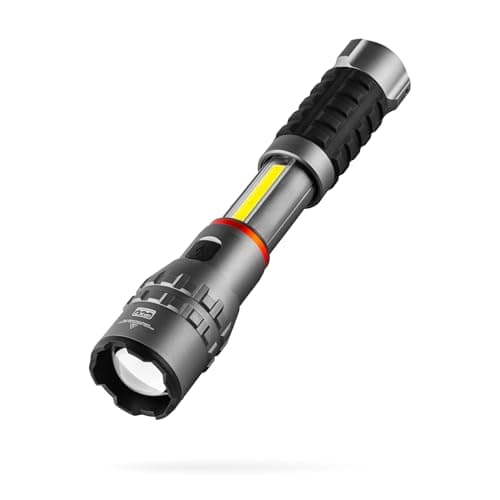 Nebo Slyde King 4KA 4,000-lumen spot and a 1,000-lumen COB work light in one sliding body, USB rechargeable. | The brightest two-in-one here | 4,000 lm spot / 1,000 lm COB work light | |
| 3 | 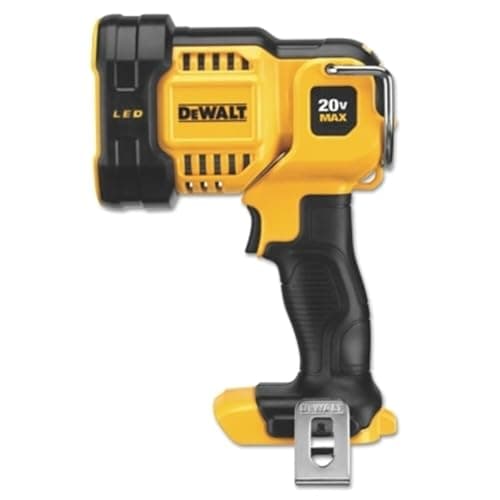 DeWalt DCL043 Jobsite Spotlight1,500 lumens and 464 m of stated reach, running off the same 20V MAX pack as everything else on the truck. | Sites already standardized on 20V MAX batteries | 1,500 lm high / 500 lm low | |
| 4 | 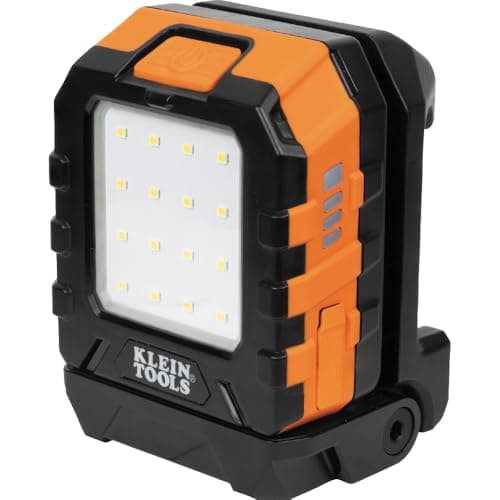 Klein Tools 56416 Rechargeable Work Light1,000 lumens, three modes, 360-degree rotation and a magnet. Built to be put down and aimed rather than held. | A magnetic work light with a kickstand | 1,000 lm |
We earn a commission if you buy through the links on this page, at no extra cost to you. It does not change what we recommend or the order they appear in. Full disclosure. Prices checked October 15, 2026.
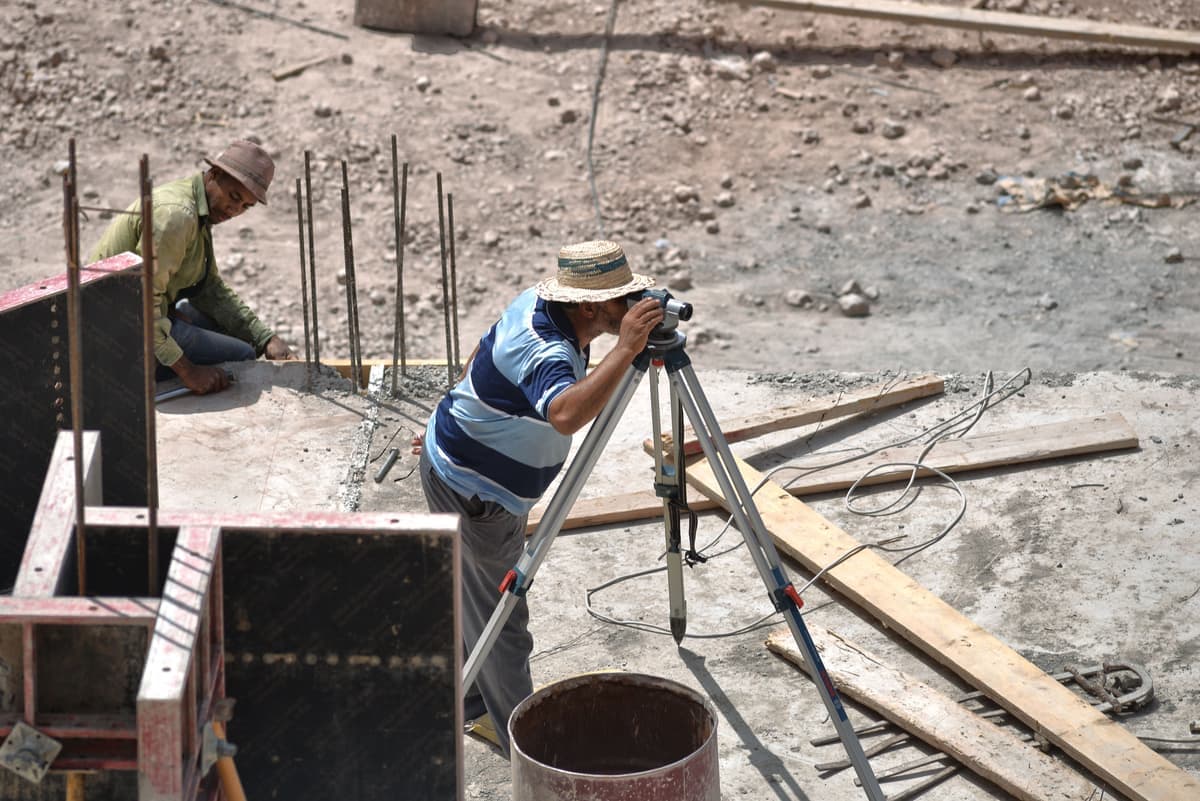
Everything else in the work-light category is about lighting the thing in front of you. This page is about lighting the room, and the two problems have almost nothing in common.
The governing physics is the inverse square law: double the distance and you quarter the illuminance. That is why a 1,000-lumen light that is excellent at half a meter is useless at six.
How we picked
Output and beam spread first, since those decide whether the light covers the area, then mounting height and stability, then runtime where a maker publishes one. Sources on every figure; see our methodology.
Sizing output to a space
| Space | Task | Target lux | Lumens needed |
|---|---|---|---|
| Small room, 10 m^2 | Moving safely | 50 | 800 to 1,000 |
| Small room, 10 m^2 | General work | 200 | 3,300 to 4,000 |
| Large room, 25 m^2 | General work | 200 | 8,000 to 10,000 |
| Large room, 25 m^2 | Detail work | 500 | 20,000 to 25,000 |
That table is the honest answer to why site lighting uses fixed floodlights rather than portables. Twenty thousand lumens from a battery is a large, heavy, short-lived object. Portables cover the first two rows well and the last row not at all.
Mounting height matters more than output
A light at two meters covers roughly four times the area of the same light at one meter, and it puts the source above eye level so it stops glaring at everyone in the room. Raising a light is free output.
It is also the single biggest practical difference between a work light on the floor and the same light on a stand, and it is why tripod-mounted lights feel dramatically better than their specifications suggest.
Battery-powered or mains
For genuine area lighting, mains wins comfortably. A 20,000-lumen battery floodlight would draw roughly 200 watts and flatten a 100 watt-hour tool pack in half an hour.
Battery area lights make sense for first fix before power is available, for outdoor work away from a supply, and for anywhere a trailing lead is a hazard. Outside those cases, a corded light gives more light for longer for less money.
Glare and the people around you
A bare high-output LED at eye level is genuinely unpleasant to work near, and unlike task lighting the effect lands on everybody in the space rather than on the person holding the light.
Two fixes, both easy: get the light above eye level, and aim it at a ceiling or a wall rather than at people. Bounced light is softer, more even and far more comfortable, at the cost of maybe 30 percent of the illuminance.
What we would not buy
A battery area light with no published runtime. At the draw these lights need, the runtime is the specification, and an unstated one is not an oversight.
We would also avoid a tall light with a narrow base. A tripod light that goes over takes the lamp head, the battery and possibly someone's ankle with it, and the stability of the base is worth more attention than the lumen figure.
The picks, in full
Top pick · Lighting a whole work area
Klein Tools 56417 Rechargeable Work Light
3,000 lumens with six modes and 360-degree rotation. The area-lighting version of the same idea.
3,000 lumens from a portable light is enough to work by without a second source, which is the threshold that matters on a jobsite.
The six modes are not brightness steps on one emitter. There are two beams - a spot and a flood - that run alone or together, and Klein publishes an output and a runtime for each of the six combinations.
Runtime is the figure that decides whether a 3,000-lumen portable is a tool or a toy, and Klein publishes all six of them: 3 hours with both beams at 3,000 lumens, out to 12 hours on the 250-lumen flood. That is the most complete runtime disclosure of any work light on this site.
What works
- 3,000 lumens is genuine area lighting
- Magnetic mount and full rotation
- Six modes cover most jobsite needs
What does not
- No candela or beam distance, so the spot beam cannot be checked against anything
- 998 g and the largest body here - a set-down light, not a carry light
- No published CRI, on a light sold into color-coded trades
Skip this ifyou mostly work in panels and engine bays. At close range 3,000 lumens is glare, not visibility.
Published specification
- Output
- 3,000 lmBoth beams together. Spot and flood also run independently.Klein Tools 56417 — manufacturer spec page (retrieved October 11, 2026)
- Peak intensity
- not published
- Beam distance
- not published(Klein publishes neither beam figure)
- Runtime
- 3 h at 3,000 lmSix published pairs: spot 1,400 lm/5 h and 475 lm/9.5 h; flood 1,400 lm/8 h, 700 lm/10 h and 250 lm/12 h.Klein Tools 56417 — manufacturer spec page (retrieved October 11, 2026)
- Battery
- Li-ion, 12 h rated lifeUSB-C charge in, USB-A out to charge other kit. Capacity not published.Klein Tools 56417 — manufacturer spec page (retrieved October 11, 2026)
- Weight
- 998 g2.2 lb.Klein Tools 56417 — manufacturer spec page (retrieved October 11, 2026)
- Ingress
- IP65Dust-tight, water resistant. 3 m drop rating.Klein Tools 56417 — manufacturer spec page (retrieved October 11, 2026)
#ad · how this is funded · price as of October 15, 2026
Pick 2 · The brightest two-in-one here
Nebo Slyde King 4K
A 4,000-lumen spot and a 1,000-lumen COB work light in one sliding body, USB rechargeable.
A thousand COB lumens is genuine small-area lighting rather than task lighting, which is what separates this from the 2K version.
At 4,000 lumens on the spot side the draw is likely around 40 watts, and without a published capacity there is no way to know whether that is twenty minutes or two hours. That gap is what keeps it off the top of our list.
Magnetic base and a hands-free stance, as every work light should have.
What works
- The highest published output of any light on the work pages
- A 1,000-lumen COB strip is genuine area light
- Magnetic base and 4x zoom on the spot side
What does not
- No sourced runtime, capacity, weight or IP rating
- Two light engines in one body means a shorter run on either
- Zoom optics lose output relative to a fixed reflector
Skip this ifyou need to know how long it runs. At this output the runtime is the specification, and it is not published.
Published specification
- Output
- 4,000 lm spot / 1,000 lm COB work lightNebo Slyde King 4K — the brand's own listing on Amazon.com (retrieved September 1, 2026)
- Peak intensity
- not published
- Beam distance
- not published
- Runtime
- not published
- Battery
- USB rechargeableNebo Slyde King 4K — the brand's own listing on Amazon.com (retrieved September 1, 2026)
- Weight
- not published
- Ingress
- not published
#ad · how this is funded · price as of October 15, 2026
Pick 3 · Sites already standardized on 20V MAX batteries
DeWalt DCL043 Jobsite Spotlight
1,500 lumens and 464 m of stated reach, running off the same 20V MAX pack as everything else on the truck.
464 m from 1,500 lumens implies about 53,800 candela. That is a proper spotlight, not a work light with a reflector.
The battery platform is the real argument. If your van already carries six 20V MAX packs, a light that shares them has no charging routine at all.
Runtime genuinely cannot be published here, because it depends entirely on which pack you fit. That is one of the few unpublished figures on this site with a legitimate reason.
What works
- Shares the 20V MAX platform, so the battery problem is already solved
- 464 m of published reach
- Pivoting head for aiming from a set-down position
What does not
- Battery not included, and the packs are not cheap on their own
- No sourced weight or IP rating
- Useless if your site runs a different battery platform
Skip this ifyou are not already on DeWalt 20V MAX. Buying into a battery platform for one light is the wrong way round.
Published specification
- Output
- 1,500 lm high / 500 lm lowDeWalt publishes both brightness settingsDeWalt DCL043 20V MAX Jobsite LED Spotlight — manufacturer spec page (retrieved September 13, 2026)
- Peak intensity
- not published
- Beam distance
- 464 mDeWalt states 508 yards / 1,525 feet; converted to metersDeWalt DCL043 20V MAX Jobsite LED Spotlight — manufacturer spec page (retrieved September 13, 2026)
- Runtime
- not published(Depends on which 20V MAX pack is fitted)
- Battery
- DeWalt 20V MAX (sold separately)DeWalt DCL043 — the brand's own listing on Amazon.com (retrieved September 1, 2026)
- Weight
- not published
- Ingress
- not published
#ad · how this is funded · price as of October 15, 2026
Pick 4 · A magnetic work light with a kickstand
Klein Tools 56416 Rechargeable Work Light
1,000 lumens, three modes, 360-degree rotation and a magnet. Built to be put down and aimed rather than held.
The magnet and the kickstand are the product. A work light you have to hold is a work light that is not working.
360-degree rotation means you set the body once and aim the head, which is the difference between a good work light and a torch on its side.
1,000 lumens is the sweet spot for a bay: enough to see, not so much that it glares back off metal.
What works
- Magnet plus kickstand plus rotation, so it goes anywhere
- 1,000 lumens is well matched to close work
- Trade distribution
What does not
- No candela or beam distance published
- No published CRI, on a light that would benefit from one
- Built-in cell
Skip this ifyou need to light a whole room. It is a task light, and a 3,000-lumen area light is a different tool.
Published specification
- Output
- 1,000 lmHigh. Medium is 425 lm, low 300 lm.Klein Tools 56416 — manufacturer spec page (retrieved October 11, 2026)
- Peak intensity
- not published
- Beam distance
- not published(Klein publishes neither beam figure)
- Runtime
- 9 h at 1,000 lmAlso 425 lm/14 h and 300 lm/21 h.Klein Tools 56416 — manufacturer spec page (retrieved October 11, 2026)
- Battery
- Li-ion, USB-CKlein Tools 56416 — manufacturer spec page (retrieved October 11, 2026)
- Weight
- 549 g19.36 oz.Klein Tools 56416 — manufacturer spec page (retrieved October 11, 2026)
- Ingress
- IP66Dust-tight and waterproof. 3 m drop rating.Klein Tools 56416 — manufacturer spec page (retrieved October 11, 2026)
$64.98 · 8% off
#ad · how this is funded · price as of October 15, 2026
Questions people actually ask
How many lumens do I need to light a room for work?
For general construction task lighting at 200 lux, roughly 3,300 to 4,000 lumens for a small room and 8,000 to 10,000 for a large one, allowing for a realistic utilization factor. Detail work at 500 lux needs two to three times that.
How high should a work light be mounted?
Above eye level, around two meters. A light at two meters covers roughly four times the area of the same light at one meter, and it stops glaring at everybody in the room. Raising a light is the cheapest way to get more out of it.
Are battery-powered area lights practical?
For first fix, outdoor work and anywhere a trailing lead is a hazard, yes. For sustained area lighting, mains wins comfortably — a 20,000-lumen battery light would draw around 200 watts and empty a 100 watt-hour pack in half an hour.
Should I aim a work light at the ceiling?
Often yes. Bouncing light off a ceiling or a pale wall gives softer, more even illumination and removes the glare, at a cost of roughly 30 percent of the illuminance. For anything with people in it, that trade is worth making.
What is the inverse square law and why does it matter here?
Illuminance falls with the square of the distance, so doubling the distance quarters the light. It is the reason a 1,000-lumen light that is excellent at half a meter does nothing useful at six.
What should I look for in a tripod work light?
Base stability first — a tall light with a narrow base is a hazard — then mounting height, then output, then runtime. The lumen figure is the one people compare and the least likely to be the limiting factor.
Sources
Every figure on this page came from one of the documents below, read on the date shown. We do not cite other review sites, forum posts or video reviews as sources of fact.
Read next

Klein Tools 56417 review
A specification-first review of the Klein Tools 56417: six published mode-and-runtime pairs, IP65, a 3 m drop rating, and the one piece of arithmetic that tells you which mode to actually use.

Best work lights for a construction site
Work lights for construction, ranked on published ingress rating, power source and area coverage, with the gaps named.
Best work lights, ranked on beam shape rather than brightness
The work-light ranking: beam shape, color rendering, mounting and runtime, with every published figure sourced.
Best rechargeable work lights
Rechargeable work lights compared on charging strategy, battery platform and published runtime.
Best work lights for electricians
Electrical work lights ranked on color rendering and glare control rather than raw output.
Best flashlights for power outages
Outage lighting ranked on shelf life, area coverage and findability rather than on output.

Lumens vs candela
The distinction that decides reach, with the conversion formula and a table of real published figures.
Found a number that is wrong? Tell us and we will fix it and say so. Our methodology shows every formula on this page.