Work Lights
Klein Tools 56417 review
The MODbox dual-beam light publishes an output and a runtime for all six of its modes. This site spent six weeks telling you no work-light maker published either, and that was our error, not the industry's.
By Scooter M. · Published · Updated
| # | Product | Best for | Output | Price |
|---|---|---|---|---|
| 1 | 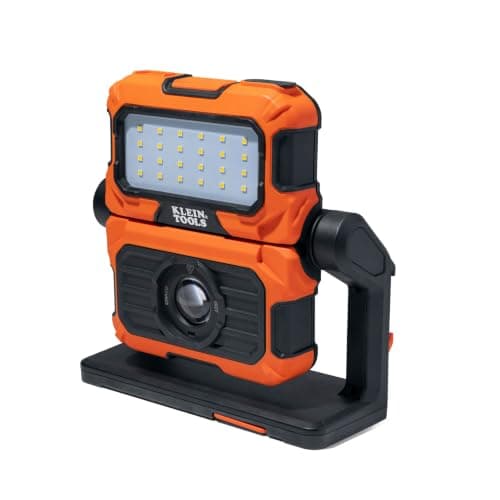 Klein Tools 56417 Rechargeable Work LightTop pick3,000 lumens with six modes and 360-degree rotation. The area-lighting version of the same idea. | Lighting a whole work area | 3,000 lm |
We earn a commission if you buy through the links on this page, at no extra cost to you. It does not change what we recommend or the order they appear in. Full disclosure. Prices checked October 11, 2026.

We have not tested this work light. We own none of the products on this site, we have no laboratory, and nothing here is an impression of how it feels in a hand. This review takes every figure Klein Tools publishes, runs the arithmetic those figures allow, and says what they do and do not commit the company to.
It also corrects something much larger than one product. Until this review, this site's work-light pages rested on a claim we repeated in eight places: that work-light makers publish a lumen number and almost nothing else - no runtime, no ingress rating, no weight - and that we would "name the gap rather than fill it with an estimate". Re-reading Klein's own product page on October 11, 2026 showed the gap was substantially ours. Klein publishes an output and a runtime for all six of this light's modes, an IP65 rating, a weight and a 3 m drop rating. It does the same for its other two lights we cover. Every page that claimed otherwise has been corrected in the same change as this one.
That reframes the product. The 56417 is not the brightest work light we cover, and brightness was never the interesting thing about it. It is the best-documented work light on this site, and on a category whose buyers ask one question - will it last the shift - that is the specification that matters.
The published specification
| Specification | Published figure |
|---|---|
| Output, both beams | 3,000 lm for 3 h |
| Spot beam | 1,400 lm for 5 h / 475 lm for 9.5 h |
| Flood beam | 1,400 lm for 8 h / 700 lm for 10 h / 250 lm for 12 h |
| Rated battery life | 12 h |
| Battery | Lithium-ion, USB-C in, USB-A out |
| Weight | 998 g (2.2 lb) |
| Dimensions | 22.4 x 23.2 x 10.5 cm (8.81 x 9.13 x 4.13 in) |
| Ingress protection | IP65 |
| Drop protection | 3 m (9.8 ft) |
| Operating temperature | 5 to 35 C (41 to 95 F) |
| Peak beam intensity | Not published |
| Beam distance | Not published |
| Color rendering | Not published |
Ten published figures and three gaps. For context, the DeWalt DCL043 on the same hub publishes a beam distance and no runtime; most of the rest of the category publishes an output and a photograph.
Six runtimes, and the arithmetic they allow
A single runtime figure tells you almost nothing, because makers quote whichever mode flatters them. Six of them, each tied to a stated output, let you do something the category almost never permits: work out how much light the thing actually delivers on a charge.
Read that line again, because it is the practical finding of this review. The 1,400-lumen flood runs 8 hours; the 1,400-lumen spot runs 5. Same stated output, three hours apart. And the flood at 1,400 lumens delivers about 24 percent more total light per charge than running both beams at 3,000.
So the 3,000-lumen mode is a burst setting, and Klein's own figures say so: three hours, the shortest of the six. If you set this light down for a whole job, the flood is the mode to use, and you would not know that from the box. How runtime is defined covers what these figures do and do not promise.
What Klein does not publish is the cell capacity, so the watt-hour arithmetic this site normally runs cannot be applied and the efficiency difference between the two beams cannot be explained from the sheet. The 12-hour "rated battery life" on the marketing copy is the 250-lumen flood figure, which is worth knowing before you plan around it.
Two beams is the design, not a mode count
The six modes are not six brightness steps. There are two separate emitters - a spot and a flood - and they run independently or together, which is where the six combinations come from. That matters because it is the difference between a light that compromises and a light you aim.
On a 360-degree rotating axle, with a magnetic base, a hanging hook and MODbox rail compatibility, the intended use is obvious: put it down or hang it, aim the flood at the work, and bring the spot in when you need to see into something. There is also a USB-A output that will charge a phone or power-share to another unit, and a battery gauge - which, on a light with six published runtimes, is the feature that makes those runtimes usable rather than theoretical.
IP65 and 3 meters, and what they cover
Under IEC 60529 the digits are read separately. The 6 is the solid-particle rating and it is the top of the scale: dust-tight. The 5 is water jets from any direction, not immersion - so this light is rated for rain and washdown, not for being dropped in a puddle and retrieved.
For context across the lights we cover: Klein's own 56416 publishes IP66 - dust-tight and a stronger water rating than this one - the 56073 publishes IP54, the Streamlight Stinger Switchblade IPX4 and the Streamlight Siege IPX7. The 3 m drop rating is the highest of any work light we cover, and ANSI FL 1 quotes impact in meters precisely so that it can be compared between makers who publish it. Work lights for construction sets the ratings side by side.
What Klein still does not publish
Three real gaps. No peak beam intensity and no beam distance, so the two figures this site normally checks against each other cannot be checked here at all - and on a light with a dedicated spot beam, that is a more serious omission than on a pure flood. The DeWalt DCL043 publishes 464 m and is the only work light we cover that publishes any distance figure.
And no CRI. On a 3,000-lumen light sold into electrical and mechanical trades, where the work is color coded, that is the figure we would most like to see. Streamlight publishes 90 CRI at 4,000 K on both of its Switchblade bars; Klein publishes nothing about color on any of its three. Why color accuracy matters on a jobsite explains what that costs you.
Who should buy something else
Skip it if the work is color-critical. No published CRI. The Streamlight Strion Switchblade publishes 90 CRI at 4,000 K and is the right tool for a wiring loom, at a fraction of this light's output.
Skip it if you need reach. No candela, no beam distance, and a 3,000-lumen area light is not a spotlight whatever its spot mode suggests. The DeWalt DCL043 publishes a real distance figure - see work lights for a service truck.
Skip it if it has to go in a pocket or a pouch. 998 g and a body wider than a sheet of paper is a set-down light. Klein's own 56073 publishes 147 g, four runtimes and IP54 if portability is the requirement.
Skip it if it will be immersed. IP65 is jets, not immersion. For standing water the Streamlight Siege publishes IPX7, and Klein's 56416 publishes IP66 on a smaller body - see best work lights under $100.
The verdict, stated as what it commits to
On published evidence this is the work light to buy when you need to light an area for a whole job and know in advance how long it will last. Klein publishes an output and a runtime for every one of its six modes, an IP65 rating, a 3 m drop rating and a weight - and the figures are internally consistent enough to tell you, against the marketing, that the 1,400-lumen flood is the mode that delivers the most light per charge.
It publishes no candela, no beam distance and no CRI, it is heavy, and IP65 will not survive immersion. Every one of those is visible in the numbers before you spend anything. For the category ranked on what each maker actually prints, see work lights; for how the two trade brands compare across formats, Klein vs Streamlight.
The picks, in full
Top pick · Lighting a whole work area
Klein Tools 56417 Rechargeable Work Light
3,000 lumens with six modes and 360-degree rotation. The area-lighting version of the same idea.
3,000 lumens from a portable light is enough to work by without a second source, which is the threshold that matters on a jobsite.
The six modes are not brightness steps on one emitter. There are two beams - a spot and a flood - that run alone or together, and Klein publishes an output and a runtime for each of the six combinations.
Runtime is the figure that decides whether a 3,000-lumen portable is a tool or a toy, and Klein publishes all six of them: 3 hours with both beams at 3,000 lumens, out to 12 hours on the 250-lumen flood. That is the most complete runtime disclosure of any work light on this site.
What works
- 3,000 lumens is genuine area lighting
- Magnetic mount and full rotation
- Six modes cover most jobsite needs
What does not
- No candela or beam distance, so the spot beam cannot be checked against anything
- 998 g and the largest body here - a set-down light, not a carry light
- No published CRI, on a light sold into color-coded trades
Skip this ifyou mostly work in panels and engine bays. At close range 3,000 lumens is glare, not visibility.
Published specification
- Output
- 3,000 lmBoth beams together. Spot and flood also run independently.Klein Tools 56417 — manufacturer spec page (retrieved October 11, 2026)
- Peak intensity
- not published
- Beam distance
- not published(Klein publishes neither beam figure)
- Runtime
- 3 h at 3,000 lmSix published pairs: spot 1,400 lm/5 h and 475 lm/9.5 h; flood 1,400 lm/8 h, 700 lm/10 h and 250 lm/12 h.Klein Tools 56417 — manufacturer spec page (retrieved October 11, 2026)
- Battery
- Li-ion, 12 h rated lifeUSB-C charge in, USB-A out to charge other kit. Capacity not published.Klein Tools 56417 — manufacturer spec page (retrieved October 11, 2026)
- Weight
- 998 g2.2 lb.Klein Tools 56417 — manufacturer spec page (retrieved October 11, 2026)
- Ingress
- IP65Dust-tight, water resistant. 3 m drop rating.Klein Tools 56417 — manufacturer spec page (retrieved October 11, 2026)
#ad · how this is funded · price as of October 11, 2026
Questions people actually ask
How long does the Klein Tools 56417 run?
Klein publishes a runtime for all six modes: 3 hours with both beams at 3,000 lumens; spot 1,400 lumens for 5 hours or 475 for 9.5; flood 1,400 lumens for 8 hours, 700 for 10, or 250 for 12. The 12-hour figure in the marketing copy is the 250-lumen flood. Klein does not publish the cell capacity, so the hours cannot be checked against stored energy.
Which mode gives the most light per charge?
The 1,400-lumen flood. Multiplying each published output by its published runtime gives 11,200 lumen-hours on the 1,400-lumen flood against 9,000 with both beams at 3,000 lumens, and only 7,000 on the 1,400-lumen spot. The 3,000-lumen setting is a burst mode by Klein's own numbers - three hours, the shortest of the six.
Is the Klein 56417 waterproof?
It publishes IP65, which under IEC 60529 means dust-tight and protected against water jets from any direction - rain and washdown, not immersion. Klein's own 56416 publishes IP66, a stronger water rating, and the Streamlight Siege publishes IPX7 for immersion in a meter of water. Klein also publishes a 3 m drop rating for the 56417, the highest of any work light we cover.
Is the Klein 56417 worth it?
If you need to light a work area for a whole job, yes - it is the best-documented work light we cover, and the only one that lets you plan a shift around published figures rather than a single marketing number. If the work is color-critical, or you need reach, or the light must be portable, no: there is no published CRI, no beam distance and no candela, and it weighs 998 g.
How bright is the Klein 56417 really?
3,000 lumens is the figure with both the spot and the flood emitters running, and it holds that for a published 3 hours. Each beam on its own publishes 1,400 lumens. Klein publishes no candela or beam distance, so how far the spot reaches is unknown and we will not estimate it.
Klein 56417 or Klein 56416?
The 56417 publishes 3,000 lumens, six mode-and-runtime pairs, IP65 and 998 g; the 56416 publishes 1,000 lumens, three runtimes out to 21 hours, IP66 and 549 g. Buy the 56417 to light an area, the 56416 if you want a stronger water rating, half the weight and far longer runtimes at lower output.
Does the Klein 56417 publish a CRI figure?
No. Klein publishes no color rendering index for any of the three lights of theirs we cover, which on a light sold into color-coded trades is the most useful figure missing from an otherwise unusually complete sheet. Among work lights, only Streamlight publishes one: 90 CRI at 4,000 K on both Switchblade bars.
Sources
Every figure on this page came from one of the documents below, read on the date shown. We do not cite other review sites, forum posts or video reviews as sources of fact.
- Klein Tools 56417 — manufacturer spec page (retrieved October 11, 2026)
- Klein Tools 56416 — manufacturer spec page (retrieved October 11, 2026)
- ANSI/PLATO FL 1 flashlight performance standard — definitions of lumens, peak beam intensity, beam distance, runtime, impact and water resistance
- IEC 60529 — the IP (ingress protection) rating system
Read next

Best work lights, ranked on beam shape rather than brightness
The work-light ranking: beam shape, color rendering, mounting and runtime, with every published figure sourced.
Best work lights under $100
Eight work lights under $100, ranked on beam shape, mounting and published figures, with the category's disclosure gaps named.
Best work lights for a construction site
Work lights for construction, ranked on published ingress rating, power source and area coverage, with the gaps named.
Best work lights for a service truck
Work lights for mobile service work, ranked on power source, beam coverage and mounting — with every published figure sourced.
Best work lights with stands and tripods
Stand-mounted and area work lights, with the illuminance math for sizing output to a space.
Best rechargeable work lights
Rechargeable work lights compared on charging strategy, battery platform and published runtime.
Streamlight Strion Switchblade review
A specification-first review of the Streamlight Strion Switchblade: the published 90 CRI figure, the 100 lumens it costs you, the UV mode nobody mentions, and what Streamlight still will not state.
Why color accuracy matters on a jobsite
What color rendering does to trade work, and how to choose when almost no maker publishes a CRI figure.
Klein vs Streamlight work lights
Klein against Streamlight on work-light beam shape, mounting and published figures - including the only ingress rating either brand states.
Flashlight runtime, computed
How runtime is defined, why thermal step-down happens, and the arithmetic to compute a real figure yourself.
Found a number that is wrong? Tell us and we will fix it and say so. Our methodology shows every formula on this page.