Work Lights
Best work lights for a construction site
A site light is judged on weather, power and whether it survives being knocked over. Exactly one light we cover publishes an ingress rating.
By Scooter M. · Published · Updated
| # | Product | Best for | Output | Price |
|---|---|---|---|---|
| 1 | 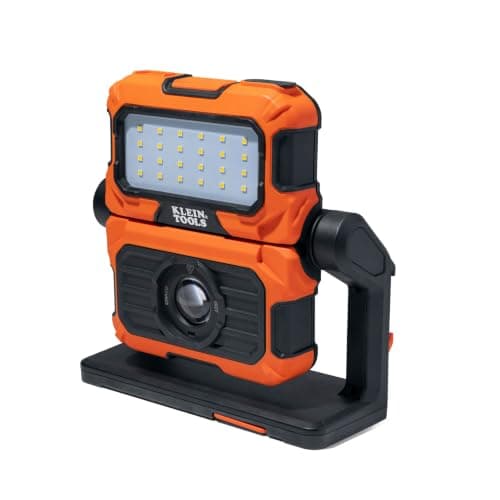 Klein Tools 56417 Rechargeable Work LightTop pick3,000 lumens with six modes and 360-degree rotation. The area-lighting version of the same idea. | Lighting a whole work area | 3,000 lm | |
| 2 | 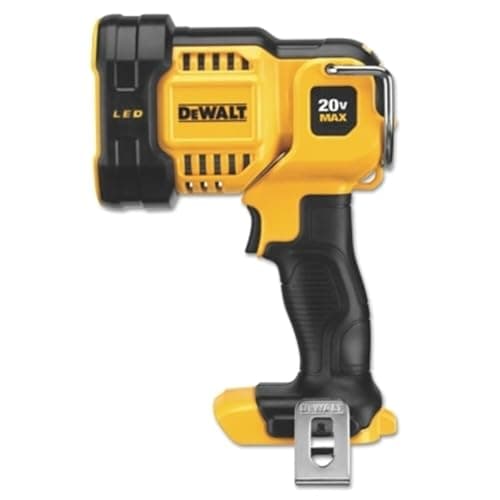 DeWalt DCL043 Jobsite Spotlight1,500 lumens and 464 m of stated reach, running off the same 20V MAX pack as everything else on the truck. | Sites already standardized on 20V MAX batteries | 1,500 lm high / 500 lm low | |
| 3 | 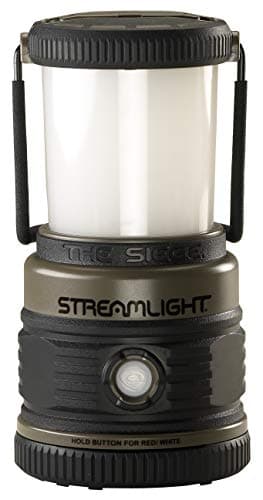 Streamlight Siege540 lumens of 360-degree area lighting, IPX7, on replaceable cells. A lantern beats a flashlight indoors and this is the one to own. | Area light in a power cut | 540 lm | |
| 4 | 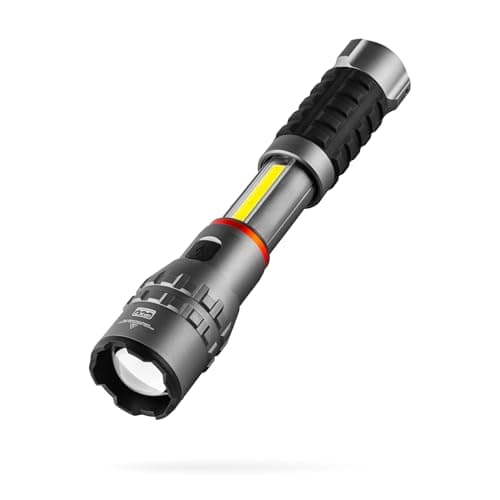 Nebo Slyde King 4KA 4,000-lumen spot and a 1,000-lumen COB work light in one sliding body, USB rechargeable. | The brightest two-in-one here | 4,000 lm spot / 1,000 lm COB work light | |
| 5 | 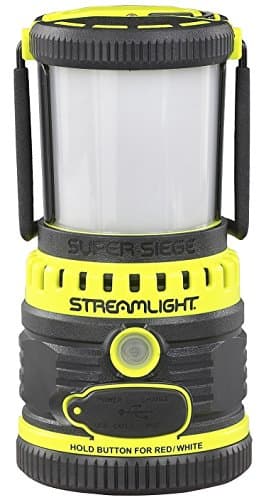 Streamlight Super Siege1,100 lumens of area light, USB rechargeable, and it will put charge back into a phone during an outage. | A lantern that also charges a phone | 1,100 lm | |
| 6 | 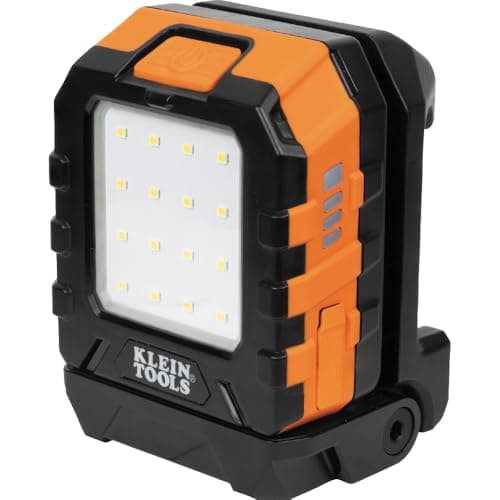 Klein Tools 56416 Rechargeable Work Light1,000 lumens, three modes, 360-degree rotation and a magnet. Built to be put down and aimed rather than held. | A magnetic work light with a kickstand | 1,000 lm | |
| 7 | 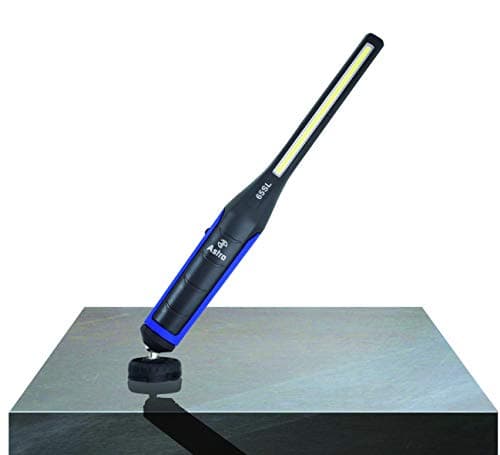 Astro Pneumatic 65SL Slim Light650 lumens in a body thin enough to slide between an engine and a fender, with a separate top-mounted spot. | Working in a gap too narrow for anything else | 650 lm |
We earn a commission if you buy through the links on this page, at no extra cost to you. It does not change what we recommend or the order they appear in. Full disclosure. Prices checked October 20, 2026.

A construction site is the hardest environment any light on this website has to survive, and the specification that describes surviving it is the one almost nobody publishes. Of every work light we cover, exactly one states an ingress rating. On a site where lights get rained on, buried in dust and knocked into a puddle, that is the disclosure gap that matters.
This page ranks on what the makers actually publish — output, power source and format — and names the missing weatherproofing rather than assuming it. If the work is inside a service body rather than on a site, work lights for a service truck covers a different set of constraints.
How we picked
- A published ingress rating, where one exists. Only one light qualifies, and it is ranked accordingly.
- Power that survives a site. Either a tool-platform battery you already stock, or replaceable cells that work when nothing on site is charged. Early in a build there is often no mains at all.
- Area coverage over peak output. A site needs a lit work zone, not a bright spot, with the exception of the one job that genuinely needs distance.
- It gets knocked over. Kickstands, magnets, hooks and rotation, because a light that only works standing upright does not work.
- Currently purchasable, checked against the live retail listing before writing.
We have not used any of these lights on a site or anywhere else. Every figure is the maker's own, linked with the date we read it — see our methodology for what we do instead of testing and why we would rather print a gap than an estimate.
What each one publishes
| Light | Published output | Ingress rating | Power source |
|---|---|---|---|
| Nebo Slyde King 4K | 4,000 lm spot / 1,000 lm COB | not published | USB rechargeable |
| Klein Tools 56417 | 3,000 lm | IP65 | Li-ion, USB-C |
| DeWalt DCL043 | 1,500 lm | not published | DeWalt 20V MAX, sold separately |
| Streamlight Super Siege | 1,100 lm | IPX7 | Li-ion, USB |
| Klein Tools 56416 | 1,000 lm | IP66 | Li-ion, USB-C |
| Astro Pneumatic 65SL | 650 lm | not published | Rechargeable |
| Streamlight Siege | 540 lm | IPX7 | Replaceable cells |
The one light with a published ingress rating has the lowest output on the page. That is an awkward result and it is the honest one. IPX7 means immersion in a meter of water for thirty minutes — not splash resistance, actual immersion — and it is the only weatherproofing claim in this category that can be checked.
Power, and the two ways a site light dies
Site lights fail in two ways and neither has anything to do with brightness. The first is water and dust. The second is that nothing on site is charged, which is a real condition on any build before the temporary power goes in and on any weekend after everyone has gone home with the chargers.
- Tool-platform batteries — the DeWalt DCL043 draws from the same 20V MAX packs as the rest of the trade tools. If the site is standardized on that platform, the light is charged whenever the tools are, and there is no extra charger to lose. The pack is sold separately.
- Replaceable cells — the Streamlight Siege takes cells you can buy anywhere. It is the only light here that works with no charging infrastructure at all, which on a first-fix site is decisive.
- USB rechargeable — the Nebo, both Kleins, the Astro and the Super Siege. Convenient, and dependent on somebody remembering. The Super Siege will also put charge back into a phone, which on a site with no power is worth more than it sounds.
The one job on a site that needs distance
Almost everything on a construction site is area lighting, with one exception: checking something at the far end of a plot, up a structure, or across a compound at night. That is a beam-distance job and no amount of area lumens does it.
The picks, and who each one is wrong for
Klein Tools 56417 — the work zone
3,000 lumens, six modes and 360-degree rotation, built to be set down and aimed. This is the light that turns a dark floor plate into somewhere you can work. The rotation is what earns it the top spot: you place it once and turn the head as the work moves, rather than repositioning a light with cables and boots around it.
Skip it if the light will be immersed — Klein publishes IP65, which covers dust and water jets but not standing water; the Streamlight Siege publishes IPX7 and Klein's own 56416 publishes IP66 if weather is the deciding factor. Skip it if you need reach; this is a broad flood and will not identify anything at the far end of a plot.
DeWalt DCL043 — if the site runs 20V MAX
1,500 lumens and 464 m of published reach on the same packs as the site's drills and impacts. Two arguments in one: it is always charged if the tools are, and it is the only light here that genuinely throws. For a site manager checking a structure or a perimeter at night, nothing else on this page does that job.
Skip it if the site is not on the DeWalt platform — the battery is sold separately and buying in for one light is poor value. Skip it as your area light; a spotlight leaves a work zone's edges dark.
Streamlight Siege — the only one that publishes waterproofing
540 lumens of 360-degree area light, IPX7, on replaceable cells. The lowest output on this page and, for a site that gets weather, the most defensible purchase. IPX7 is immersion rather than splash resistance, and replaceable cells mean it works in week one before temporary power arrives and in week fifty when every charger has gone home. A lantern also beats a directional light indoors, where a single hard shadow is what makes people trip.
Skip it if 540 lumens is not enough to work by — it is a presence light and a safety light more than a task light. Skip it if you want rechargeable convenience.
Nebo Slyde King 4K — the most output and both beam types
A 4,000-lumen spot and a 1,000-lumen COB panel in one sliding body — the highest published output in this category and a reasonable way to carry both beam shapes in one object. For a subcontractor arriving with one bag, that combination is worth real money.
Skip it if it will be rained on, since no ingress rating is published. Skip the spot mode indoors, where 4,000 lumens off a plasterboard wall is glare rather than light. And note that Nebo publishes no beam distance, so we cannot tell you how far the spot actually reaches.
Streamlight Super Siege — the one that charges a phone
1,100 lumens of 360-degree area light, USB rechargeable, and a power bank for a phone. Double the Siege's output and a genuinely useful second function on a site with no power. It stands on its own and lights a full circle, which suits a room or a compound rather than one working face.
Skip it if you need a directional beam. On weatherproofing it is now one of the stronger picks here rather than a gap: Streamlight publishes IPX7, a 2 m impact rating and that it floats. This page claimed no ingress rating was published for it until 2026-10-13, which was wrong.
Klein Tools 56416 — the magnetic one
1,000 lumens, three modes, 360-degree rotation, a magnet and a kickstand. On a site full of steel — studs, strut, plant, scaffold, a site box lid — a magnet is the fastest way to get a light where you need it with both hands free. 1,000 lumens is the right amount for close work without glaring off freshly boarded walls.
Skip it as a whole-area light, and skip it if the magnet has nothing ferrous to hold. No ingress rating or runtime published.
Astro Pneumatic 65SL — for the gaps
650 lumens in a body thin enough to slide into a space nothing else fits, with a separate top-mounted spot. On a site that means behind studs, into a riser, under formwork or along a crawl space. It is a specialist and the lowest-output rechargeable here, which is the correct trade for the job it does.
Skip it as a general site light — it lights a narrow space well and a room badly. No ingress rating, runtime or beam distance published.
How to buy on this page
- It will be rained on — Streamlight Siege, the only published IPX7 here, and accept 540 lumens.
- There is no power on site yet — Streamlight Siege on replaceable cells, or the DeWalt if the trade packs are already circulating.
- You need to light a work zone — Klein 56417 at 3,000 lm, with the Super Siege for shadowless fill indoors.
- You need to see the far end of the plot — DeWalt DCL043, the only published beam distance in the category at 464 m.
- You want one light for everything — Nebo Slyde King 4K, spot and COB in one body.
- You need a light on a tripod over a whole floor — see work light stands and tripods.
What we would not tell you
Four of these seven publish an ingress rating: the Klein 56417 at IP65, the Klein 56416 at IP66 — dust-tight and waterproof, the strongest rating on this page — and the Streamlight Siege and Super Siege at IPX7, the Super Siege also floating and carrying a 2 m impact rating. This page said none of their makers published one until 2026-10-11, which was wrong. For the rest we still will not claim weatherproofing: a rugged-looking jobsite light with no published rating is a genuine unknown rather than a safe assumption. Re-checked on 2026-10-13 against the makers' own pages; the Nebo and Astro picks here are still being re-verified.
We would also not tell you how long any of them run. Not one manufacturer on this page publishes a runtime figure, including for the 4,000-lumen mode on the Nebo, which will draw hard. In a category sold on toughness, the two specifications that describe toughness and endurance are the two nobody prints.
The picks, in full
Top pick · Lighting a whole work area
Klein Tools 56417 Rechargeable Work Light
3,000 lumens with six modes and 360-degree rotation. The area-lighting version of the same idea.
3,000 lumens from a portable light is enough to work by without a second source, which is the threshold that matters on a jobsite.
The six modes are not brightness steps on one emitter. There are two beams - a spot and a flood - that run alone or together, and Klein publishes an output and a runtime for each of the six combinations.
Runtime is the figure that decides whether a 3,000-lumen portable is a tool or a toy, and Klein publishes all six of them: 3 hours with both beams at 3,000 lumens, out to 12 hours on the 250-lumen flood. That is the most complete runtime disclosure of any work light on this site.
What works
- 3,000 lumens is genuine area lighting
- Magnetic mount and full rotation
- Six modes cover most jobsite needs
What does not
- No candela or beam distance, so the spot beam cannot be checked against anything
- 998 g and the largest body here - a set-down light, not a carry light
- No published CRI, on a light sold into color-coded trades
Skip this ifyou mostly work in panels and engine bays. At close range 3,000 lumens is glare, not visibility.
Published specification
- Output
- 3,000 lmBoth beams together. Spot and flood also run independently.Klein Tools 56417 — manufacturer spec page (retrieved October 11, 2026)
- Peak intensity
- not published
- Beam distance
- not published(Klein publishes neither beam figure)
- Runtime
- 3 h at 3,000 lmSix published pairs: spot 1,400 lm/5 h and 475 lm/9.5 h; flood 1,400 lm/8 h, 700 lm/10 h and 250 lm/12 h.Klein Tools 56417 — manufacturer spec page (retrieved October 11, 2026)
- Battery
- Li-ion, 12 h rated lifeUSB-C charge in, USB-A out to charge other kit. Capacity not published.Klein Tools 56417 — manufacturer spec page (retrieved October 11, 2026)
- Weight
- 998 g2.2 lb.Klein Tools 56417 — manufacturer spec page (retrieved October 11, 2026)
- Ingress
- IP65Dust-tight, water resistant. 3 m drop rating.Klein Tools 56417 — manufacturer spec page (retrieved October 11, 2026)
#ad · how this is funded · price as of October 20, 2026
Pick 2 · Sites already standardized on 20V MAX batteries
DeWalt DCL043 Jobsite Spotlight
1,500 lumens and 464 m of stated reach, running off the same 20V MAX pack as everything else on the truck.
464 m from 1,500 lumens implies about 53,800 candela. That is a proper spotlight, not a work light with a reflector.
The battery platform is the real argument. If your van already carries six 20V MAX packs, a light that shares them has no charging routine at all.
Runtime genuinely cannot be published here, because it depends entirely on which pack you fit. That is one of the few unpublished figures on this site with a legitimate reason.
What works
- Shares the 20V MAX platform, so the battery problem is already solved
- 464 m of published reach
- Pivoting head for aiming from a set-down position
What does not
- Battery not included, and the packs are not cheap on their own
- No sourced weight or IP rating
- Useless if your site runs a different battery platform
Skip this ifyou are not already on DeWalt 20V MAX. Buying into a battery platform for one light is the wrong way round.
Published specification
- Output
- 1,500 lm high / 500 lm lowDeWalt publishes both brightness settingsDeWalt DCL043 20V MAX Jobsite LED Spotlight — manufacturer spec page (retrieved September 13, 2026)
- Peak intensity
- not published
- Beam distance
- 464 mDeWalt states 508 yards / 1,525 feet; converted to metersDeWalt DCL043 20V MAX Jobsite LED Spotlight — manufacturer spec page (retrieved September 13, 2026)
- Runtime
- not published(Depends on which 20V MAX pack is fitted)
- Battery
- DeWalt 20V MAX (sold separately)DeWalt DCL043 — the brand's own listing on Amazon.com (retrieved September 1, 2026)
- Weight
- not published
- Ingress
- not published
#ad · how this is funded · price as of October 20, 2026
Pick 3 · Area light in a power cut
Streamlight Siege
540 lumens of 360-degree area lighting, IPX7, on replaceable cells. A lantern beats a flashlight indoors and this is the one to own.
A flashlight in a dark kitchen produces one bright circle and a room full of hard shadow. A 360-degree lantern at a quarter of the output makes the room usable. That is the whole argument for owning one.
Three D cells is the reason to buy this one rather than its rechargeable sibling. Multiply Streamlight's own figures and the Siege delivers 16,200 lumen-hours on high against the Super Siege's 6,325 - roughly two and a half times the total light, at nearly the same weight.
295 hours at 55 lumens is twelve days of usable room light from cells you can buy in any supermarket, which is a different proposition from a sealed pack that needs a socket.
IPX7 on an outage light matters because outages and weather arrive together, and Streamlight states that this one floats.
What works
- Five published output-and-runtime pairs, including 295 h at 55 lm
- 360-degree area lighting, which is the right beam shape indoors
- IPX7, a 2 m impact rating, and it floats
- Three D cells and a keyed battery door you can open in the dark
What does not
- 878.83 g with cells in: a lantern you place rather than carry
- 540 lumens is modest if you want to light a whole floor
- D cells are not sold with it, and alkalines leak if left in for years
Skip this ifyou need to walk outside with it. A lantern spreads light everywhere, which is exactly wrong on a dark path.
Published specification
- Output
- 540 lmWhite high, cover removed. Medium 275 lm, low 55 lm, plus a 10 lm red LED.Streamlight Siege — manufacturer spec page (retrieved October 17, 2026)
- Peak intensity
- not published
- Beam distance
- not published(Not applicable to a 360-degree lantern)
- Runtime
- 30 h at 540 lm / 70 h at 275 lm / 295 h at 55 lmStreamlight also publishes the red LED at 10 lm for 235 h steady and 430 h on SOS. Five output-and-runtime pairs in all.Streamlight Siege — manufacturer spec page (retrieved October 17, 2026)
- Battery
- 3 x D alkaline (sold separately)Keyed battery door, so cells can be changed in the dark, and a four-state battery level indicator.Streamlight Siege — manufacturer spec page (retrieved October 17, 2026)
- Weight
- 878.83 g with batteries1 lb 15 oz. 18.42 cm tall.Streamlight Siege — manufacturer spec page (retrieved October 17, 2026)
- Ingress
- IPX7Waterproof to 1 m submersion, 2 m impact resistance tested, and it floats.Streamlight Siege — manufacturer spec page (retrieved October 17, 2026)
$85.81 · 47% off
#ad · how this is funded · price as of October 20, 2026
Pick 4 · The brightest two-in-one here
Nebo Slyde King 4K
A 4,000-lumen spot and a 1,000-lumen COB work light in one sliding body, USB rechargeable.
A thousand COB lumens is genuine small-area lighting rather than task lighting, which is what separates this from the 2K version.
At 4,000 lumens on the spot side the draw is likely around 40 watts, and without a published capacity there is no way to know whether that is twenty minutes or two hours. That gap is what keeps it off the top of our list.
Magnetic base and a hands-free stance, as every work light should have.
What works
- The highest published output of any light on the work pages
- A 1,000-lumen COB strip is genuine area light
- Magnetic base and 4x zoom on the spot side
What does not
- No sourced runtime, capacity, weight or IP rating
- Two light engines in one body means a shorter run on either
- Zoom optics lose output relative to a fixed reflector
Skip this ifyou need to know how long it runs. At this output the runtime is the specification, and it is not published.
Published specification
- Output
- 4,000 lm spot / 1,000 lm COB work lightNebo Slyde King 4K — the brand's own listing on Amazon.com (retrieved September 1, 2026)
- Peak intensity
- not published
- Beam distance
- not published
- Runtime
- not published
- Battery
- USB rechargeableNebo Slyde King 4K — the brand's own listing on Amazon.com (retrieved September 1, 2026)
- Weight
- not published
- Ingress
- not published
#ad · how this is funded · price as of October 20, 2026
Pick 5 · A lantern that also charges a phone
Streamlight Super Siege
1,100 lumens of area light, USB rechargeable, and it will put charge back into a phone during an outage.
1,100 lumens is enough to light a whole room to a level where you can read and cook, which is the difference between coping with an outage and enduring one.
The USB output is the second reason to own it. In a multi-day outage, the phone is the thing that matters.
Rechargeable rather than replaceable cells is a real trade-off for emergency kit: better in a planned outage, worse if it has been in a cupboard for eighteen months. The red LED is the hedge: 1 lumen for a published 348 hours means a flat-ish pack still gives you two weeks of find-the-stairs light.
What works
- Six published output-and-runtime pairs, including 348 h on the 1 lm red
- IPX7 to a meter, a 2 m impact rating, and it floats
- Charges a phone over USB - Streamlight states 4+ phone charges
What does not
- No sourced runtime, weight or IP rating
- Rechargeable cell self-discharges in storage
- Bulkier and heavier than the standard Siege
Skip this ifit will sit untouched for years. For pure standby, replaceable cells beat a rechargeable pack every time.
Published specification
- Output
- 1,100 lmWhite high. Medium 550 lm, low 125 lm, plus a three-mode red LED.Streamlight Super Siege — manufacturer spec page (retrieved October 13, 2026)
- Peak intensity
- not published
- Beam distance
- not published(Not applicable to a 360-degree lantern)
- Runtime
- 5 h 45 min at 1,100 lmSix published pairs: white 550 lm/11.5 h and 125 lm/36.25 h; red 2.7 lm/140 h, 1 lm/348 h and SOS 2.7 lm/320 h.Streamlight Super Siege — manufacturer spec page (retrieved October 13, 2026)
- Battery
- Li-ion, USB rechargeableAlso a USB power bank: Streamlight states 4+ phone charges. Capacity not published.Streamlight Super Siege — manufacturer spec page (retrieved October 13, 2026)
- Weight
- 868 g1 lb 14.0 oz. 19.05 cm tall.Streamlight Super Siege — manufacturer spec page (retrieved October 13, 2026)
- Ingress
- IPX7Submersible to 1 m, 2 m impact rating, and it floats.Streamlight Super Siege — manufacturer spec page (retrieved October 13, 2026)
#ad · how this is funded · price as of October 20, 2026
Pick 6 · A magnetic work light with a kickstand
Klein Tools 56416 Rechargeable Work Light
1,000 lumens, three modes, 360-degree rotation and a magnet. Built to be put down and aimed rather than held.
The magnet and the kickstand are the product. A work light you have to hold is a work light that is not working.
360-degree rotation means you set the body once and aim the head, which is the difference between a good work light and a torch on its side.
1,000 lumens is the sweet spot for a bay: enough to see, not so much that it glares back off metal.
What works
- Magnet plus kickstand plus rotation, so it goes anywhere
- 1,000 lumens is well matched to close work
- Trade distribution
What does not
- No candela or beam distance published
- No published CRI, on a light that would benefit from one
- Built-in cell
Skip this ifyou need to light a whole room. It is a task light, and a 3,000-lumen area light is a different tool.
Published specification
- Output
- 1,000 lmHigh. Medium is 425 lm, low 300 lm.Klein Tools 56416 — manufacturer spec page (retrieved October 11, 2026)
- Peak intensity
- not published
- Beam distance
- not published(Klein publishes neither beam figure)
- Runtime
- 9 h at 1,000 lmAlso 425 lm/14 h and 300 lm/21 h.Klein Tools 56416 — manufacturer spec page (retrieved October 11, 2026)
- Battery
- Li-ion, USB-CKlein Tools 56416 — manufacturer spec page (retrieved October 11, 2026)
- Weight
- 549 g19.36 oz.Klein Tools 56416 — manufacturer spec page (retrieved October 11, 2026)
- Ingress
- IP66Dust-tight and waterproof. 3 m drop rating.Klein Tools 56416 — manufacturer spec page (retrieved October 11, 2026)
$64.98 · 8% off
#ad · how this is funded · price as of October 20, 2026
Pick 7 · Working in a gap too narrow for anything else
Astro Pneumatic 65SL Slim Light
650 lumens in a body thin enough to slide between an engine and a fender, with a separate top-mounted spot.
The slim format is the entire specification. Thickness decides whether a light fits where the work is, and no lumen figure compensates for a body that does not.
A top-mounted spot alongside the main flood turns one tool into two: wide light for the area, narrow light for the fastener.
Astro sells to mechanics through tool trucks, which is why this shape exists and why hiking brands do not make it.
What works
- Thin enough for genuinely tight access
- Separate flood and spot from one body
- Designed for the trade rather than adapted from an outdoor light
What does not
- No sourced runtime, weight or IP rating
- No published CRI
- 650 lumens is modest for the size
Skip this ifaccess is not your problem. A magnetic work light gives more light for the money if it fits.
Published specification
- Output
- 650 lmAstro Pneumatic 65SL — the brand's own listing on Amazon.com (retrieved September 1, 2026)
- Peak intensity
- not published
- Beam distance
- not published
- Runtime
- not published
- Battery
- RechargeableAstro Pneumatic 65SL — the brand's own listing on Amazon.com (retrieved September 1, 2026)
- Weight
- not published
- Ingress
- not published
#ad · how this is funded · price as of October 20, 2026
Questions people actually ask
What is the best work light for a construction site?
For a lit work zone, the Klein Tools 56417 at 3,000 lumens with 360-degree rotation. For weather exposure, the Streamlight Siege is the only work light we cover that publishes an ingress rating, at IPX7, and it runs on replaceable cells. If the site is standardized on DeWalt 20V MAX, the DCL043 shares those packs and is the only light here that publishes a beam distance.
Are construction work lights waterproof?
Only one of the seven on this page publishes an ingress rating — the Streamlight Siege at IPX7, which means immersion in a meter of water for thirty minutes. The other six publish nothing, so we do not claim they are weatherproof. That is a disclosure gap rather than evidence they leak, but on a site it is a gap worth taking seriously.
How many lumens do I need for a construction site light?
Around 3,000 lumens covers a working area well. Above that you are mostly adding glare, particularly indoors off fresh plasterboard. What matters more is beam shape and placement — a 360-degree light in the middle of a room beats a brighter directional light from one corner, because it removes the hard shadows people trip over.
Should site lights use tool batteries?
If the site is standardized on one platform, yes. The DeWalt DCL043 draws from the same 20V MAX packs as the trade tools, so it is charged whenever they are and there is no extra charger to lose. The trade-off is that the battery is sold separately, so it only makes sense if those packs are already circulating.
What light works before temporary power is installed?
One that runs on replaceable cells. The Streamlight Siege is the only light on this page that does, which makes it the practical answer for first-fix work and for weekends when every charger has gone home. Rechargeable lights are convenient exactly as long as somebody is charging them.
How long do construction work lights run?
None of the seven makers here publishes a runtime, so we cannot tell you and will not estimate. It is the largest evidence gap in this category alongside the missing ingress ratings. Where runtime is published elsewhere on this site, it is usually a single maximum describing the lowest mode rather than a per-mode table.
Do I need a spotlight or an area light on site?
An area light for almost everything, and a spot for one job: checking something at the far end of a plot or up a structure. The DeWalt DCL043 publishes 464 m, which works back to 53,824 candela at 36 candela per lumen. No area light will do that regardless of its lumen figure.
Sources
Every figure on this page came from one of the documents below, read on the date shown. We do not cite other review sites, forum posts or video reviews as sources of fact.
- Klein Tools 56417 Rechargeable Work Light — the brand's own listing on Amazon.com (retrieved September 1, 2026)
- DeWalt DCL043 Jobsite Spotlight — the brand's own listing on Amazon.com (retrieved September 1, 2026)
- Streamlight Siege — the brand's own listing on Amazon.com (retrieved September 1, 2026)
- Nebo Slyde King 4K — the brand's own listing on Amazon.com (retrieved September 1, 2026)
- Streamlight Super Siege — the brand's own listing on Amazon.com (retrieved September 1, 2026)
- Klein Tools 56416 Rechargeable Work Light — the brand's own listing on Amazon.com (retrieved September 1, 2026)
- Astro Pneumatic 65SL Slim Light — the brand's own listing on Amazon.com (retrieved September 1, 2026)
- ANSI/PLATO FL 1 flashlight performance standard — definitions of lumens, peak beam intensity, beam distance, runtime, impact and water resistance
- IEC 60529 — the IP (ingress protection) rating system
Read next

Klein Tools 56417 review
A specification-first review of the Klein Tools 56417: six published mode-and-runtime pairs, IP65, a 3 m drop rating, and the one piece of arithmetic that tells you which mode to actually use.
DeWalt DCL043 review
A specification-first review of the DeWalt DCL043 jobsite spotlight: what 508 yards works out to, what the platform battery actually costs, and the figures DeWalt does not publish.
Best work lights, ranked on beam shape rather than brightness
The work-light ranking: beam shape, color rendering, mounting and runtime, with every published figure sourced.
Best work lights for a service truck
Work lights for mobile service work, ranked on power source, beam coverage and mounting — with every published figure sourced.
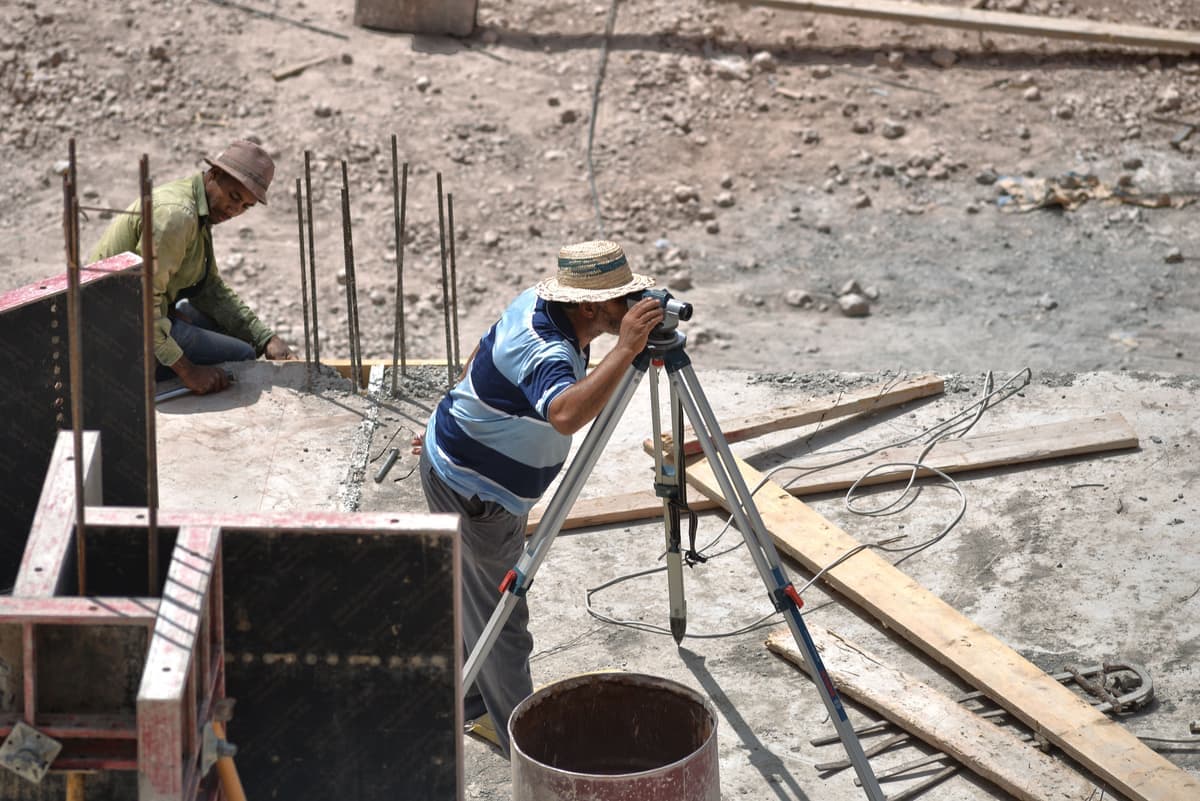
Best work lights with stands and tripods
Stand-mounted and area work lights, with the illuminance math for sizing output to a space.
Best rechargeable work lights
Rechargeable work lights compared on charging strategy, battery platform and published runtime.
Best work lights for painting
Lighting for painting, ranked on published color rendering and on the beam placement that actually reveals a missed spot.
Lumens vs candela
The distinction that decides reach, with the conversion formula and a table of real published figures.
Found a number that is wrong? Tell us and we will fix it and say so. Our methodology shows every formula on this page.