Headlamps
Best headlamps for work
A work headlamp is judged on whether it lasts the shift and whether you can tell a brown wire from a red one. Neither is a lumen figure.
By Scooter M. · Published · Updated
| # | Product | Best for | Output / weight | Price |
|---|---|---|---|---|
| 1 | 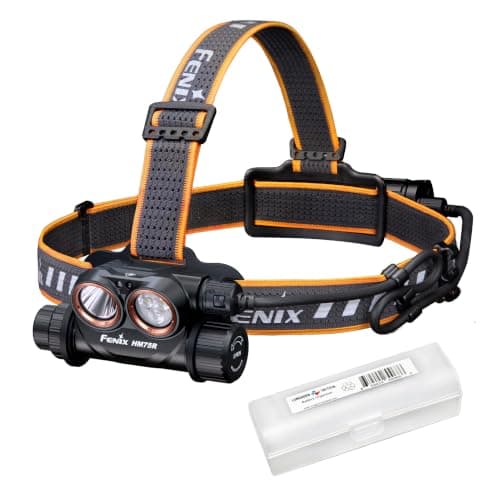 Fenix HM75RTop pickTwo cells in a rear case feeding a 1,600-lumen head. Heavy at 321 g, and the only lamp here that will genuinely run a full night shift on high-ish output. | All-shift work lighting | 1,600 lm / 321 g (11.32 oz) complete; 170 g without the rear power bank | |
| 2 | 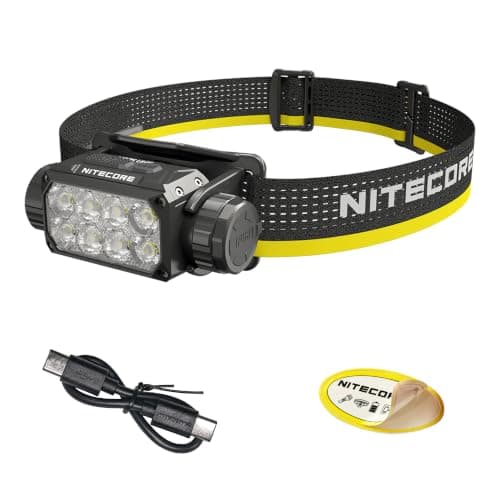 Nitecore HC75 UHE3,000 lumens with a zoomable head, white and red beams, and 192 m of stated reach. The brightest headlamp on the site. | Industrial work where you need to change the beam | 3,000 lm | |
| 3 | 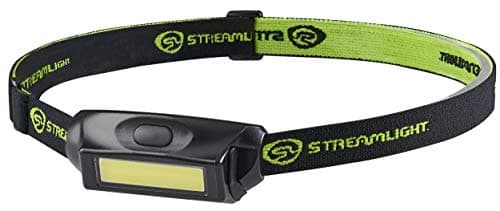 Streamlight Bandit Pro180 lumens of deliberately diffused light at 45 grams, running 4.5 hours on high. Modest numbers, and the right ones for the job. | Close work where you want a diffused beam, not a spotlight | 180 lm / 45.4 g (1.6 oz) | |
| 4 | 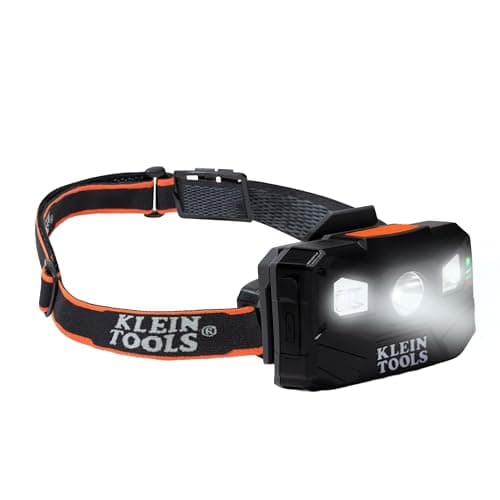 Klein Tools 56048 Rechargeable Headlamp400 lumens on a fabric strap built for a hard-hat brim, from a brand that sells to electricians rather than to hikers. | Trades work with a hard hat | 400 lm | |
| 5 | 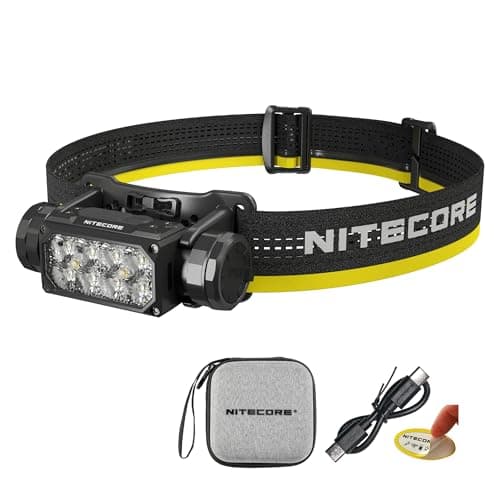 Nitecore HC65 UHE2,000 lumens in a heavy-duty metal body with white, red and reading lights. Built like a work light, worn like a headlamp. | A metal-bodied headlamp that takes abuse | 2,000 lm |
We earn a commission if you buy through the links on this page, at no extra cost to you. It does not change what we recommend or the order they appear in. Full disclosure. Prices checked October 16, 2026.
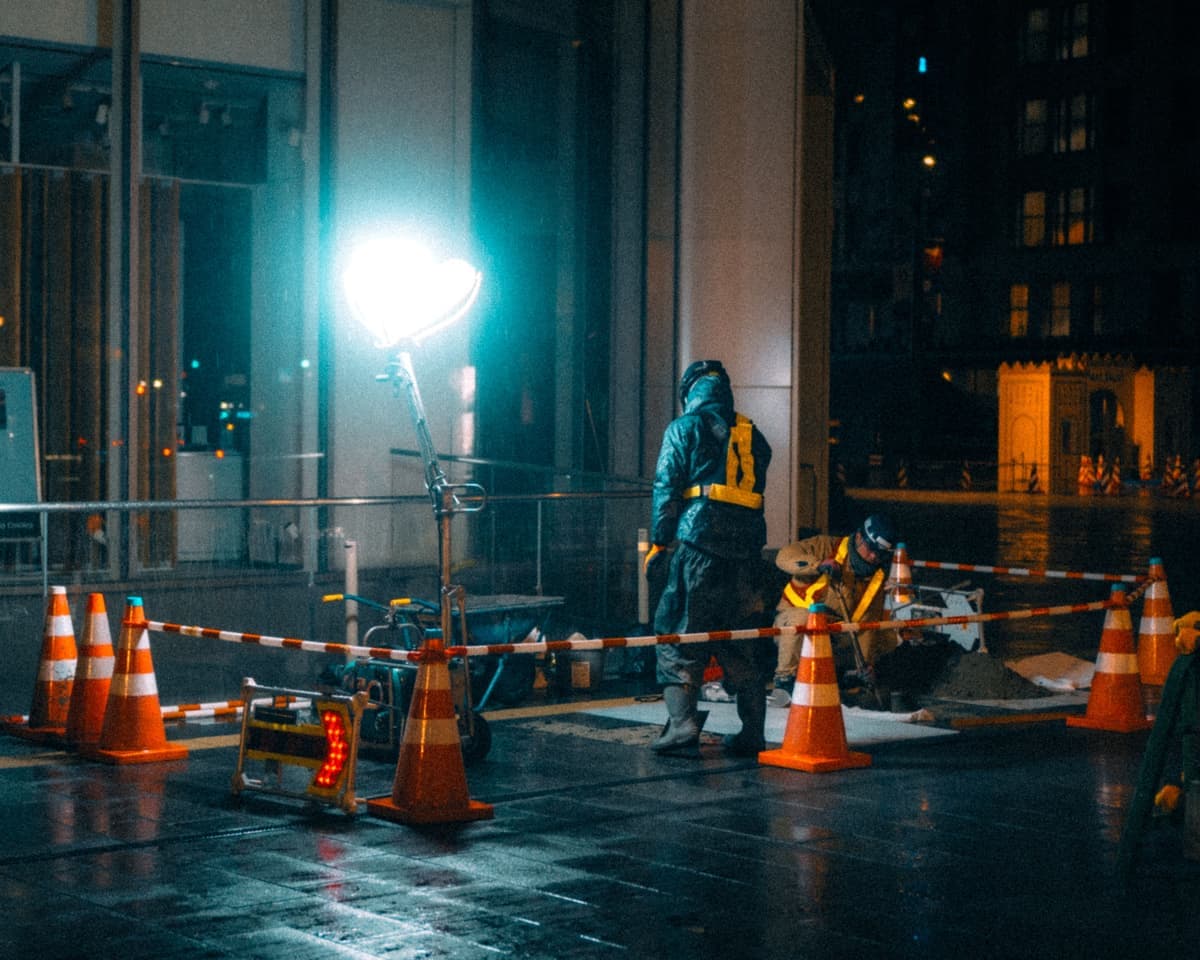
Three things separate a work headlamp from an outdoor one, and none of them is brightness. It has to last a shift rather than an outing. It has to mount on a hard hat rather than on a bare head. And for a lot of trades it has to render color honestly, because getting a wire color wrong is not a cosmetic error.
How we picked
Stored energy first, then mounting, then whether the maker says anything credible about color rendering. Everything is sourced to the manufacturer where we could reach one, and to the brand's own listing where we could not — the entries say which. See our methodology.
Shift-length runtime, computed
| Lamp | Watt-hours | Hours at 2 W | Covers an 8 h shift? |
|---|---|---|---|
| Fenix HM75R | 30.2 | 15.1 | Yes, with margin |
| Fenix HM65R-T V2.0 | 12.2 | 6.1 | No — needs a spare 18650 |
| Streamlight Bandit Pro | not published | 4.5 h at 180 lm (published) | No, but the output is lower |
| Nitecore HC75 UHE | not published | not computable | Unknown — no published capacity |
| Klein Tools 56048 | not published | not computable | Unknown — 'all-day runtime' is not a figure |
That table is doing something deliberate. Three of these five makers do not publish a battery capacity, which means their shift runtime cannot be computed by anybody, including them, in a way a buyer can check. We would rather show the gap than fill it in.
Color rendering is the trades specification nobody markets
Under a cheap cool-white LED with a color rendering index around 70, a brown wire and a red wire look very similar, and so do a rusted fastener and a painted one. High-CRI emitters — 90 and above — fix this, and they cost roughly 10 to 20 percent of the light output to do it.
Almost no headlamp maker publishes a CRI figure. This is a genuine gap in the category, and it is why we recommend pairing a work headlamp with a high-CRI handheld for color-critical tasks — our CRI guide for trades covers what to look for and what CRI actually measures covers the number itself.
Hard hats change the mounting problem
An elastic band designed for a bare head does not stay put on a hard hat shell. Lamps built for the trades use either a wider flat strap that grips a shell, a set of clips that hook the brim, or a rubber strap. The Klein 56048 and the hard-hat version of the Streamlight Bandit Pro are the two here designed around it.
Beam shape for close work
Panel work, engine bays and crawl spaces all want a wide, even flood at arm's length. A tight hotspot at 40 centimeters creates a bright circle surrounded by darkness and a glare bounce straight back at you off any painted or polished surface. The Streamlight Bandit Pro's deliberately diffused 180 lumens is a better close-work light than a 1,000-lumen spot, and that is not a compromise — it is the correct specification.
What we would not buy for work
A high-output lamp with no published runtime. On site that is the number your day depends on, and a maker who omits it is telling you something. We would also avoid buying purely on output for close work: above about 400 lumens at arm's length you are adding glare, not visibility.
If you need to light a whole bay rather than the thing in front of you, a headlamp is the wrong tool. See work lights for the alternatives.
The picks, in full
Top pick · All-shift work lighting
Fenix HM75R
Two cells in a rear case feeding a 1,600-lumen head. Heavy at 321 g, and the only lamp here that will genuinely run a full night shift on high-ish output.
3,400 mAh at 3.6 V plus 5,000 mAh at 3.6 V is 30.2 watt-hours. That is 2.5 times a Petzl NAO RL and roughly ten times a Swift LT, which is the single reason to accept 321 grams.
It also discharges over USB-C, so on a jobsite it is a headlamp and a phone charger. That is a genuine second function rather than a spec-sheet bullet.
The 170 g figure without the rear case matters: you can leave the power bank behind on a short job and carry a normal-weight lamp.
What works
- 30.2 Wh of stored energy, by far the most on the site
- Rear case detaches, so the lamp has a light configuration and a long configuration
- USB-C output charges a phone from the same cells
What does not
- 321 g complete is heavy enough to notice within an hour
- No IP code, only a statement that the lamp is completely waterproof
- The two-cell arrangement means two things to keep charged
Skip this ifyou are not working a full shift. For recreation it is 200 g of battery you will never flatten.
Published specification
- Peak intensity
- not published
- Beam distance
- 223 mFenix states 732 feet (223 m)Fenix HM75R — manufacturer spec page (retrieved September 21, 2026)
- Runtime
- 234 h floodlight / 365 h redMaximum, lowest modes. Fenix does not break runtime out per spotlight or floodlight level. Red tops out at 130 lm.Fenix HM75R — manufacturer spec page (retrieved September 1, 2026)
- Battery
- One 18650 (3,400 mAh) plus one 21700 (5,000 mAh) in a rear battery caseFenix HM75R — manufacturer spec page (retrieved September 1, 2026)
- Weight
- 321 g (11.32 oz) complete; 170 g without the rear power bankFenix HM75R — manufacturer spec page (retrieved September 1, 2026)
- Ingress
- Impact-resistant to 2 mFenix states the lamp is completely waterproof but gives no IP code, so it cannot be placed on the IEC 60529 scale.Fenix HM75R — manufacturer spec page (retrieved September 21, 2026)
#ad · how this is funded · price as of October 16, 2026
Pick 2 · Industrial work where you need to change the beam
Nitecore HC75 UHE
3,000 lumens with a zoomable head, white and red beams, and 192 m of stated reach. The brightest headlamp on the site.
A zoomable head is unusual on a headlamp and it is the point of this one: you can flood a panel at arm's length, then throw the same 3,000 lumens 190 m down a yard.
3,000 lumens is not a setting you run in. It is a burst for identifying something, and any lamp this bright will step down within minutes to protect the emitter and your forehead.
192 m from 3,000 lumens implies a fairly wide hotspot. A dedicated thrower at a third of the output would reach further — which is exactly the lumens-versus-candela confusion this site exists to unpick.
What works
- Zoom lets one lamp do close work and distance
- The highest published output of any headlamp here
- White and red in a work-rated body
What does not
- No sourced runtime, which on a 3,000-lumen lamp is the number you most need
- Zoom optics lose light compared with a fixed reflector
- Heavy enough that a hard hat mount is the sensible way to wear it
Skip this ifyou want reach specifically. 192 m from 3,000 lumens is a flood-biased beam; a thrower gets you further on a quarter of the output.
Published specification
- Output
- 3,000 lmNitecore HC75 UHE — the brand's own listing on Amazon.com (retrieved September 1, 2026)
- Peak intensity
- not published
- Beam distance
- 192 mNitecore HC75 UHE (192 m beam, 3,000 lm) — the brand's own listing on Amazon.com (retrieved September 1, 2026)
- Runtime
- not published
- Battery
- USB-C rechargeableNitecore HC75 UHE — the brand's own listing on Amazon.com (retrieved September 1, 2026)
- Weight
- not published
- Ingress
- not published
#ad · how this is funded · price as of October 16, 2026
Pick 3 · Close work where you want a diffused beam, not a spotlight
Streamlight Bandit Pro
180 lumens of deliberately diffused light at 45 grams, running 4.5 hours on high. Modest numbers, and the right ones for the job.
4.5 hours on high and 21 hours on low are published per-mode figures, not a reserve-visibility claim. That is rarer than it should be and it is why this lamp scores well despite the smallest headline here.
180 diffused lumens at arm's length is more comfortable than 1,000 focused ones. Under a dashboard or inside an electrical panel, glare is the enemy and this is built to avoid it.
45 g puts it within 2 g of a Petzl Swift LT while costing a fraction as much.
What works
- Honest per-mode runtimes published by the maker
- 45 g, and a hard-hat strap option
- Diffused beam that does not blind you off close work
What does not
- 180 lumens will not light a trail
- No beam distance published, because there is not much to publish
- IPX4
Skip this ifyou need to see past about ten meters. It is a task light worn on the head, not a trail lamp.
Published specification
- Output
- 180 lmHigh. Low is 35 lm.Streamlight Bandit Pro — manufacturer spec page (retrieved September 1, 2026)
- Peak intensity
- not published
- Beam distance
- not published(Streamlight does not publish one for this diffused lamp)
- Runtime
- 4.5 h on high, 21 h on lowStreamlight Bandit Pro — manufacturer spec page (retrieved September 1, 2026)
- Battery
- USB rechargeable, charges in the light in 3.5 hStreamlight Bandit Pro — manufacturer spec page (retrieved September 1, 2026)
- Weight
- 45.4 g (1.6 oz)Streamlight Bandit Pro — manufacturer spec page (retrieved September 1, 2026)
- Ingress
- IPX42 m impact resistance testedStreamlight Bandit Pro — manufacturer spec page (retrieved September 1, 2026)
#ad · how this is funded · price as of October 16, 2026
Pick 4 · Trades work with a hard hat
Klein Tools 56048 Rechargeable Headlamp
400 lumens on a fabric strap built for a hard-hat brim, from a brand that sells to electricians rather than to hikers.
The strap is the product. Klein designs around a hard hat, which means the lamp sits where a brim allows rather than where an elastic band wants to put it.
400 lumens is the right number for panel work. More output at close range is glare, and glare on a live panel is a hazard rather than a feature.
All-day runtime is a marketing phrase, not a specification, and we will not convert it into a number.
What works
- Designed for a hard hat rather than adapted to one
- 400 lumens is well matched to close electrical work
- Sold through trade channels, so replacement is easy
What does not
- No published runtime figure, only the phrase all-day
- No sourced beam distance, weight or IP rating
- Nothing here for outdoor use
Skip this ifyou want it outdoors. It is a jobsite lamp and its beam, strap and rating all say so.
Published specification
- Peak intensity
- not published
- Beam distance
- not published
- Runtime
- not published(Listing states 'all-day runtime' without a figure)
- Battery
- RechargeableKlein Tools 56048 — the brand's own listing on Amazon.com (retrieved September 1, 2026)
- Weight
- not published
- Ingress
- not published
#ad · how this is funded · price as of October 16, 2026
Pick 5 · A metal-bodied headlamp that takes abuse
Nitecore HC65 UHE
2,000 lumens in a heavy-duty metal body with white, red and reading lights. Built like a work light, worn like a headlamp.
A metal body is the reason to buy this rather than the NU43. Plastic headlamps survive drops; metal ones survive being stepped on in a truck bed.
Three emitters — white, red and a dedicated reading light — is more useful than it sounds. The reading light is a low, wide, close-range flood, which is the mode people actually leave on.
As with the rest of the Nitecore range, we could only reach the brand's retail listing, so the spec table stops at the two figures it states.
What works
- Metal construction in a category dominated by polymer
- White, red and reading emitters
- 2,000-lumen headline for a mid-range price
What does not
- Heavier than any polymer lamp here, though we cannot give you the number
- No sourced runtime or beam distance
- Metal conducts heat, so turbo will get warm against your forehead
Skip this ifyou want it for running. The mass that makes it durable is the mass that makes it bounce.
Published specification
- Output
- 2,000 lmMaximumNitecore HC65 UHE — the brand's own listing on Amazon.com (retrieved September 1, 2026)
- Peak intensity
- not published
- Beam distance
- not published
- Runtime
- not published
- Battery
- USB-C rechargeableNitecore HC65 UHE — the brand's own listing on Amazon.com (retrieved September 1, 2026)
- Weight
- not published(Metal body; no figure in the listing we read)
- Ingress
- not published
#ad · how this is funded · price as of October 16, 2026
Questions people actually ask
How many lumens do I need for a work headlamp?
200 to 400 lumens for close work like panels, engine bays and plumbing. More than that at arm's length produces glare off metal and painted surfaces rather than better visibility. Save the high modes for finding something across a yard.
Will a headlamp last a full shift?
Only if it carries roughly 16 watt-hours or more at a working output of 250 to 300 lumens. On this page only the Fenix HM75R does, at 30.2 Wh. Everything else needs a lower setting or a spare cell.
Do I need a high-CRI headlamp for electrical work?
It helps significantly, because wire insulation colors are exactly what a low-CRI cool-white emitter renders worst. Very few headlamp makers publish a CRI figure, so the practical answer is to pair a normal headlamp with a high-CRI handheld or work light for color-critical tasks.
How do I mount a headlamp on a hard hat?
Either buy a lamp sold with a hard-hat strap — the Klein 56048 and the hard-hat variant of the Streamlight Bandit Pro both are — or use clips that hook the shell's brim. A standard elastic band will slide on a smooth shell.
Is a rechargeable work headlamp practical on site?
Yes, if you have somewhere to charge it overnight and the capacity to cover a shift. If you do not, a lamp taking replaceable cells or a dual-cell lamp like the HM75R is the safer choice.
What IP rating do I need on a jobsite?
Dust is usually the bigger problem than water, so look for the first digit: IP6X means dust tight. The Fenix HM65R-T's IP68 is the highest rating in our headlamp set; several work-focused lamps here publish no rating at all, which we flag in each entry.
Sources
Every figure on this page came from one of the documents below, read on the date shown. We do not cite other review sites, forum posts or video reviews as sources of fact.
- Fenix HM75R — manufacturer spec page (retrieved September 1, 2026)
- Fenix HM65R-T V2.0 — manufacturer spec page (retrieved September 1, 2026)
- Streamlight Bandit Pro — manufacturer spec page (retrieved September 1, 2026)
- IEC 60529 — the IP (ingress protection) rating system
- ANSI/PLATO FL 1 flashlight performance standard — definitions of lumens, peak beam intensity, beam distance, runtime, impact and water resistance
Read next

The brightest headlamps, and what the lumens actually buy
Nine of the highest-output headlamps we cover, ranked on published lumens with the reach and runtime figures that contradict the ranking.
Best headlamps, ranked on the watt-hours behind the lumens
The full headlamp ranking: output, weight, battery energy and beam distance, every figure sourced to the maker.

Best work lights, ranked on beam shape rather than brightness
The work-light ranking: beam shape, color rendering, mounting and runtime, with every published figure sourced.
Why color accuracy matters on a jobsite
What color rendering does to trade work, and how to choose when almost no maker publishes a CRI figure.
CRI explained
What CRI measures, the R9 problem, the output cost, and how CRI differs from color temperature.
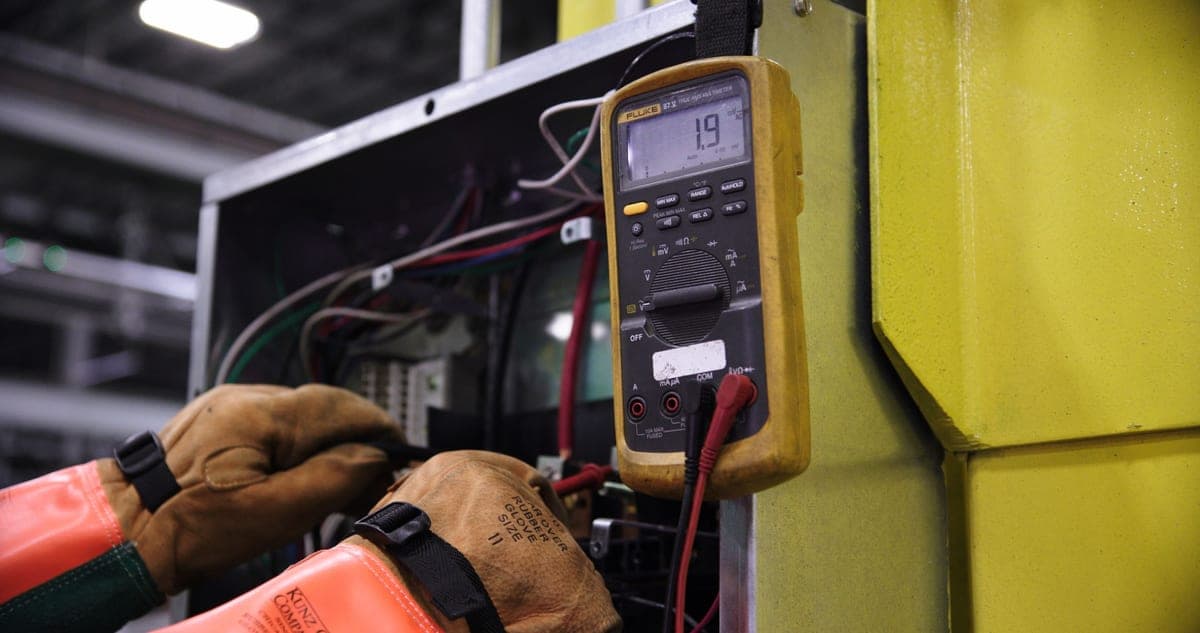
Best work lights for electricians
Electrical work lights ranked on color rendering and glare control rather than raw output.
Klein vs Streamlight work lights
Klein against Streamlight on work-light beam shape, mounting and published figures - including the only ingress rating either brand states.
Best headlamps for HVAC and mechanical trades
Headlamps for HVAC, machinists and night maintenance, ranked on close-range beam shape, hard-hat compatibility and what each maker actually publishes.
Fenix HM75R review
A specification-first review of the Fenix HM75R: what 30.2 watt-hours and a rear battery case actually buy, and who should wear something lighter.
Streamlight Bandit Pro review
A specification-first review of the Streamlight Bandit Pro: 45.4 grams, a published runtime for both levels, a diffused close-range beam, and the two-year warranty that goes with it.
Found a number that is wrong? Tell us and we will fix it and say so. Our methodology shows every formula on this page.