Headlamps
Fenix HM75R review
The largest energy store of any light on this site, strapped to your forehead with a battery case at the back. That sentence contains both the case for it and the case against.
By Scooter M. · Published · Updated
| # | Product | Best for | Output / weight | Price |
|---|---|---|---|---|
| 1 | 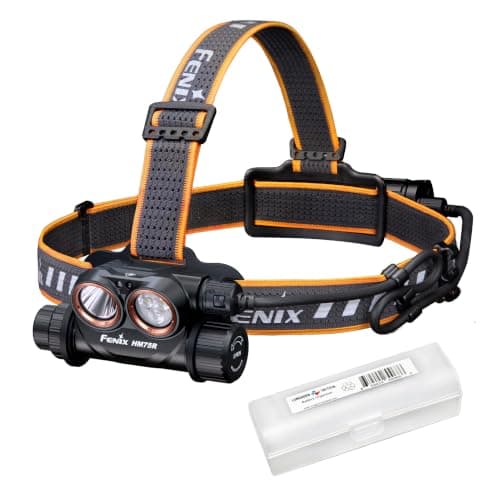 Fenix HM75RTop pickTwo cells in a rear case feeding a 1,600-lumen head. Heavy at 321 g, and the only lamp here that will genuinely run a full night shift on high-ish output. | All-shift work lighting | 1,600 lm / 321 g (11.32 oz) complete; 170 g without the rear power bank |
We earn a commission if you buy through the links on this page, at no extra cost to you. It does not change what we recommend or the order they appear in. Full disclosure. Prices checked September 21, 2026.
We have not tested this headlamp. We own none of the products on this site and have no laboratory. This review works from Fenix's own product page, read on September 21, 2026, and the arithmetic those figures allow.
The HM75R is the outlier of this whole site. It carries an 18650 and a 21700 at the same time — a computed 30.2 watt-hours, more than any other product we cover, and about two and a half times the next best. Everything interesting about it follows from that decision, including the reasons not to buy it.
What Fenix publishes
| Specification | Published figure |
|---|---|
| Maximum output | 1,600 lm |
| Beam distance | 223 m (732 feet) |
| Runtime | 234 h floodlight / 365 h red |
| Red mode | 130 lm maximum |
| Batteries | ARB-L18-3400 (18650, 3,400 mAh) + ARB-L21-5000 V2.0 (21700, 5,000 mAh) |
| Weight | 321 g complete; 170 g without the power bank and cord |
| Charging | USB-C, about 4 h from empty |
| Impact resistance | 2 m |
| Water resistance | Stated completely waterproof, no IP code given |
| Per-mode runtime | not broken out per spotlight or floodlight level |
| Peak candela | not published |
That is a strong sheet. Two cell capacities, a beam distance, an impact rating and a charge time put Fenix comfortably ahead of most of the category — but note the two gaps at the bottom, because they matter more than they look.
The 30.2 watt-hours, and what they are for
The published 234 hours on floodlight is a maximum on a low setting, as these figures always are. The useful way to read the energy is the middle: this is the only headlamp we cover where a genuinely bright working level for an entire night shift is arithmetically comfortable rather than optimistic.
It also works as a power bank, with Fenix listing PD3.0, QC3.0 and several other fast-charge protocols. On a site with no power that is a real second function, though Fenix does not publish an output wattage so we cannot tell you how fast it charges a phone.
The weight is the whole argument against
The 170 g figure is the lamp without the rear pack and cord, and it is worth knowing that even stripped it is heavier than a fully assembled HM65R-T at 140 g. The mass is not only the battery case.
The beam, computed
7.8 candela per lumen is a moderately wide beam — more concentrated than the Petzl Actik Core's 5.3, less than the Streamlight ProTac HL-X's 27. For a work lamp that is sensible: enough reach to see across a yard, enough spread to work by. Compare it with the brightest headlamps, where two 3,000-lumen lamps sit at 3.1 and 2.1 candela per lumen and reach less far than this one.
The power bank, and what it is worth
Fenix lists the HM75R as discharging over USB-C with support for PD3.0, PD2.0, QC3.0, QC2.0 and several other fast-charge protocols. On a site or a multi-day trip that turns a headlamp into the thing that keeps a phone alive, which is not a spec-sheet bullet — it is a second device you no longer have to carry.
If you want to know what that is worth for your own devices, the arithmetic is simple and you can do it yourself: find the watt-hour rating printed on the device you want to charge, and divide 30.2 by it. Subtract something for conversion losses, which are real in any USB power-delivery circuit and which Fenix does not quantify. That is a better answer than any figure we could give you, because it uses your device rather than an assumed one.
Fenix does not publish an output wattage either, so how fast it charges is unstated. Protocol support tells you the negotiation is there; it does not tell you the current behind it. What is published is the energy, and 30.2 watt-hours is more than any other product on this site holds.
How it compares on energy per gram
That ratio is the best defense of the design. The rear case looks like dead weight and is in fact the opposite: a larger cell pays a smaller proportional penalty for its casing, contacts and housing than a small one does. Every gram of the HM75R carries more energy than every gram of a Swift LT.
It does not follow that you should buy it. Total mass is what your neck feels, not mass efficiency, and 321 g is 321 g however well the grams are spent. But it does mean the weight is buying something real rather than being wasted on packaging. Brightest headlamps sets the full table out.
Two gaps worth stating
- No IP code. Fenix states the lamp is completely waterproof and rates it to 2 m impact, but gives no IEC 60529 rating. That is a meaningful claim we can repeat and cannot place on a scale — unlike the HM65R-T, which publishes IP68. For a lamp at this price it is a conspicuous omission.
- No per-mode runtime. Fenix gives 234 hours on floodlight and 365 on red, both maxima, and does not break the spotlight and floodlight levels out individually. So the middle of the range — where you will live — has to be reasoned from the watt-hours rather than read off the page.
Who should buy something else
Skip it for anything recreational. 321 g is a work decision. For hiking, running or camping the Actik Core at 88 g or the Petzl Swift LT at 43 g are in a different category of comfort.
Skip it if you want a coded waterproofing rating. The HM65R-T publishes IP68 and costs meaningfully less.
Skip it if you want maximum output. 1,600 lumens is mid-pack; the Nitecore HC75 UHE and Olight Perun 3 both publish 3,000 — though neither publishes a runtime, so what that output costs is unknown.
Skip it if a rear battery case is a non-starter. Some people cannot stand the weight distribution, and no specification will tell you whether you are one of them.
The verdict, stated as what it commits to
On published evidence this is the headlamp to buy when the job outlasts every other lamp's battery. 30.2 watt-hours, 223 m, a 2 m impact rating, a power-bank function and both weight figures printed is a strong, checkable sheet, and the energy figure is not close to being matched by anything else we cover.
What it is not is light, cheap, brightest, or rated on the IP scale. Buy it for the shift that does not end, and wear something else the rest of the time. For the wider field ranked on the energy behind the claims, see best headlamps.
The picks, in full
Top pick · All-shift work lighting
Fenix HM75R
Two cells in a rear case feeding a 1,600-lumen head. Heavy at 321 g, and the only lamp here that will genuinely run a full night shift on high-ish output.
3,400 mAh at 3.6 V plus 5,000 mAh at 3.6 V is 30.2 watt-hours. That is 2.5 times a Petzl NAO RL and roughly ten times a Swift LT, which is the single reason to accept 321 grams.
It also discharges over USB-C, so on a jobsite it is a headlamp and a phone charger. That is a genuine second function rather than a spec-sheet bullet.
The 170 g figure without the rear case matters: you can leave the power bank behind on a short job and carry a normal-weight lamp.
What works
- 30.2 Wh of stored energy, by far the most on the site
- Rear case detaches, so the lamp has a light configuration and a long configuration
- USB-C output charges a phone from the same cells
What does not
- 321 g complete is heavy enough to notice within an hour
- No IP code, only a statement that the lamp is completely waterproof
- The two-cell arrangement means two things to keep charged
Skip this ifyou are not working a full shift. For recreation it is 200 g of battery you will never flatten.
Published specification
- Peak intensity
- not published
- Beam distance
- 223 mFenix states 732 feet (223 m)Fenix HM75R — manufacturer spec page (retrieved September 21, 2026)
- Runtime
- 234 h floodlight / 365 h redMaximum, lowest modes. Fenix does not break runtime out per spotlight or floodlight level. Red tops out at 130 lm.Fenix HM75R — manufacturer spec page (retrieved September 1, 2026)
- Battery
- One 18650 (3,400 mAh) plus one 21700 (5,000 mAh) in a rear battery caseFenix HM75R — manufacturer spec page (retrieved September 1, 2026)
- Weight
- 321 g (11.32 oz) complete; 170 g without the rear power bankFenix HM75R — manufacturer spec page (retrieved September 1, 2026)
- Ingress
- Impact-resistant to 2 mFenix states the lamp is completely waterproof but gives no IP code, so it cannot be placed on the IEC 60529 scale.Fenix HM75R — manufacturer spec page (retrieved September 21, 2026)
#ad · how this is funded · price as of September 21, 2026
Questions people actually ask
Is the Fenix HM75R worth it?
For all-shift work, on published evidence, yes: it carries a computed 30.2 watt-hours across an 18650 and a 21700, publishes 223 m of reach and a 2 m impact rating, and doubles as a power bank. It is not worth it for recreational use, where 321 g complete is a great deal of weight to wear.
How long does the Fenix HM75R last?
Fenix publishes 234 hours on floodlight and 365 hours on red, both maxima on low settings. It does not break runtime out per spotlight or floodlight level. The more useful figure is the energy: 30.2 watt-hours, which at a 2 W working draw is roughly fifteen hours.
How much does the Fenix HM75R weigh?
Fenix publishes both figures: 321 g complete including the battery case, batteries and headband, and 170 g without the power bank and cord. For comparison the Petzl Actik Core is 88 g and the Fenix HM65R-T is 140 g.
Is the Fenix HM75R waterproof?
Fenix states it is completely waterproof and rates it impact-resistant to 2 meters, but gives no IP code, so it cannot be placed on the IEC 60529 scale the way the HM65R-T's published IP68 can. It is a real claim we can repeat and not one we can compare.
Can the Fenix HM75R charge a phone?
Yes - Fenix lists it as supporting PD3.0, PD2.0, QC3.0, QC2.0 and several other fast-discharge protocols through its USB-C port. Fenix does not publish an output wattage, so how quickly it charges a phone is not something we can state.
Fenix HM75R or HM65R-T?
The HM75R for endurance: 30.2 watt-hours against 12.2, plus a power bank. The HM65R-T for everything else: a published IP68, 140 g against 321, a standard removable 18650 with a CR123A fallback, and a lower price. Most buyers want the HM65R-T.
How far does the Fenix HM75R shine?
Fenix publishes 223 m, or 732 feet. That works back to about 12,432 candela, roughly 7.8 candela per lumen - a moderately wide beam that reaches further than several 3,000-lumen headlamps, because those spread their output rather than concentrating it.
Sources
Every figure on this page came from one of the documents below, read on the date shown. We do not cite other review sites, forum posts or video reviews as sources of fact.
- Fenix HM75R — manufacturer spec page (retrieved September 1, 2026)
- Fenix HM65R-T V2.0 — manufacturer spec page (retrieved September 1, 2026)
- ANSI/PLATO FL 1 flashlight performance standard — definitions of lumens, peak beam intensity, beam distance, runtime, impact and water resistance
- IEC 60529 — the IP (ingress protection) rating system
Read next
Best headlamps, ranked on the watt-hours behind the lumens
The full headlamp ranking: output, weight, battery energy and beam distance, every figure sourced to the maker.
Best headlamps for work
Work headlamps ranked on shift runtime, color rendering and hard-hat compatibility.

The brightest headlamps, and what the lumens actually buy
Nine of the highest-output headlamps we cover, ranked on published lumens with the reach and runtime figures that contradict the ranking.
Headlamp brands, ranked on what they tell you
Every headlamp brand we cover, ranked on specification disclosure — from the one publishing watt-hours to the three publishing only a lumen figure.
Petzl vs Fenix headlamps
Petzl against Fenix on published battery energy, beam distance, weight and ingress rating — four matched pairs where both makers actually show their work.
Best headlamps for HVAC and mechanical trades
Headlamps for HVAC, machinists and night maintenance, ranked on close-range beam shape, hard-hat compatibility and what each maker actually publishes.
Found a number that is wrong? Tell us and we will fix it and say so. Our methodology shows every formula on this page.