Headlamps
Petzl Actik Core review
The most completely documented headlamp we cover, and the one whose famous hybrid battery turns out to be a trade rather than a free fallback.
By Scooter M. · Published · Updated
| # | Product | Best for | Output / weight | Price |
|---|---|---|---|---|
| 1 | 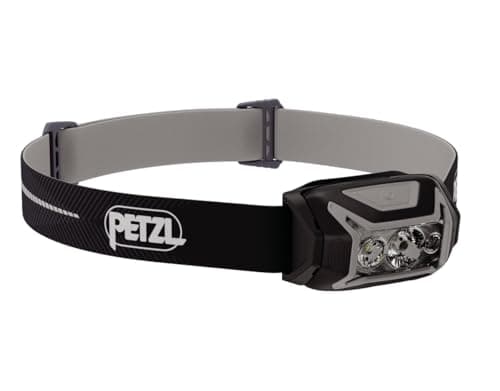 Petzl Actik CoreTop pickThe default outdoor headlamp: hybrid power, a published ANSI figure, and a beam shaped for walking rather than for a spec sheet. | Hiking and general outdoor use | 625 lm / 88 g |
We earn a commission if you buy through the links on this page, at no extra cost to you. It does not change what we recommend or the order they appear in. Full disclosure. Prices checked September 20, 2026.

We have not tested this headlamp. We own none of the products on this site and have no laboratory. This review works from Petzl's own product page, read on September 19, 2026, and does the arithmetic those published figures allow.
The Actik Core is the lamp this site recommends more than any other, and it earns that position for a reason that has nothing to do with brightness: Petzl publishes more about it than any other maker publishes about anything we cover. Not a headline and a maximum — a complete table, for every level, on both power sources.
What Petzl publishes, in full
| Level | Output | Beam distance | Runtime |
|---|---|---|---|
| Max Power | 625 lm | 115 m | 2 h |
| Standard | 100 lm | 60 m | 7 h |
| Max Burn Time | 7 lm | 10 m | 100 h |
| Red, continuous | 2 lm | 5 m | 60 h |
Three columns for four levels, all stated in text rather than buried in a chart image. For comparison, Nitecore, Olight, Coast, Black Diamond and Klein publish no runtime at all for the lamps we cover; Fenix publishes a maximum and a Turbo figure. Nobody else in the category publishes a table like this.
| Level | Output | Beam distance | Runtime |
|---|---|---|---|
| Max Power | 450 lm | 100 m | 2 h |
| Standard | 100 lm | 60 m | 10 h |
| Max Burn Time | 7 lm | 10 m | 100 h |
| Red, continuous | 2 lm | 5 m | 60 h |
That is a genuinely useful thing to know before a trip. If the plan is a long, steady night walk at a sensible output, the AAA cells are not a compromise at all — they are the better choice, and three spares weigh almost nothing. If the plan needs the full 625 lumens, only the CORE pack delivers it.
The arithmetic the published figures allow
The beam, and one oddity in the numbers
Standard mode is the more concentrated of the two, at roughly 9 candela per lumen against 5.3 at Max Power. That is the opposite of what most people would assume. The published numbers say the beam gets proportionally wider as output rises, which is sensible behavior for a walking lamp — more light spread across more ground rather than pushed further down the trail. Petzl does not explain the mechanism on the page, so we are not going to invent one for it.
Either way, 5.3 candela per lumen is a flood, and correctly so. A headlamp should light the ground around your feet. If you want reach, the brightest headlamps shows why output alone will not buy it.
The 625-versus-650 discrepancy
Worth flagging because it is confusing in the shop: Petzl's own US product page states 625 lumens, and the brand's own Amazon listing is titled 650 lumens. Both come from Petzl.
We use 625 throughout this site because the manufacturer's own specification page outranks a retail listing under our sourcing policy, and because 625 is the figure Petzl attaches to the ANSI/PLATO FL 1 standard. The gap is small enough not to matter in use and large enough to notice, and if a difference of 25 lumens decides your purchase, the decision is not really about lumens.
Red mode, stated properly
Petzl publishes the red mode as a real level rather than a marketing bullet: 2 lumens, 5 meters, 60 hours, continuous, with a separate strobe. Two lumens sounds like nothing and is the point — red preserves dark adaptation precisely because it is dim, and 60 hours means it is not a mode you have to ration.
The separate strobe figure, visible at 700 m for 400 hours, is a be-seen claim rather than a see-by one. It describes how long you remain detectable to somebody else, not how long you have usable light. It belongs in an emergency plan, not in a runtime comparison. Why headlamps have a red mode covers the night-vision mechanism.
What is not published
- No peak candela. Petzl publishes beam distance instead, so the 3,306 cd above is our arithmetic and has nothing to check it against.
- IPX4 only. Weather resistant, rated for splashing water from any direction. It is not immersion rated, and Petzl does not claim it is. The Fenix HM65R-T publishes IP68 if a lamp has to survive a creek.
- No impact rating. Nothing published about drops.
- Reserve behavior on the CORE pack. Petzl gives the reserve figure for AAA operation; the page does not state the equivalent for the rechargeable pack.
Who should buy something else
Skip it if the lamp will be submerged. IPX4 covers rain and not a creek crossing. See the Fenix HM65R-T review for a published IP68 alternative.
Skip it if you need a long night at high output. 4.5 watt-hours is modest, and two hours at Max Power is exactly what that buys. A six-hour walk at a genuinely bright setting needs roughly twice this energy — the HM65R-T carries 12.2 Wh and the Fenix HM75R carries 30.2.
Skip it if you want maximum output for the money. The Nitecore NU43 publishes 1,400 lumens for less, though it publishes no runtime, weight or IP rating at all. That is the trade, and it is set out in full on headlamp brands, ranked on what they publish.
Skip it if you are counting grams hard. 88 g is light but not the lightest: Petzl's own Swift LT publishes 43 g. See headlamps under $50 for the cheaper end of the range.
The verdict, stated as what it commits to
On published evidence the Actik Core is the headlamp we would recommend to most people walking at night, and the reason is documentation rather than performance. Petzl states every level, its output, its reach and its runtime, on both power sources, and the watt-hour figure reconciles with the capacity. Nothing else in this category is that checkable, and a lamp whose numbers can be verified is a lamp whose numbers can be trusted.
What it is not is bright for the money, waterproof beyond rain, or big on stored energy. And its hybrid battery, which almost every recommendation presents as a free safety net, costs you 175 lumens of peak output when you use it. That is still a good trade for most nights — but you should know you are making it. For the wider field ranked on the energy behind the claims, see best headlamps.
The picks, in full
Top pick · Hiking and general outdoor use
Petzl Actik Core
The default outdoor headlamp: hybrid power, a published ANSI figure, and a beam shaped for walking rather than for a spec sheet.
625 lumens and 115 meters is a walking beam, not a searching beam. The FL1 definition puts illuminance at 115 m down to 0.25 lux, which is enough to tell that something is there and not enough to identify it. In practice you run the middle level and see 30 to 60 m of usable trail.
4.5 watt-hours matters more than the lumen figure. A lamp drawing a regulated 2 W empties that pack in a bit over two hours. The 400-hour number Petzl quotes is a reserve-mode visibility claim, not 400 hours of light you can walk by.
The hybrid design is the real feature. When the CORE pack dies three hours into a night descent, three AAA cells from a gas station bring the lamp back. Very little else at this price does that.
What works
- Runs on the rechargeable pack or three AAA cells, which is a genuine field fix rather than a marketing bullet
- Petzl publishes the full ANSI FL 1 table, including a distance for every mode
- 88 g is light enough that you stop noticing it
What does not
- IPX4 only: rain is fine, a dropped-in-the-creek recovery is not
- No published peak candela, so the 115 m claim cannot be checked against the intensity
- The maker's own site and its own Amazon listing disagree about peak output
Skip this ifyou need reach. 115 m is short by 2026 standards, and the 625-lumen headline does not change the shape of the beam.
Published specification
- Output
- 625 lmANSI/PLATO FL 1. Petzl's US product page states 625; the brand's own Amazon listing says 650. We use the maker's own site.Petzl Actik Core — manufacturer spec page (retrieved September 1, 2026)
- Peak intensity
- not published(Petzl publishes distance, not peak intensity)
- Beam distance
- 115 mMaximum, on the CORE rechargeable batteryPetzl Actik Core — manufacturer spec page (retrieved September 1, 2026)
- Runtime
- 2 h at 625 lm / 7 h at 100 lm / 100 h at 7 lm, on the CORE packPetzl publishes a full per-mode table for both power sources. On 3 x AAA the same levels run 2 h / 10 h / 100 h, with peak output capped at 450 lm. Its separate strobe figure, visible at 700 m for 400 h, is a be-seen claim and not a working runtime.Petzl Actik Core — manufacturer spec page (retrieved September 19, 2026)
- Battery
- CORE 1250 mAh / 3.6 V / 4.5 Wh, or 3 x AAAPetzl Actik Core — manufacturer spec page (retrieved September 1, 2026)
- Ingress
- IPX4Weather resistant. Not immersion rated.Petzl Actik Core — manufacturer spec page (retrieved September 1, 2026)
$87.95 · 9% off
#ad · how this is funded · price as of September 20, 2026
Questions people actually ask
Is the Petzl Actik Core worth it?
On published evidence, yes for most night walking: it is the most completely documented headlamp we cover, with output, beam distance and runtime stated for every level on both power sources, and a 4.5 Wh battery figure that reconciles with its 1,250 mAh capacity. It is not the brightest for the money and it is only IPX4.
How long does the Petzl Actik Core last?
Petzl publishes 2 hours at 625 lumens, 7 hours at 100 lumens and 100 hours at 7 lumens on the CORE rechargeable pack, plus 60 hours on red. On three AAA cells the same levels run 2 hours, 10 hours and 100 hours — so the middle setting actually lasts longer on AAA.
Does the Petzl Actik Core work with AAA batteries?
Yes, three AAA cells — alkaline, lithium or Ni-MH — and Petzl publishes the full mode table for them. The catch is that peak output is capped at 450 lumens on AAA instead of 625, and beam distance at 100 m instead of 115. Standard mode runs longer, at 10 hours against 7.
Is the Petzl Actik Core 625 or 650 lumens?
Petzl's own US product page states 625 lumens against the ANSI/PLATO FL 1 standard, while the brand's Amazon listing is titled 650. We use 625 throughout this site because a manufacturer specification page outranks a retail listing under our sourcing policy. The difference is not meaningful in use.
Is the Petzl Actik Core waterproof?
It publishes IPX4, which is protection against splashing water from any direction. That covers rain; it does not cover immersion, and Petzl makes no immersion claim. If you need a published immersion rating, the Fenix HM65R-T states IP68.
What does the red light on the Actik Core do?
Petzl publishes it as a full level: 2 lumens, 5 meters, 60 hours of continuous red, with a separate strobe. It is dim by design, because that is what preserves dark adaptation, and 60 hours means you never need to ration it. There is also a strobe rated visible at 700 m for 400 hours, which is a be-seen figure rather than usable light.
Petzl Actik Core or Fenix HM65R-T?
The Petzl for weight and documentation: 88 g, a full published mode table and a 4.5 Wh figure that checks out. The Fenix for endurance and weather: 12.2 Wh, a removable 18650 with a CR123A fallback, and a published IP68. Our Petzl vs Fenix comparison works through the whole range.
Sources
Every figure on this page came from one of the documents below, read on the date shown. We do not cite other review sites, forum posts or video reviews as sources of fact.
- Petzl Actik Core — manufacturer spec page (retrieved September 19, 2026)
- Petzl — ANSI/PLATO FL 1 technical information for its headlamp range
- Fenix HM65R-T V2.0 — manufacturer spec page (retrieved September 1, 2026)
- ANSI/PLATO FL 1 flashlight performance standard — definitions of lumens, peak beam intensity, beam distance, runtime, impact and water resistance
- IEC 60529 — the IP (ingress protection) rating system
Read next
Best headlamps, ranked on the watt-hours behind the lumens
The full headlamp ranking: output, weight, battery energy and beam distance, every figure sourced to the maker.
Headlamp brands, ranked on what they tell you
Every headlamp brand we cover, ranked on specification disclosure — from the one publishing watt-hours to the three publishing only a lumen figure.
Best headlamps for hiking
Hiking headlamps ranked on hybrid power, published runtime and weight — not on peak output.
Petzl vs Fenix headlamps
Petzl against Fenix on published battery energy, beam distance, weight and ingress rating — four matched pairs where both makers actually show their work.
Fenix HM65R-T V2.0 review
A specification-first review of the Fenix HM65R-T V2.0: what the published figures mean, what they do not cover, and who should buy something else.
Flashlight runtime, computed
How runtime is defined, why thermal step-down happens, and the arithmetic to compute a real figure yourself.
Found a number that is wrong? Tell us and we will fix it and say so. Our methodology shows every formula on this page.