Headlamps
Fenix HM65R-T V2.0 review
The best-documented headlamp we cover, and the only one that publishes an immersion rating. Here is what its numbers actually commit Fenix to.
By Scooter M. · Published · Updated
| # | Product | Best for | Output / weight | Price |
|---|---|---|---|---|
| 1 | 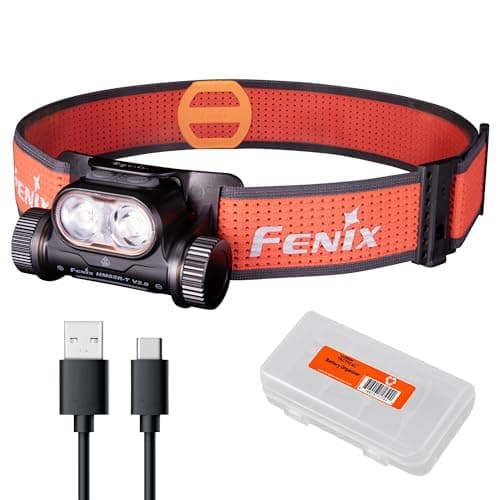 Fenix HM65R-T V2.0Top pick1,600 lumens and 170 m from a magnesium body running a standard 18650, at 140 g. The removable cell is what separates it from the sealed-pack lamps. | Long nights where you want reach and a spare cell | 1,600 lm / 140 g (4.94 oz) |
We earn a commission if you buy through the links on this page, at no extra cost to you. It does not change what we recommend or the order they appear in. Full disclosure. Prices checked September 13, 2026.

We have not tested this headlamp. We do not own one, we have no laboratory, and nothing on this page is an impression of how it feels on a forehead. What this review does instead is take every figure Fenix publishes, run the arithmetic those figures imply, and say plainly what they do and do not commit the company to.
That turns out to be unusually productive here, because the HM65R-T publishes more than any other headlamp on this site — and one of its numbers is a claim almost no competitor is willing to make.
What Fenix actually publishes
| Specification | Published figure |
|---|---|
| Output | 1,600 lm |
| Beam distance | 170 m |
| Runtime | 300 h maximum |
| Battery | 3,400 mAh 18650 Li-ion, included, or 2 x CR123A |
| Weight | 140 g (4.94 oz) |
| Ingress protection | IP68 |
| Peak candela | not published |
Six figures where most headlamp makers publish one. For context, three of the ten brands we cover — Coast, Black Diamond and Klein Tools — publish output and nothing else at all. Our headlamp brand ranking puts Fenix second only to Petzl on disclosure, and this is the lamp that earns it.
The IP68 rating is the headline, not the lumens
That gap is the single strongest argument for this lamp, and it is worth being precise about why. IPX4 is splashing water from any direction: it covers rain and it does not cover dropping the lamp in a creek, wearing it through a river crossing, or a downpour that runs water down your face for three hours. IP68 covers all of those.
It is also a tested, published, standards-referenced claim rather than marketing language. A maker that prints IP68 has committed to a specific test; a maker that prints nothing has committed to nothing, which is the position most of this category takes.
The arithmetic the published figures allow
Fenix publishes cell capacity, which is what makes the runtime claim checkable rather than something you take on trust.
That comparison is worth pausing on. The Petzl Swift RL publishes 1,200 lumens and 168 meters; this lamp publishes 1,600 lumens and 170 meters. Four hundred extra lumens buy two meters of reach, because the Petzl's optic is more efficient. If you were buying on the output figure expecting a third more reach, that is not what you would get.
The removable cell, and why it is the second-best feature
The HM65R-T takes a standard 3,400 mAh 18650 — a cell you can buy anywhere, carry a charged spare of, and swap in the dark in about ten seconds. It also accepts two CR123A lithium primaries, which store for roughly a decade and work when no charger exists.
This is a structural advantage over sealed lamps rather than a convenience. A sealed rechargeable headlamp with a flat cell on the second night of a trip is a plastic object. This one takes a spare out of your pocket. It is also why the lamp remains useful years in: when a lithium cell degrades to 80 percent after a few hundred cycles, a removable-cell lamp is a few-dollar fix and a sealed lamp is finished.
The magnesium body is the other durability argument, though Fenix makes no published claim we can check about impact resistance, so we will not make one for it.
What the specification does not cover
Three gaps are worth stating, because a review that only repeats the maker's strengths is an advertisement.
- No per-mode runtime table. Fenix publishes a single 300-hour maximum. That describes the lowest setting, and nothing published tells you what the lamp does at 1,600 lumens, or at the mid setting you will actually walk on. Streamlight publishes a figure for every mode on its lights; Fenix does not.
- No published candela. The 7,225 cd above is our arithmetic from Fenix's own distance figure, not a number Fenix states. Where a maker publishes both, they can be checked against each other — here there is only one to work from.
- No impact rating. ANSI FL 1 defines an impact-resistance test in meters and Fenix does not publish a result for this lamp, so its ruggedness beyond water and dust is undocumented.
Who should buy something else
Skip it if you are counting grams. 140 g is a real weight on a forehead over a long night. The Petzl Swift LT publishes 43 g and the Actik Core 88 g, and if your lamp is for fast movement rather than wet work, that difference will matter more to you than an ingress rating.
Skip it if you want maximum output. 1,600 lumens is mid-pack among the lamps we cover. The Nitecore HC75 UHE and Olight Perun 3 both publish 3,000, and the Coast XPH34R publishes 2,700 — though none of the three publishes a runtime, so what that output costs you is unknown. See the brightest headlamps.
Skip it if the price is the constraint. This sits well above the bracket where most headlamps sell, and a Petzl Tikka at a third of the money publishes beam distance, weight and an IPX4 rating and will cover camping and chores completely. See headlamps under $50.
Skip it if you want reactive lighting. Petzl's Swift RL and NAO RL dim automatically when you look at something close, which extends real burn time in a way no fixed-output lamp matches. That is a genuine feature Fenix does not answer. Petzl vs Fenix works through the whole trade.
The verdict, stated as what it commits to
On published evidence the HM65R-T V2.0 is the headlamp we would choose for a long night in bad weather where the lamp has to keep working. It is the only headlamp on this site with a published IP68, it holds more energy than Petzl's flagship, and it runs on a standard cell you can replace forever. Those three facts are checkable, and together they describe a lamp built to be depended on rather than to win a lumen comparison.
What it is not is the brightest, the lightest, or the cheapest, and it does not tell you what it does at full output. If any of those is your deciding factor, buy accordingly — and if you are still choosing, our how to choose a headlamp guide sets out the order we would weigh them in.
The picks, in full
Top pick · Long nights where you want reach and a spare cell
Fenix HM65R-T V2.0
1,600 lumens and 170 m from a magnesium body running a standard 18650, at 140 g. The removable cell is what separates it from the sealed-pack lamps.
A 3,400 mAh 18650 at a nominal 3.6 V is 12.2 watt-hours. That is more energy than a Petzl NAO RL carries, in a lamp 5 g lighter, because a bare 18650 is a more efficient package than a molded pack.
It is also the only headlamp in this set whose battery you can replace at a checkpoint for three dollars, because 18650 is a standard cell and not a proprietary brick.
IP68 rather than IPX4 is the second real difference. This one survives being dropped in water; most of the running lamps here do not.
What works
- Standard 18650 cell: swappable, cheap, and available everywhere
- IP68 and 2 m impact rating, the toughest specification in this roundup
- Dual emitters, one white and one warm white, so it works for close tasks as well as reach
What does not
- 140 g is at the heavy end for a running lamp
- Charging works only with Fenix ARB-L18 series cells, which limits the swap-any-18650 advantage
- No published candela figure
Skip this ifyou count grams. A Swift LT does the camp job at 43 g; you are carrying 97 g extra for reach and a removable cell.
Published specification
- Peak intensity
- not published(Fenix publishes distance, not peak intensity)
- Runtime
- 300 h maximumLowest mode. The turbo figure is far shorter and Fenix publishes it per-mode.Fenix HM65R-T V2.0 — manufacturer spec page (retrieved September 1, 2026)
- Battery
- 3,400 mAh 18650 Li-ion (included), or 2 x CR123AFenix HM65R-T V2.0 — manufacturer spec page (retrieved September 1, 2026)
- Weight
- 140 g (4.94 oz)Including battery and headbandFenix HM65R-T V2.0 — manufacturer spec page (retrieved September 1, 2026)
- Ingress
- IP68Dust tight and immersion rated; 2 m impact resistanceFenix HM65R-T V2.0 — manufacturer spec page (retrieved September 1, 2026)
#ad · how this is funded · price as of September 13, 2026
Questions people actually ask
Is the Fenix HM65R-T worth it?
On published figures it makes the strongest case of any headlamp we cover for wet, demanding use: a published IP68, 12.2 computed watt-hours, 170 m of reach and a removable 18650 with a CR123A fallback. It is not the brightest or the lightest, and Fenix publishes only a single maximum runtime rather than a per-mode table.
Is the Fenix HM65R-T waterproof?
Fenix publishes IP68 for it, which under IEC 60529 means dust-tight and protected against continuous immersion beyond one meter on the manufacturer's stated conditions. It is the only headlamp on this site with a published IP68 — Petzl, by comparison, publishes IPX4 across its entire range, which covers rain but not submersion.
How long does the Fenix HM65R-T last on a charge?
Fenix publishes a 300-hour maximum, which describes the lowest mode rather than the 1,600 lumens on the box. The 3,400 mAh 18650 works out to 12.2 watt-hours, so at a 2 W working draw you would expect roughly six hours. Fenix publishes no per-mode table, so what it does at full output is not something we can source.
Does the Fenix HM65R-T take regular batteries?
It takes two CR123A lithium primaries as an alternative to its included 3,400 mAh 18650. CR123A cells store for around a decade, which makes this one of the few high-output headlamps that still works when no charger is available. The 18650 is also a standard cell, so a charged spare swaps in seconds.
How far does the Fenix HM65R-T shine?
Fenix publishes 170 m. That works back to 7,225 candela, or 4.5 candela per lumen — a wide beam, which is the right shape for a headlamp. Worth knowing that the 1,200-lumen Petzl Swift RL publishes 168 m, so the extra 400 lumens here buy about two meters.
Fenix HM65R-T or Petzl Swift RL?
The Fenix for wet conditions and cell flexibility: IP68, 12.2 Wh, a removable 18650 and CR123A fallback. The Petzl for weight and efficiency: 92 g against 140 g, reactive dimming, and essentially the same reach on a third less output. Our Petzl vs Fenix comparison works through all four matched pairs.
Is the HM65R-T good for running?
It would work, but it is not what we would choose. At 140 g it is heavy for running, and its strengths — immersion rating and a replaceable cell — matter less on a route you finish in a couple of hours. Our headlamps for running page ranks on weight and reactive behavior instead.
Sources
Every figure on this page came from one of the documents below, read on the date shown. We do not cite other review sites, forum posts or video reviews as sources of fact.
- Fenix HM65R-T V2.0 — manufacturer spec page (retrieved September 1, 2026)
- Petzl Swift RL — manufacturer spec page (retrieved September 1, 2026)
- Petzl — ANSI/PLATO FL 1 technical information for its headlamp range
- ANSI/PLATO FL 1 flashlight performance standard — definitions of lumens, peak beam intensity, beam distance, runtime, impact and water resistance
- IEC 60529 — the IP (ingress protection) rating system
Read next
Best headlamps, ranked on the watt-hours behind the lumens
The full headlamp ranking: output, weight, battery energy and beam distance, every figure sourced to the maker.
Headlamp brands, ranked on what they tell you
Every headlamp brand we cover, ranked on specification disclosure — from the one publishing watt-hours to the three publishing only a lumen figure.
The brightest headlamps, and what the lumens actually buy
Nine of the highest-output headlamps we cover, ranked on published lumens with the reach and runtime figures that contradict the ranking.
Petzl vs Fenix headlamps
Petzl against Fenix on published battery energy, beam distance, weight and ingress rating — four matched pairs where both makers actually show their work.
How to choose a headlamp
A decision guide built on watt-hours, weight, beam distance, ingress rating and red-mode access.
18650 vs 21700, and every other cell format
Cell formats compared on capacity, current rating and dimensions, with the safety rules that matter.
Found a number that is wrong? Tell us and we will fix it and say so. Our methodology shows every formula on this page.