Headlamps
Petzl Tikka review
A cheap headlamp that publishes more about itself than lamps costing three times as much — including the fact that its rechargeable pack makes it brighter and its alkalines make it last longer.
By Scooter M. · Published · Updated
| # | Product | Best for | Output / weight | Price |
|---|---|---|---|---|
| 1 | 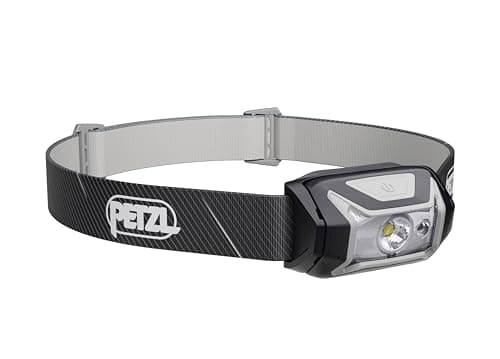 Petzl TikkaTop pick350 lumens, three AAA cells, a red mode, 94 grams. The unglamorous answer that covers most of what people actually do after dark. | A first headlamp, and the glovebox | 350 lm / 94 g |
We earn a commission if you buy through the links on this page, at no extra cost to you. It does not change what we recommend or the order they appear in. Full disclosure. Prices checked September 27, 2026.

We have not tested this headlamp. We own none of the products on this site and have no laboratory. This review works from Petzl's own product page, re-read on September 27, 2026, and the arithmetic those figures allow.
The Tikka is the cheapest lamp we would recommend without caveats about the specification sheet, because Petzl publishes a complete runtime table twice — once for alkaline AAA cells and once for its CORE rechargeable pack. Almost nobody in this category publishes one table. The two are not the same, and the difference is the most interesting thing about the lamp.
What Petzl publishes, on three AAA cells
| Level | Output | Beam distance | Burn time |
|---|---|---|---|
| White, max power | 350 lm | 70 m | 2 h, plus 20 h reserve |
| White, standard | 100 lm | 45 m | 12 h, plus 20 h reserve |
| White, max burn time | 7 lm | 10 m | 110 h |
| Red, continuous | 2 lm | 5 m | 60 h |
| Red, strobe | not stated | visible at 700 m | 400 h |
And on the CORE rechargeable pack
| Level | Output | Beam distance | Burn time |
|---|---|---|---|
| White, max power | 450 lm | 75 m | 2.5 h |
| White, standard | 100 lm | 45 m | 7 h, plus 2 h reserve |
| White, max burn time | 7 lm | 10 m | 110 h |
| Red, continuous | 2 lm | 5 m | 60 h |
| Red, strobe | not stated | visible at 700 m | 400 h |
The general rule on this site is that hybrid lamps are the honest answer for most buyers. The Tikka is the strongest case for it: nothing is downgraded when you run it on cells from a gas station except peak output you will rarely use.
The rest of the sheet
| Specification | Published figure |
|---|---|
| Weight | 94 g |
| Battery | 3 x AAA/LR03 (included), or the CORE pack |
| Water resistance | IPX4, stated as weather resistant |
| Certification | CE |
| Warranty | 5 years |
| Peak candela | not published |
| Battery capacity | not published in mAh or watt-hours |
A five-year warranty is notable at this price. The Petzl Swift LT carries three years or 300 charging cycles, and the shorter term there is a direct consequence of its sealed cell. A lamp with no battery to wear out can be guaranteed for longer, which is a real if indirect argument for replaceable cells.
The beam, computed
Around 3 candela per lumen is a very wide beam — wider than the Petzl Actik Core's 5.3 and the Fenix HM65R-T's 4.5, and about the same as two 3,000-lumen lamps we cover. For a path at walking pace that is the right shape: even light in front of your feet rather than a hotspot in the middle distance.
It is the wrong shape for identifying anything at distance, and 70 m is among the shortest published reaches in our headlamp set. If reach matters, throw versus flood explains what you are giving up.
The red mode is a full level, not a token
Petzl publishes red as 2 lumens at 5 meters for 60 hours — output, distance and runtime, the same treatment as the white levels. Most makers mention a red LED and publish nothing about it.
Sixty hours matters more than it sounds. It means you never ration the red mode, which is the one people end up using most: it preserves dark adaptation, it does not wake a tent, and it does not blind whoever you are talking to. What a red mode is actually for covers the mechanism.
The 400-hour strobe figure is not a runtime and we do not treat it as one. It is a be-seen claim — how long you stay detectable to somebody else — and it belongs in an emergency plan rather than a runtime comparison. Our own record previously listed it as this lamp's runtime, which was wrong; it has been corrected.
What it costs you
- 350 lumens on the cells it ships with. Enough for a path, not for a trail at speed. Two hours of it, then you are on the 100-lumen level.
- IPX4. Weather resistance rather than immersion, with no dust digit. Petzl publishes IPX4 across nearly its whole range, so this is a brand position rather than a corner cut.
- No candela and no battery capacity, so beam intensity is derived and stored energy cannot be computed — the one figure this site normally builds its whole argument on.
- The CORE pack is sold separately, so the hybrid advantage costs extra to unlock.
- 70 m of reach, near the bottom of our headlamp set.
Who should buy something else
Skip it if you move fast in the dark. 350 lumens and 70 m are not trail-running figures. The Petzl Actik Core publishes 625 lumens and 115 m, and is 6 grams lighter — for roughly double the money.
Skip it if grams are the point. 94 g is light and not the lightest: the Petzl Swift LT publishes 43 g.
Skip it if it will be rained on hard or used at work. IPX4 is weather resistance; the Fenix HM65R-T publishes IP68 and takes a replaceable 18650.
Skip it if you want stored energy on the record. Petzl publishes watt-hours for its rechargeable lamps and not for this one, because the cells are yours to choose.
The verdict, stated as what it commits to
Petzl commits to 350 lumens at 70 m for 2 hours, 100 at 45 m for 12, 7 at 10 m for 110, red at 2 lumens for 60, a 20-hour reserve, 94 g, IPX4 and a 5-year warranty on AAA cells — and a second complete table for the CORE pack, where peak output rises to 450 lm and mid-level runtime falls to 7 hours.
For a first headlamp, a glovebox, a camping box or a lamp lent to somebody who will not charge it, this is the one to buy, and the reason is disclosure rather than performance. Plenty of lamps are brighter. Very few tell you what they do when you turn them down. See headlamps under $50 for the rest of that end of the range.
The picks, in full
Top pick · A first headlamp, and the glovebox
Petzl Tikka
350 lumens, three AAA cells, a red mode, 94 grams. The unglamorous answer that covers most of what people actually do after dark.
Three alkaline AAA cells hold roughly 3.9 Wh between them at a modest draw. That is comparable to the Swift LT's entire battery, for a couple of dollars, available in any gas station in the country.
The red mode is the feature people end up using most. It preserves night adaptation and does not wake a tent.
350 lumens looks modest next to a 3,000-lumen listing. On a footpath at walking pace it is more light than you need, and it will still be running when the 3,000-lumen light has stepped down twice.
What works
- AAA cells: replaceable anywhere, storable for years, no charge cycle to manage
- A red mode you can reach without a mode-cycling ordeal
- Cheap enough to own two
What does not
- No rechargeable pack in the box
- 70 m throw identifies nothing at distance
- IPX4
Skip this ifyou want one lamp for everything including work. There is no real flood mode and no high-CRI option.
Published specification
- Output
- 350 lmANSI/PLATO FL 1Petzl Tikka — manufacturer spec page (retrieved September 1, 2026)
- Peak intensity
- not published
- Beam distance
- 70 mOn three AAA cells; 75 m on the CORE rechargeable accessoryPetzl Tikka — manufacturer spec page (retrieved September 1, 2026)
- Runtime
- 2 h at 350 lm / 12 h at 100 lm / 110 h at 7 lm, on AAAOn the CORE pack the same levels run 2.5 h at 450 lm / 7 h at 100 lm / 110 h at 7 lm. AAA gives less peak output and more mid-level runtime. The 400 h figure Petzl lists is the red strobe, not a working runtime.Petzl Tikka — manufacturer spec page (retrieved September 27, 2026)
- Battery
- 3 x AAA (included), or the CORE rechargeable packPetzl Tikka — manufacturer spec page (retrieved September 1, 2026)
#ad · how this is funded · price as of September 27, 2026
Questions people actually ask
How many lumens is the Petzl Tikka?
350 lumens on the three AAA cells it ships with, and 450 lumens on Petzl's CORE rechargeable pack, which is sold separately. Petzl publishes a full runtime table for both power sources, which almost nothing else in this price bracket does.
How long does the Petzl Tikka last?
On AAA cells: 2 hours at 350 lumens, 12 hours at 100, 110 hours at 7, plus a 20-hour reserve. On the CORE pack: 2.5 hours at 450 lumens, 7 hours at 100, 110 hours at 7, plus a 2-hour reserve. The often-quoted 400-hour figure is the red strobe, not a working runtime.
Is the CORE rechargeable battery worth it for the Tikka?
It depends which figure you care about. The CORE pack raises peak output from 350 to 450 lumens and reach from 70 to 75 m. Alkaline AAA cells give you 12 hours at the 100-lumen working level instead of 7, and a 20-hour reserve instead of 2. For most use, the cheaper option lasts longer.
Does the Petzl Tikka have a red light?
Yes, and Petzl publishes it as a full level: 2 lumens, 5 meters, 60 hours of continuous red. Sixty hours means you never have to ration it, which matters because red is the mode most people end up using - it preserves dark adaptation and does not wake a tent.
Is the Petzl Tikka waterproof?
It is rated IPX4, which Petzl describes as weather resistant - splashing water from any direction, not immersion, and no dust rating. That is Petzl's rating across nearly its whole range. For immersion and dust protection the Fenix HM65R-T publishes IP68.
Petzl Tikka or Tikkina?
The Tikka for the red mode, which the Tikkina does not have, and for 350 lumens against 300 and 70 m against 65. Both take three AAA cells or the CORE pack and both weigh about the same. The red mode alone is worth the small difference for most buyers.
Petzl Tikka or Actik Core?
The Tikka if price matters and you want a lamp that runs on shop-bought cells out of the box. The Actik Core for performance: 625 lumens against 350, 115 m against 70, and its CORE pack is included rather than an extra. The Actik Core is the better lamp; the Tikka is the better value.
How far does the Petzl Tikka shine?
70 m on max power with AAA cells, 75 m on the CORE pack, 45 m at the 100-lumen standard level and 10 m on the lowest. That works back to roughly 1,225 candela, about 3.5 candela per lumen - a very wide beam, which is the right shape for a path and the wrong one for distance.
Sources
Every figure on this page came from one of the documents below, read on the date shown. We do not cite other review sites, forum posts or video reviews as sources of fact.
- Petzl Tikka — manufacturer spec page (retrieved September 1, 2026)
- Petzl Actik Core — manufacturer spec page (retrieved September 1, 2026)
- Petzl Swift LT — manufacturer spec page (retrieved September 1, 2026)
- Fenix HM65R-T V2.0 — manufacturer spec page (retrieved September 1, 2026)
- Petzl — ANSI/PLATO FL 1 technical information for its headlamp range
- ANSI/PLATO FL 1 flashlight performance standard — definitions of lumens, peak beam intensity, beam distance, runtime, impact and water resistance
- IEC 60529 — the IP (ingress protection) rating system
Read next
Best headlamps, ranked on the watt-hours behind the lumens
The full headlamp ranking: output, weight, battery energy and beam distance, every figure sourced to the maker.
Best headlamps under $50
Seven headlamps in the sub-$50 bracket, ranked on what their makers actually publish, with the gaps named and live prices on every pick.
Best headlamps for camping
Camping headlamps ranked on red-mode access, replaceable cells and honest runtime figures.
What a headlamp red light mode is actually for
The physiology behind red headlamp modes, and how to choose a lamp whose red is reachable in one click.
Petzl Actik Core review
A specification-first review of the Petzl Actik Core: the full per-mode table, what the AAA fallback actually costs you, and who should buy something else.

Petzl Swift LT review
A specification-first review of the Petzl Swift LT: what 43 grams and 3.27 watt-hours actually cover, and the three things that weight costs you.
Found a number that is wrong? Tell us and we will fix it and say so. Our methodology shows every formula on this page.