Headlamps
Fenix HL18R-T V2.0 review
A trail-running lamp with a feature no other headlamp we cover offers: a second, warmer, higher-CRI emitter beside the cold one.
By Scooter M. · Published · Updated
| # | Product | Best for | Output / weight | Price |
|---|---|---|---|---|
| 1 | 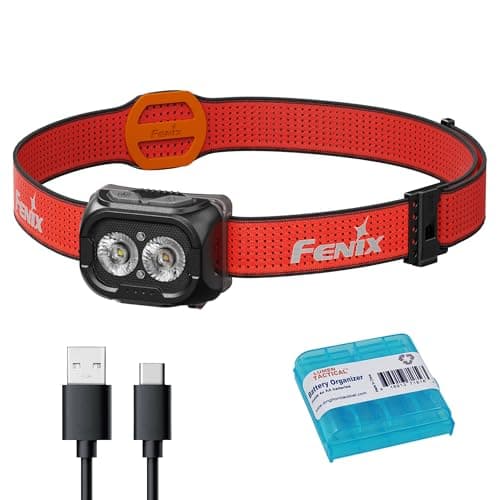 Fenix HL18R-T V2.0Top pick103 g, 800 lumens, and an AAA fallback. The cheapest lamp here that is genuinely built for running rather than adapted to it. | Trail running on a budget | 800 lm / 103 g (3.63 oz) |
We earn a commission if you buy through the links on this page, at no extra cost to you. It does not change what we recommend or the order they appear in. Full disclosure. Prices checked September 27, 2026.
We have not tested this headlamp. We own none of the products on this site and have no laboratory. This review works from Fenix's own product page, read on September 27, 2026, and the arithmetic those figures allow.
Most headlamps in this bracket differ from each other by a few lumens and a strap design. The HL18R-T has something genuinely unusual: two white emitters at different color temperatures — a cool one around 6000 K and a warm one around 3000 K with a stated CRI of 80 — plus two red LEDs. Nothing else in our headlamp set does that.
What Fenix publishes
| Specification | Published figure |
|---|---|
| Maximum output | 800 lm |
| Maximum beam distance | 125 m (410 feet) |
| Maximum runtime | 160 h |
| Emitters | Luminus SST25 cool white, SST20 warm white CRI80, 2 x 2835 red |
| Modes | 10 — four cool white, four warm white, red, red SOS |
| Color temperature | about 6000 K cool, about 3000 K warm |
| Battery | 1,900 mAh Li-ion pack (included), or 3 x AAA |
| Charging | USB-C, about 3 h from empty at 5 V/1 A or above |
| Weight | 103 g (3.63 oz) including battery and headband |
| Ingress protection | IP66 |
| Impact resistance | 1 m |
| Per-mode output and runtime | charted, not stated in text |
The dual color temperature is the reason to buy it
Color rendering index measures how faithfully a light source renders color against a reference. A typical cool-white LED sits around 70; Fenix states CRI 80 for the warm emitter here. That is not a high-CRI light by flashlight-enthusiast standards, but it is meaningfully better than the cold emitter beside it, and having both in one head is the point.
- Cool white at 6000 K cuts through distance and looks brighter for the same output. It is what you want on a path at speed.
- Warm white at 3000 K with CRI 80 renders color and reduces the flat, blue-gray cast that makes a cold beam tiring to read by. It is what you want in a tent, over a map, or working on something.
- Red, with an SOS mode, for preserving dark adaptation and for being found.
Warm light also scatters less usefully in mist and rain than people assume — the effect is real but modest. The honest reason to want two color temperatures is not weather; it is that one beam is better for moving and the other is better for looking at things. CRI explained covers what the number does and does not tell you.
Energy, computed
The AAA fallback is the practically valuable part. Three alkaline AAA cells hold roughly 3.9 watt-hours between them — a little over half the pack — and they are available anywhere. A flat lamp on the third night of a trip becomes a two-minute problem instead of a dead one.
The beam, computed
4.9 candela per lumen is a moderately wide beam, close to the Fenix HM65R-T's 4.5 and wider than the HM75R's 7.8. Sensible for running: enough spread to see your footing, enough concentration to read the path ahead.
IP66 is the odd rating out
IP66 is the only one on this site — every other rated lamp we cover is IPX4, IPX7 or IP68. The 6 in the first position means dust-tight, which almost no headlamp publishes; the 6 in the second means protection against powerful water jets, which is more than rain and less than immersion.
For a running lamp that is a sensible place to land. It will not mind a downpour or a dusty trail and it is not rated to be dropped in a stream. The Fenix HM65R-T publishes IP68 if immersion matters.
What it costs you
- Per-mode figures are charted, not printed. Fenix states 800 lumens, 125 m and 160 hours as maxima and puts the level-by-level breakdown in an image. Petzl prints the whole table in text, and that difference is why Petzl outranks Fenix in our brand ranking.
- 160 hours describes the lowest mode, not anything you would run on. Treat it as a reserve figure.
- 125 m is the shortest published reach of any Fenix lamp we cover.
- 1 m impact resistance, against 2 m on the HM65R-T.
- No candela, so the beam figure above is derived.
- Ten modes on a lamp for running is more interface than most people want at mile eight.
Who should buy something else
Skip it if you want one bright setting and nothing to learn. Ten modes across two color temperatures is a lot of cycling. The Petzl Tikka has three white levels and a red one.
Skip it if grams matter most. 103 g is reasonable and the Petzl Swift LT publishes 43 g.
Skip it if you need immersion protection or real reach. IP66 is not IP68, and 125 m is modest. The HM65R-T publishes 170 m and IP68 for more money and 37 more grams.
Skip it if you want per-mode figures before buying. They exist only in a chart image, and we will not transcribe numbers we cannot read reliably.
The verdict, stated as what it commits to
Fenix commits to 800 lumens, 125 meters, 160 hours at its lowest, a 1,900 mAh pack or three AAA cells, a 3-hour USB-C charge, 103 grams, IP66 and 1 m impact resistance — plus a dual-emitter arrangement giving four cool-white levels at 6000 K, four warm-white levels at CRI 80 and 3000 K, red and red SOS.
Buy it for the two color temperatures, which nothing else here offers and which genuinely change what the lamp is good at. Do not buy it for reach, immersion protection or a printed per-mode table. For the field ranked on what makers actually disclose, see headlamp brands.
The picks, in full
Top pick · Trail running on a budget
Fenix HL18R-T V2.0
103 g, 800 lumens, and an AAA fallback. The cheapest lamp here that is genuinely built for running rather than adapted to it.
1,900 mAh at 3.7 V is about 7.0 watt-hours. That is 83 percent of a Swift RL's tank in a lamp 11 g lighter and considerably cheaper.
The AAA fallback is unusual at this weight and it is the reason to pick this over a sealed running lamp: a flat pack at 2 a.m. is a battery change rather than the end of the night.
IP66 is a step up from the IPX4 that most running lamps ship with. It will not survive immersion, but it will survive a downpour.
What works
- 103 g with three AAA cells as a backup power source
- IP66, better than most of the running field
- A warm-white emitter alongside the cool white, which helps in fog and dust
What does not
- Fenix does not publish a beam distance for it on the pages we read
- The 800-lumen turbo is a short burst, not a setting you can run in
- Proprietary ARB-LP1900 pack for the rechargeable option
Skip this ifyou need to identify things at distance. Without a published beam distance we cannot tell you how far it reaches, and the aperture suggests it is not far.
Published specification
- Output
- 800 lmFenix HL18R-T V2.0 — the brand's own listing on Amazon.com (retrieved September 1, 2026)
- Peak intensity
- not published
- Beam distance
- 125 mFenix states 410 feet (125 m) as the maximumFenix HL18R-T V2.0 — manufacturer spec page (retrieved September 27, 2026)
- Runtime
- 160 h maximumLowest modeFenix HL18R-T V2.0 — manufacturer spec page (retrieved September 1, 2026)
- Battery
- 1,900 mAh Li-ion pack (included), or 3 x AAAFenix HL18R-T V2.0 — manufacturer spec page (retrieved September 1, 2026)
- Weight
- 103 g (3.63 oz)Including battery and headbandFenix HL18R-T V2.0 — manufacturer spec page (retrieved September 1, 2026)
- Ingress
- IP66Dust tight, withstands heavy rain and splashes; 1 m impact resistanceFenix HL18R-T V2.0 — manufacturer spec page (retrieved September 1, 2026)
#ad · how this is funded · price as of September 27, 2026
Questions people actually ask
Is the Fenix HL18R-T V2.0 worth it?
For a running or hiking lamp where you also want good color rendering, yes - it is the only headlamp we cover with both a cool 6000 K emitter and a warm 3000 K CRI80 one, plus a published IP66 and an AAA fallback. It is not the choice for reach, immersion protection or interface simplicity.
How far does the Fenix HL18R-T V2.0 shine?
Fenix publishes 410 feet, or 125 m, as the maximum. That works back to roughly 3,906 candela, about 4.9 candela per lumen - a moderately wide beam. It is the shortest published beam distance of any Fenix lamp we cover.
How long does the Fenix HL18R-T V2.0 run?
Fenix publishes 160 hours as the maximum, which describes the lowest mode rather than a working level. Per-mode runtimes exist only in a chart image on the product page, so we do not quote them. The pack holds a computed 6.8 watt-hours.
What does the warm white light on the Fenix HL18R-T do?
It renders color better. Fenix states CRI 80 at about 3000 K for the warm emitter against a cool one at about 6000 K. Cool white looks brighter and cuts through distance; warm white is easier to read by and shows color more faithfully, which matters over a map or in a tent.
Can the Fenix HL18R-T run on AAA batteries?
Yes - it takes its included 1,900 mAh rechargeable pack or three AAA cells. Three alkaline AAAs hold roughly 3.9 watt-hours, a little over half the pack, so output and runtime will be lower, but a flat lamp far from a socket stops being a problem.
Is the Fenix HL18R-T waterproof?
It publishes IP66, which is the only IP66 on this site. The first 6 means dust-tight and the second means protection against powerful water jets - more than rain, less than immersion. For immersion the Fenix HM65R-T publishes IP68.
Fenix HL18R-T or HM65R-T?
The HL18R-T for dual color temperatures, 103 g and a lower price. The HM65R-T for everything performance-related: 1,600 lumens against 800, 170 m against 125, IP68 against IP66, 2 m impact against 1 m, and a replaceable 18650 with a CR123A fallback.
How many modes does the Fenix HL18R-T have?
Ten: four levels of cool white, four of warm white, red, and red SOS. That is a lot of interface for a running lamp, and it is the main usability criticism - though having both color temperatures available is the reason to buy it in the first place.
Sources
Every figure on this page came from one of the documents below, read on the date shown. We do not cite other review sites, forum posts or video reviews as sources of fact.
- Fenix HL18R-T V2.0 — manufacturer spec page (retrieved September 1, 2026)
- Fenix HM65R-T V2.0 — manufacturer spec page (retrieved September 1, 2026)
- Petzl Tikka — manufacturer spec page (retrieved September 1, 2026)
- ANSI/PLATO FL 1 flashlight performance standard — definitions of lumens, peak beam intensity, beam distance, runtime, impact and water resistance
- IEC 60529 — the IP (ingress protection) rating system
Read next
Best headlamps, ranked on the watt-hours behind the lumens
The full headlamp ranking: output, weight, battery energy and beam distance, every figure sourced to the maker.
Best headlamps for running
Running headlamps ranked on weight, stored energy and beam stability rather than on peak output.
Best rechargeable headlamps
Rechargeable headlamps sorted by cell strategy: sealed, swappable standard cell, or hybrid.
Headlamp brands, ranked on what they tell you
Every headlamp brand we cover, ranked on specification disclosure — from the one publishing watt-hours to the three publishing only a lumen figure.

Fenix HM65R-T V2.0 review
A specification-first review of the Fenix HM65R-T V2.0: what the published figures mean, what they do not cover, and who should buy something else.
CRI explained
What CRI measures, the R9 problem, the output cost, and how CRI differs from color temperature.
Found a number that is wrong? Tell us and we will fix it and say so. Our methodology shows every formula on this page.