Headlamps
Coast XPH34R review
One of the brightest headlamps we cover, from the brand that publishes the least about any of them. This review is mostly about what that costs you.
By Scooter M. · Published · Updated
| # | Product | Best for | Output / weight | Price |
|---|---|---|---|---|
| 1 | 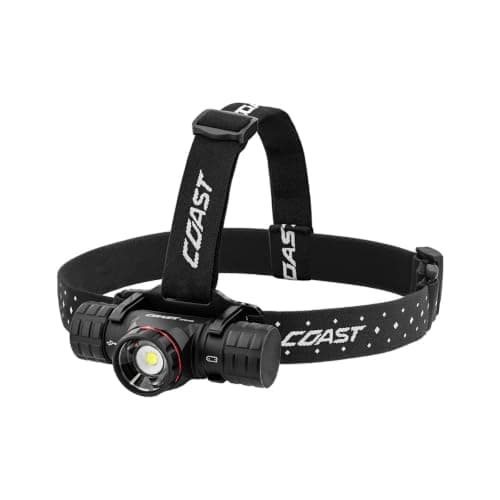 Coast XPH34RTop pick2,700 lumens, a twist-focus beam, and dual-power operation on either the rechargeable pack or alkaline cells. | Maximum output with a swappable power source | 2,700 lm |
We earn a commission if you buy through the links on this page, at no extra cost to you. It does not change what we recommend or the order they appear in. Full disclosure. Prices checked September 21, 2026.

We have not tested this headlamp, own none of the products on this site, and have no laboratory. This review works from what Coast publishes — and the defining fact about the XPH34R is how little that is.
Coast finished eighth of ten in our headlamp brand ranking, in the group that publishes output and nothing else. Writing a review of a product whose maker states one number is an unusual exercise, and the honest version of it is to be clear about what can and cannot be said.
What Coast publishes
| Specification | Published figure |
|---|---|
| Maximum output | 2,700 lm |
| Power | Dual power: rechargeable pack or alkaline cells |
| Beam distance | not published |
| Runtime | not published |
| Battery capacity | not published |
| Weight | not published |
| Ingress protection | not published |
| Peak candela | not published |
One figure and a power arrangement. For context, Petzl publishes output, beam distance, runtime, watt-hours, weight and an IPX rating for every lamp we cover, and gives the runtime table twice — once for each power source.
The dual-power arrangement is the real feature
Strip the lumen headline away and there is a genuine advantage here: the XPH34R takes either its rechargeable pack or ordinary alkaline cells in the same body.
That matters more than most spec-sheet items. A sealed rechargeable lamp with a flat pack on the third night of a trip is an object; a dual-fuel lamp takes cells from any shop. Among the high-output headlamps we cover it is close to unique — the Nitecore HC75 UHE, Olight Perun 3 and Nitecore NU43 are all rechargeable-only. Petzl's hybrid lamps do the same thing at far lower output, and the Actik Core review covers what that trade looks like when a maker publishes both tables.
The honest caveat: because Coast publishes no figures for either power source, we cannot tell you whether output or runtime changes when you switch to alkalines. On the Petzl Actik Core, which does publish both, peak output drops by 28 percent on AAA cells. Whether the same happens here is unknown.
The focusing head, and what it costs
Coast has built its range around a twist-focus head, and the XPH34R has one. It is the brand's signature and the most refined focusing mechanism among the lamps we cover, so it deserves a fair account rather than a dismissal.
What you gain is one lamp that does two beam shapes. Twisted wide it is a flood for close work; twisted narrow it concentrates into a spot for distance. On a lamp bought for mixed use — camping, a job site, a property at night — that is genuinely useful, and it is something a fixed reflector cannot do at any price.
What you lose is efficiency. A focusing optic has to move light through a lens rather than bounce it off a reflector, and every optical surface absorbs and scatters some of it. A focusing lamp gives up output and usually some beam quality against a fixed reflector of the same aperture. That is a physical trade, not a manufacturing flaw.
The consequence here is specific: because Coast publishes no beam distance, you cannot tell how much reach the narrow setting actually buys. A twist-focus head that concentrates well and one that produces a slightly tighter circle of the same brightness look identical on a spec sheet with no candela figure. Throw versus flood explains what the missing number would have settled.
This is a range-wide pattern, not one thin listing
It would be unfair to judge a brand on one product, so it is worth noting that the XPH34R is not an outlier. The Coast FL85R, its tri-color hunting lamp, publishes 1,000 lumens and — on the listings we could source — no beam distance, runtime, weight or ingress rating either.
Two products is a pattern. It puts Coast in the same disclosure group as Klein Tools and Black Diamond in our headlamp brand ranking, and a long way behind Petzl, which publishes a full per-mode table for every lamp, and Fenix, which publishes beam distance, weight and an IP code.
Nothing about that makes Coast's hardware bad. It makes Coast's hardware unevaluable from the outside, which is a different claim and the only one we are in a position to make.
What cannot be said about this lamp
This is the section that would normally be arithmetic. Here it is a list of things the published data does not support:
- How far it throws. No beam distance and no candela, so the reach cannot be computed. A 2,700-lumen lamp could be a wide flood or a moderate thrower and nothing published distinguishes them.
- How long it runs, at any level. No runtime and no battery capacity, so neither the figure nor the arithmetic is available.
- Whether it survives weather. No ingress rating. Not a claim that it fails, but an unknown on a lamp sold for the outdoors.
- What it weighs. No figure, on the specification you notice most after an hour.
- What the alkaline fallback costs. No second table.
Who should buy it anyway
There is a real buyer for this lamp, and it is not a hypothetical one. If you want the most output available with a fallback to shop-bought cells, and you are content to judge the rest by handling it yourself, the XPH34R is one of very few lamps that offers that combination. Coast is widely stocked, which is its own kind of practical advantage.
It is also the cheapest high-output headlamp we cover, and the 3,000-lumen Nitecore and Olight lamps publish no runtime either — so you are not giving up disclosure by choosing it over them. Against Petzl or Fenix you plainly are.
Who should buy something else
Skip it if you plan around numbers. If knowing the runtime, weight or waterproofing before you spend matters, this lamp cannot serve you and no amount of output changes that. The Fenix HM65R-T publishes all three.
Skip it if you need reach. With no beam distance published you are buying blind on the one thing lumens do not tell you. See the brightest headlamps for what happens when output and reach are compared directly.
Skip it if it will be rained on hard. No ingress rating. Fenix publishes IP68 on the HM65R-T and Petzl IPX4 across its range.
The verdict, stated as what it commits to
Coast commits to one thing about the XPH34R: 2,700 lumens, with the option of alkaline cells. That is a real and unusual combination, and for a buyer who wants maximum output without a proprietary-charging dependency it is a defensible purchase.
Everything else about this lamp is something you will find out after buying it rather than before. That is not a verdict on the hardware, which may well be excellent — it is a verdict on the sheet, and on this site the sheet is what we can actually judge. If that bothers you, buy from a maker that publishes more; if it does not, this is the brightest dual-fuel lamp we cover.
The picks, in full
Top pick · Maximum output with a swappable power source
Coast XPH34R
2,700 lumens, a twist-focus beam, and dual-power operation on either the rechargeable pack or alkaline cells.
Dual power is the same hybrid idea Petzl and Fenix use, and it is the single most practically valuable feature a headlamp can have.
2,700 lumens is the largest headline on this page. Treat it as a burst; sustained output on any headlamp is limited by what your forehead will tolerate as heat.
The twist focus is Coast's signature. It works, and it costs you some throw efficiency compared with a fixed reflector of the same aperture.
What works
- Runs on rechargeable or disposable cells
- The highest published output of any lamp in the headlamp set
- Twist focus covers flood and spot from one head
What does not
- No sourced runtime, weight, beam distance or IP rating
- 2,700 lumens on a head-mounted light is a heat problem before it is a light problem
- Bulky next to the running lamps
Skip this ifyou plan to wear it for hours. Output this high on a headlamp is a burst tool and the mass reflects it.
Published specification
- Peak intensity
- not published
- Beam distance
- not published
- Runtime
- not published
- Battery
- Dual power: rechargeable pack or alkaline cellsCoast XPH34R — the brand's own listing on Amazon.com (retrieved September 1, 2026)
- Weight
- not published
- Ingress
- not published
#ad · how this is funded · price as of September 21, 2026
Questions people actually ask
Is the Coast XPH34R worth it?
It offers something rare - 2,700 published lumens with the option of running on ordinary alkaline cells - and it is cheaper than the 3,000-lumen rechargeable-only lamps we cover. The cost is disclosure: Coast publishes no runtime, beam distance, weight, battery capacity or ingress rating for it.
How long does the Coast XPH34R run?
Coast does not publish a runtime, and it does not publish a battery capacity either, so there is no figure to quote and no arithmetic available to estimate one. We will not invent a number. On any 2,700-lumen headlamp, expect the peak to be a burst rather than a working level.
Does the Coast XPH34R take regular batteries?
Yes - it is dual power, taking either its rechargeable pack or alkaline cells in the same body. Among high-output headlamps that is unusual and genuinely useful, because a flat sealed lamp with no socket nearby is an object. Coast does not publish whether output or runtime changes on alkalines.
How far does the Coast XPH34R throw?
Unknown. Coast publishes neither a beam distance nor a peak candela figure, so there is nothing to compute from. Lumens alone cannot answer a reach question - our lumens versus candela guide explains why.
Is the Coast XPH34R waterproof?
Coast publishes no ingress rating for it, so we do not state one. That is a disclosure gap rather than evidence it leaks. If a published rating matters, the Fenix HM65R-T states IP68 and Petzl states IPX4 across its range.
Coast XPH34R or Nitecore HC75 UHE?
The Nitecore publishes 3,000 lumens and 192 m of reach; the Coast publishes 2,700 and no distance. Neither publishes a runtime, weight or IP rating. The Coast's advantage is the alkaline fallback; the Nitecore's is a published beam distance and a zoomable head.
Which headlamp brands publish the most specifications?
Petzl, then Fenix. Petzl publishes output, beam distance, runtime, battery watt-hours, weight and an IPX rating on every lamp we cover. Coast, Black Diamond and Klein Tools publish output alone. Our headlamp brand ranking sets out all ten.
Sources
Every figure on this page came from one of the documents below, read on the date shown. We do not cite other review sites, forum posts or video reviews as sources of fact.
- Coast XPH34R — the brand's own listing on Amazon.com (retrieved September 1, 2026)
- Fenix HM65R-T V2.0 — manufacturer spec page (retrieved September 1, 2026)
- Petzl — ANSI/PLATO FL 1 technical information for its headlamp range
- ANSI/PLATO FL 1 flashlight performance standard — definitions of lumens, peak beam intensity, beam distance, runtime, impact and water resistance
- IEC 60529 — the IP (ingress protection) rating system
Read next
Best headlamps, ranked on the watt-hours behind the lumens
The full headlamp ranking: output, weight, battery energy and beam distance, every figure sourced to the maker.
Headlamp brands, ranked on what they tell you
Every headlamp brand we cover, ranked on specification disclosure — from the one publishing watt-hours to the three publishing only a lumen figure.

The brightest headlamps, and what the lumens actually buy
Nine of the highest-output headlamps we cover, ranked on published lumens with the reach and runtime figures that contradict the ranking.
Best rechargeable headlamps
Rechargeable headlamps sorted by cell strategy: sealed, swappable standard cell, or hybrid.
Fenix HM65R-T V2.0 review
A specification-first review of the Fenix HM65R-T V2.0: what the published figures mean, what they do not cover, and who should buy something else.
Petzl Actik Core review
A specification-first review of the Petzl Actik Core: the full per-mode table, what the AAA fallback actually costs you, and who should buy something else.
Found a number that is wrong? Tell us and we will fix it and say so. Our methodology shows every formula on this page.