Headlamps
Nitecore NU25 UL review
Forty-seven grams, three color temperatures, and the most concentrated headlamp beam we compute anywhere - including Nitecore's own lamp with three and a half times the output.
By Scooter M. · Published · Updated
| # | Product | Best for | Output / weight | Price |
|---|---|---|---|---|
| 1 | 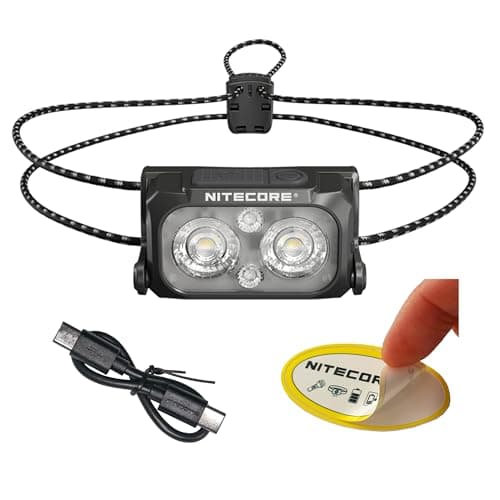 Nitecore NU25 ULTop pick400 lumens, USB-C, and multiple color temperatures in an ultralight body. The thru-hiker default for good reason. | The lightest rechargeable that still has three emitters | 400 lm / 47 g |
We earn a commission if you buy through the links on this page, at no extra cost to you. It does not change what we recommend or the order they appear in. Full disclosure. Prices checked November 1, 2026.
Buy the NU25 UL if you want the lightest rechargeable lamp we cover that still has real reach and a choice of light color. Nitecore publishes 47 grams including the bracket and headband, 400 lumens, 132 meters, 4,351 candela, IP66, and three color temperatures plus red. The figure that will surprise you is the reach: at 10.9 candela per lumen this is the most concentrated headlamp beam on this site, and its 132 m beats the 130 m Nitecore publishes for its own 1,400-lumen NU43. The limit is energy - a 700 mAh cell is 2.6 watt-hours, the smallest store of any rechargeable lamp here.
We have not tested this headlamp. We own none of the products on this site, we have no laboratory, and nothing here is an impression of how it feels on a head after six hours. This review takes every figure Nitecore publishes, runs the arithmetic those figures allow, and says what they do and do not commit the company to.
It also settles an argument this site has been having with itself. Until today we wrote, in four separate places, that the NU25 UL's reputation as the ultralight default was "doing work the published data does not" - because we had recorded its weight, beam distance, candela, runtime and ingress rating as unpublished. All five are published, and have been, on Nitecore's own product page. This is the third Nitecore page we have found by reading nitecore.com/sitemap.xml after guessing a URL wrongly, following the P30i and the NU43. Every page that called the weight unavailable has been corrected in the same change as this one.
The published specification
| Specification | Published figure |
|---|---|
| Maximum output | 400 lm |
| Max beam distance | 132 m |
| Max beam intensity | 4,351 cd |
| Color temperatures | 3,000 K warm, 4,500 K neutral, 6,500 K cool, plus auxiliary red |
| Maximum runtime | 45 h |
| Battery | Built-in 700 mAh Li-ion |
| Stored energy | 2.6 Wh (computed from 700 mAh at 3.7 V) |
| Charging | USB-C, with a USB-C to USB-C cable in the box |
| Weight | 47 g (1.66 oz), bracket and headband included |
| Dimensions | 60.0 x 33.0 x 25.7 mm, bracket included |
| Emitter | NiteLab MCT UHE, dual-core |
| Modes | 4 brightness levels, 3 special modes, 2 red brightness options |
| Ingress protection | IP66 |
| Impact resistance | 1 m |
| Housing | PC |
| In the box | Bracket and headband, USB-C cable, diffusing stuff sack |
| Per-mode runtime table | Not published |
| Color rendering | Not published |
| Charge-cycle life | Not published |
Sixteen published figures and three gaps. The notable absence is CRI, on a lamp whose headline feature is a choice of three color temperatures - more on that below.
The surprise: this is the longest-reaching headlamp we cover
Nitecore publishes both a beam distance and a peak intensity here, which means the two figures check each other. Under ANSI FL 1 beam distance is the point where illuminance falls to 0.25 lux, so the relationship is fixed and exact.
Put that next to the rest of Nitecore's own range and it produces the most useful single fact on this page. This 400-lumen lamp publishes 132 meters. Nitecore's 1,400-lumen NU43 publishes 130. Three and a half times the output, two meters less reach - from the same company, in the same catalog. If you have ever wondered whether lumens buy distance, that pair answers it more cleanly than anything else we have found.
What it means in use is that the NU25 UL is the unusual ultralight lamp that can actually pick something out at a distance. What it gives up is spill: a beam that concentrated puts proportionally less light at your feet and in the verges, which is the trade throw versus flood sets out. For a lamp you walk by, the NU43's wide 2.7 is arguably the better shape; for spotting a cairn or a trail marker, this one is.
The weight question, finally answered
47 grams, bracket and headband included. That phrasing matters, and Nitecore deserves credit for it: most makers publish a weight without saying what is on the scale, so the figures across a category are not strictly comparable.
| Lamp | Published weight | What the maker says it includes |
|---|---|---|
| Petzl Swift LT | 43 g | Not specified |
| Streamlight Bandit Pro | 45.4 g | Not specified |
| Nitecore NU25 UL | 47 g | Bracket and headband |
| Fenix HM50R V2.0 | 78 g | Not specified |
| Black Diamond Spot 400-R | 86 g | Not specified |
| Petzl Actik Core | 88 g | Not specified |
So on the raw numbers the NU25 UL is third, within 4 grams of the lightest - and it is the only one of the three whose maker tells you the headband is on the scale. We are not going to re-rank the table on an assumption about what the other two figures cover; we are going to point out that the NU25 UL's reputation for being the lightest practical rechargeable is now defensible from a published figure rather than from forum consensus, which is all we previously had.
Three color temperatures, and the figure that is missing
The feature this lamp is actually sold on is its dual-core MCT emitter: 3,000 K warm, 4,500 K neutral and 6,500 K cool white, plus auxiliary red with two brightness options. Nothing else we cover offers three white color temperatures in one lamp; the Fenix HL18R-T offers two.
Why it matters outdoors is scattering. Cool white at 6,500 K scatters hardest off fog, dust and falling snow, which is why a bright cool beam can be worse than a dimmer warm one in bad air. Warm light at 3,000 K cuts through it and renders browns and reds more naturally, which helps on a trail or a map. Our CRI explained guide covers how color temperature and color rendering differ - they are routinely confused, and they are not the same thing.
Which is exactly where the gap bites. Nitecore publishes no CRI figure for any of the three temperatures. Color temperature tells you the tint of the light; CRI tells you whether colors under it look like themselves. A lamp sold on light quality that publishes the first and not the second is answering half the question. Only two products on this site publish a CRI figure at all - the Acebeam Pokelit AA at 90-plus and the Wurkkos FC11C at 90 - so this is a category failing rather than a Nitecore one, but on this particular lamp it is the figure we would most want.
Two point six watt-hours is the real constraint
Nitecore publishes the cell capacity, which lets the lamp be placed on the measure this site uses across the whole category: stored energy against the weight you carry.
This is the honest counterweight to everything good above. An ultralight lamp is light because it carries less energy, not because it is more efficient, and 2.6 watt-hours is a genuine limit on how long 400 lumens can last. If you want both light weight and endurance, the comparison to make is against the NU43, which carries nearly five times the energy for 69 grams more.
Forty-five hours, and what it does not tell you
Nitecore publishes one runtime figure: a 45-hour maximum. There are four brightness levels, three special modes and two red brightness options, and the 45 hours is not attached to any of them. That is a thinner disclosure than the NU43 manages, where Nitecore at least names 8 lumens and 100 lumens as two separate points.
How runtime is defined sets out the ANSI FL 1 rule these figures are measured under - time until output falls to a tenth of where it started - which is a second reason the single headline number is not a working figure.
IP66: the one place the sheet goes backwards
Nitecore publishes IP66 and a 1 m impact rating. Under IEC 60529 the first 6 is dust tight and the second is protection against powerful water jets - not immersion. That is a real step down from the IP68 Nitecore publishes for the NU43 and Fenix publishes for the HM65R-T, both of which state submersion to 2 meters.
For walking, backpacking and camping in rain, IP66 is enough; dropped in a creek, it is not a rating that covers you. It is better than the IPX4 Petzl publishes across the Tikkina, Tikka and Actik Core, because the dust digit is real and jets are a harder test than splashing. But if the lamp is going near water, the Princeton Tec Vizz publishes IPX7 immersion on replaceable AAA cells and the Black Diamond Spot 400-R publishes IP67.
Small details that are published and worth knowing
- Two buttons, deliberately different in shape and feel, which Nitecore states is for one-handed operation. On a lamp you adjust with gloves on in the dark, that is a design decision rather than a specification, and it is the right one.
- A diffusing stuff sack in the box. Pull it over the lamp and you have a small lantern - a genuinely useful inclusion on a lamp this size, and the kind of thing most makers charge extra for.
- A USB-C to USB-C cable, not USB-A to C. Worth knowing if everything else you carry still charges from an A port.
- Power indicators for remaining charge, which matters on a sealed 700 mAh cell where running out is the whole failure mode.
- No charge-cycle figure. On a built-in battery that is the gap we would most like filled - Petzl states three years or 300 cycles for the Swift LT.
Who should buy something else
Skip it if you need a night's light rather than a night's weight. 2.6 watt-hours is the smallest store here. The Nitecore NU43 carries 12.6 Wh at 116 g, and the Fenix HM65R-T 12.2 Wh with a replaceable 18650 and a CR123A fallback.
Skip it if the lamp will be immersed. IP66 covers jets, not submersion. The Vizz publishes IPX7 and the Spot 400-R IP67.
Skip it if you want a runtime you can plan with. One figure for nine settings, with no level attached, is the thinnest runtime disclosure of any lamp we have reviewed - and the arithmetic says it belongs to the dimmest setting.
Skip it if the battery has to outlive the lamp. The cell is sealed and no cycle life is published. The Petzl Tikka and Tikkina run on three AAA cells you can buy anywhere, which is also the right answer for a car or a drawer.
The verdict, stated as what it commits to
Nitecore commits to 400 lumens, 132 meters, 4,351 candela, three color temperatures plus red, 47 grams with the bracket and headband, a 700 mAh cell, a 45-hour maximum, IP66 and a 1 m drop rating - and the two beam figures agree to within a tenth of a percent, which is as good as disclosure gets. For backpacking, fastpacking or anything where grams are the budget and you still want to see something at distance, this is the lamp, and its reputation is now backed by the maker's own numbers rather than by consensus.
What it does not commit to is a CRI figure on a lamp sold on light color, a runtime attached to any particular level, or a cycle life on a sealed cell - and 2.6 watt-hours is a hard ceiling no interface design gets around. Buy it for weight, reach and color choice. Buy something else if you need endurance, immersion, or a battery you can replace. For the category ranked on what each maker actually prints, see headlamp brands compared.
The picks, in full
Top pick · The lightest rechargeable that still has three emitters
Nitecore NU25 UL
400 lumens, USB-C, and multiple color temperatures in an ultralight body. The thru-hiker default for good reason.
The multiple-color-temperature version is the interesting one. A warm emitter beside a cool one is genuinely more useful in fog, dust and snow than another 200 lumens would be.
The surprise on the sheet is reach. 4,351 candela from 400 lumens is 10.9 candela per lumen - the most concentrated headlamp beam we compute anywhere - and its published 132 m beats the 130 m Nitecore publishes for the 1,400-lumen NU43.
47 grams with the bracket and headband included is a published figure, which this catalogue previously recorded as unavailable. Its reputation as the ultralight default turns out to be supported by the maker's own number.
The cell is the limit: 700 mAh is 2.6 watt-hours, which is 5.5 Wh per 100 g and near the bottom of the energy-density table. A very small cell pays a proportionally large penalty for its casing.
What works
- Three color temperatures plus red, which matters more than peak lumens outdoors
- A published 47 g including bracket and headband, and Nitecore says what the figure covers
- 10.9 candela per lumen: it reaches further than Nitecore's own 1,400-lumen NU43
- USB-C, built-in cell, nothing proprietary to lose
What does not
- We could not source a weight, runtime, beam distance or IP rating
- Built-in cell: when it degrades the lamp is done
- 400 lumens is modest if you want to see down a valley
Skip this ifyou want a spec sheet you can check. Petzl and Fenix publish full ANSI tables; for this one we could not get past the retail listing.
Published specification
- Peak intensity
- 4,351 cdReconciles with the published 132 m to within 5 cd: 0.25 x 132 x 132 = 4,356. At 10.9 candela per lumen it is the most concentrated headlamp beam we compute.Nitecore NU25 UL — manufacturer spec page (retrieved October 30, 2026)
- Beam distance
- 132 mNitecore NU25 UL — manufacturer spec page (retrieved October 30, 2026)
- Runtime
- 45 h maximumOne figure, with no level attached, covering four brightness levels, three special modes and two red options.Nitecore NU25 UL — manufacturer spec page (retrieved October 30, 2026)
- Battery
- Built-in 700 mAh Li-ion, USB-C2.6 Wh at a 3.7 V nominal cell.Nitecore NU25 UL — manufacturer spec page (retrieved October 30, 2026)
- Weight
- 47 g1.66 oz, bracket and headband included - Nitecore states what the figure covers, which most makers do not. 60.0 x 33.0 x 25.7 mm.Nitecore NU25 UL — manufacturer spec page (retrieved October 30, 2026)
- Ingress
- IP66Dust tight and protected against powerful water jets, but not immersion. 1 m drop rating.Nitecore NU25 UL — manufacturer spec page (retrieved October 30, 2026)
- CRI
- not published(Three color temperatures offered; no CRI figure stated)
#ad · how this is funded · price as of November 1, 2026
Questions people actually ask
How long does the Nitecore NU25 UL last?
Nitecore publishes a single 45-hour maximum and does not say which of the lamp's nine settings it belongs to. Our arithmetic puts it on the lowest: 2.6 watt-hours over 45 hours is about 58 milliwatts of average draw, which at any efficacy a headlamp achieves is a single-digit-lumen output. No runtime is published for the 400-lumen mode.
How much does the Nitecore NU25 UL weigh?
47 grams, or 1.66 oz, and Nitecore states that the figure includes the bracket and the headband - which most makers do not specify. That makes it the third-lightest lamp we cover on raw numbers, behind the Petzl Swift LT at 43 g and the Streamlight Bandit Pro at 45.4 g, neither of which says what its figure covers.
Is the Nitecore NU25 UL worth it?
For weight-conscious use, yes. It publishes 47 g, 400 lumens, 132 m, 4,351 candela, three color temperatures and IP66, and its two beam figures reconcile to within a tenth of a percent. The honest limits are a 700 mAh cell - 2.6 watt-hours, the smallest of any rechargeable lamp we cover - one unattached runtime figure, and no CRI number on a lamp sold on light quality.
How far does the Nitecore NU25 UL shine?
Nitecore publishes 132 meters and 4,351 candela, and those two figures agree almost exactly. That works out to 10.9 candela per lumen, the most concentrated headlamp beam we compute on this site - and it means this 400-lumen lamp out-reaches Nitecore's own 1,400-lumen NU43, which publishes 130 m.
Is the Nitecore NU25 UL waterproof?
It is IP66 rated, which under IEC 60529 means dust tight and protected against powerful water jets - but not immersion. Rain is fine; a creek is not covered. That is a step below the IP68 Nitecore publishes for its own NU43, and below the IPX7 and IP67 that the Princeton Tec Vizz and Black Diamond Spot 400-R publish.
What are the three color temperatures for?
3,000 K warm, 4,500 K neutral and 6,500 K cool white, plus red. Cool white scatters hardest off fog, dust and falling snow, so a warm beam often shows you more in bad air and renders browns and reds more naturally. Note that Nitecore publishes no CRI figure for any of them, so the tint is specified and the color accuracy is not.
Nitecore NU25 UL or NU43?
The NU25 UL for weight and reach, the NU43 for endurance. The NU25 UL publishes 47 g and 132 m; the NU43 publishes 116 g, 130 m and 1,400 lumens on a 3,400 mAh cell - nearly five times the stored energy for 69 grams more. The NU43 also publishes IP68 against the NU25's IP66. If grams are your budget, the little one; if hours are, the big one.
Can you replace the battery in the Nitecore NU25 UL?
No. The 700 mAh Li-ion cell is built in and charges over USB-C, and Nitecore publishes no charge-cycle figure, so there is no stated point at which it is expected to lose capacity. If you want a lamp whose power source you can swap in the field, the Petzl Tikka and Tikkina take three AAA cells and publish full runtime tables for them.
Does the Nitecore NU25 UL come with anything useful?
Three things Nitecore lists: the bracket and headband, a USB-C to USB-C charging cable, and a diffusing stuff sack that turns the lamp into a small lantern. The last is a genuinely useful inclusion at this size and weight, and most makers charge extra for a diffuser.
Sources
Every figure on this page came from one of the documents below, read on the date shown. We do not cite other review sites, forum posts or video reviews as sources of fact.
- Nitecore NU25 UL — manufacturer spec page (retrieved October 30, 2026)
- Nitecore NU43 — manufacturer spec page (retrieved October 24, 2026)
- Petzl Swift LT — manufacturer spec page (retrieved September 1, 2026)
- Streamlight Bandit Pro — manufacturer spec page (retrieved September 1, 2026)
- Fenix HM65R-T V2.0 — manufacturer spec page (retrieved September 1, 2026)
- ANSI/PLATO FL 1 flashlight performance standard — definitions of lumens, peak beam intensity, beam distance, runtime, impact and water resistance
- IEC 60529 — the IP (ingress protection) rating system
Read next
Best headlamps, ranked on the watt-hours behind the lumens
The full headlamp ranking: output, weight, battery energy and beam distance, every figure sourced to the maker.
Best headlamps for backpacking
Backpacking headlamps ranked on the grams-per-watt-hour trade, computed from published figures.
Best headlamps under $50
Seven headlamps in the sub-$50 bracket, ranked on what their makers actually publish, with the gaps named and live prices on every pick.

Best headlamps for hiking
Hiking headlamps ranked on hybrid power, published runtime and weight — not on peak output.
Best headlamps for camping
Camping headlamps ranked on red-mode access, replaceable cells and honest runtime figures.
Headlamp brands, ranked on what they tell you
Every headlamp brand we cover, ranked on specification disclosure — from the one publishing watt-hours to the three publishing only a lumen figure.
The brightest headlamps, and what the lumens actually buy
Nine of the highest-output headlamps we cover, ranked on published lumens with the reach and runtime figures that contradict the ranking.
Nitecore NU43 review
A specification-first review of the Nitecore NU43: 12.6 watt-hours in 116 grams, the widest beam we compute anywhere, and the two published numbers that contradict each other.
Petzl Swift LT review
A specification-first review of the Petzl Swift LT: what 43 grams and 3.27 watt-hours actually cover, and the three things that weight costs you.
Streamlight Bandit Pro review
A specification-first review of the Streamlight Bandit Pro: 45.4 grams, a published runtime for both levels, a diffused close-range beam, and the two-year warranty that goes with it.
Nitecore vs Black Diamond headlamps
Nitecore against Black Diamond on published headlamp output and features — the least documented matchup on this site, and what you can still decide from it.
Nitecore vs Fenix
Nitecore against Fenix: output per dollar against specification completeness, across headlamps and handhelds.
Throw vs flood
How reflector geometry produces throw or flood, what each suits, and where the middle ground lives.
CRI explained
What CRI measures, the R9 problem, the output cost, and how CRI differs from color temperature.
Flashlight runtime, computed
How runtime is defined, why thermal step-down happens, and the arithmetic to compute a real figure yourself.
Found a number that is wrong? Tell us and we will fix it and say so. Our methodology shows every formula on this page.