Headlamps
Black Diamond Spot 400-R review
A complete published spec sheet from the brand this site had recorded as publishing almost nothing - and an arithmetic result that says the 200-lumen setting costs you no light at all.
By Scooter M. · Published · Updated
| # | Product | Best for | Output / weight | Price |
|---|---|---|---|---|
| 1 | 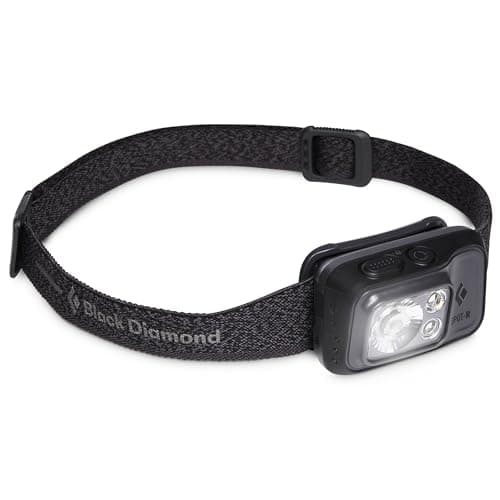 Black Diamond Spot 400-RTop pick400 lumens, red night vision, and brightness memory, from the brand most likely to already be in your gear closet. | Camping with a red mode that stays put | 400 lm / 86 g |
We earn a commission if you buy through the links on this page, at no extra cost to you. It does not change what we recommend or the order they appear in. Full disclosure. Prices checked October 23, 2026.

Buy the Spot 400-R if the lamp will get wet and you want a red mode you can reach in one press. Black Diamond publishes 400/200/6 lumens, 100/60/12 meters, 4/8/225 hours of burn time, 86 g, a 1,500 mAh cell and IP67 immersion - and IP67 is a better rating than any Petzl lamp we cover carries. What you give up is the thing its own non-rechargeable twin still has: three AAA cells when the battery is flat.
We have not tested this headlamp. We own none of the products on this site, we have no laboratory, and nothing here is an impression of how it sits on a head. This review takes every figure Black Diamond publishes, runs the arithmetic those figures allow, and says what they do and do not commit the company to. Black Diamond's own page carries a customer star rating; we ignore it, because an aggregated rating is not a specification and this site publishes none.
It also completes a correction. Until October 2026 this site described Black Diamond as a brand that "publishes output alone", because the only source we had reached was an Amazon listing. Black Diamond's own product page publishes a fuller sheet than Nitecore, Olight or Coast manage for anything we cover. That correction was applied across the comparison pages on 2026-10-17; this review is the page that sets the whole sheet out.
The published specification
| Mode | Output | Max beam distance | Max burn time | Computed candela |
|---|---|---|---|---|
| High | 400 lm | 100 m | 4 h | 2,500 cd |
| Medium | 200 lm | 60 m | 8 h | 900 cd |
| Low | 6 lm | 12 m | 225 h | 36 cd |
| Specification | Published figure |
|---|---|
| Weight | 86 g |
| Ingress protection | IP67, stated as tested to operate at least 1.0 m underwater for 30 minutes |
| Battery | Integrated 1,500 mAh Li-ion (BD 1500) |
| Charge port | Micro-USB |
| Stored energy | 5.6 Wh (computed from 1,500 mAh at 3.7 V) |
| Modes | Proximity and distance, dimming, strobe, red night vision, digital lock |
| Red mode | Dimming and strobe; activates without cycling through white |
| Battery meter | Three LEDs over six settings, showing percent remaining |
| Interface | PowerTap, brightness memory, patented digital lockout, second switch for lens mode |
| Headband | Recycled Repreve elastic |
| Warranty | Three years |
| Peak candela | Not published |
| Charge time | Not published |
| Charge-cycle life | Not published |
| Impact resistance | Not published |
Eleven published figures and four named gaps. For a brand this site ranked eighth of ten on disclosure as recently as last month, that is a better sheet than its reputation here suggested - and the gaps are the same ones almost everybody leaves: no candela, no charge time, no cycle count.
The arithmetic: medium costs you nothing
Three output-and-runtime pairs let you work out how much total light each setting delivers from one charge. On this lamp the result is unusual, and it is the single most useful thing on this page.
That evenness is worth stating as a buying consequence. On most lamps the middle setting is the economical one and the top setting wastes energy on heat; here the maker's figures say the choice is purely about how long you need the lamp to last tonight. If you want 400 lumens, take it - it costs you nothing you would have got at 200.
One caveat applies to all three numbers. Black Diamond calls them max burn time, which is the ANSI FL 1 measure: time until output falls to ten percent of where it started. Run the arithmetic against the cell and that definition shows through.
The beam, and a ratio that does not stay still
Black Diamond publishes a distance for each mode and no candela figure at all, so the intensity has to be computed - and under ANSI FL 1 that conversion is exact, because beam distance is defined as the point where illuminance falls to 0.25 lux.
At 6.25 candela per lumen on high this is still a flood-biased lamp, which is correct for something worn on a head - a tight hotspot bobs with every step. For comparison, the dedicated throwers we cover run from 125 to 256 candela per lumen, and a Petzl Actik Core computes to 5.3. Throw versus flood covers the trade, and the brightest headlamps ranks the category on this figure rather than on output.
Five point six watt-hours, and what it buys per gram
Black Diamond publishes the cell capacity, which most headlamp makers do not, and that makes the lamp comparable on the measure this site uses across the category: stored energy against the weight you carry.
So on energy density the Spot 400-R is a better-engineered object than its price suggests. What the number cannot tell you is how long the cell stays that good, because Black Diamond publishes no charge-cycle figure - where Petzl states three years or 300 cycles for the Swift LT and Maglite states 1,000 cycles for the ML150LRX. On a lamp whose battery is not user-replaceable, that is the gap we would most like filled.
IP67, and the IPX8 on the same page
The specification line reads IP67, which Black Diamond glosses as tested to operate at least 1.0 meter underwater for thirty minutes. Under IEC 60529 the 6 is dust tight and the 7 is immersion to a meter. That is the strongest ingress rating of any headlamp we cover except the Fenix HM65R-T's IP68, and it is better than the IPX4 that Petzl publishes across the Tikkina, Tikka and Actik Core - rain resistance, not immersion.
A paragraph of marketing copy further down the same page says the lamp "sports an IPX8 waterproof housing", which is a different claim. We flagged that contradiction when we first read the page and can now explain it: IPX8 is the figure Black Diamond publishes for the non-rechargeable Spot 400, the dual-fuel version of the same lamp, and that paragraph is shared copy carried across from it. The specification line for this product says IP67, and the spec line is what we quote.
It is worth noticing which rating is actually better. IPX8 claims deeper immersion - Black Diamond states 1.1 m for the non-R - but the X means no dust test was declared, and on the AAA version the company adds that if submerged "water may enter the battery compartment". IP67 on this sealed version adds the dust digit and drops that caveat. For a lamp used in dust, grit or snow, the -R has the better sheet of the two. IP ratings explained covers the scale.
The interface is where this lamp actually wins
Specifications are not the whole of a headlamp, and the features Black Diamond publishes here are the ones we would most want on a lamp used in the dark next to other people:
- Red night vision that activates without cycling through white. Black Diamond states this explicitly, and it is the difference between a lamp you can use in a shared tent and one people resent. Petzl does not fit red to the Actik Core at all. See what a red mode is for.
- Brightness memory. The lamp returns to the level you switched it off at, so the dim setting is one press rather than a cycle.
- A patented digital lockout. The lamp cannot switch itself on in a pack or a coat pocket - the failure that flattens a sealed battery before you ever use it.
- PowerTap. A tap jumps from any setting straight to full output and back.
- A battery meter with three LEDs over six states, showing percent remaining. On a lamp with no spare cells, knowing what is left is not a luxury.
- A second switch for lens mode, which is how the proximity and distance beams are selected rather than buried in a press sequence.
None of that is a number we can verify, and we are not going to pretend to have used any of it. They are published features rather than published measurements, and we report them as the maker's claims - but a lockout and a reachable red mode are the two things most likely to matter at 2 a.m., and this lamp is specified with both.
The sealed battery, and the twin that keeps the AAA option
This is the real cost of the -R, and Black Diamond's own catalog makes it easy to measure. The plain Spot 400 publishes the same 400/200/6 lumens and the same 100/60/12 meters, and it is dual-fuel: three AAA cells in the box, or the same BD 1500 pack this lamp has sealed in. On that pack its burn times are 4, 8 and 225 hours - identical to the -R. On AAA cells they are 2.5, 5 and 200.
So the -R is the same lamp with the battery permanently installed and the AAA door removed. Whether that is a good trade is a question about you rather than about the lamp: for a night walk from your own front door it is irrelevant, and for a multi-day trip or a power cut it is decisive. Our car emergency kit page makes the strongest version of that argument.
Micro-USB, in 2026
The charge port is micro-USB. Every other rechargeable lamp we cover that publishes a port type uses USB-C, and the practical consequence is a cable you probably no longer carry for anything else. On a lamp with no battery fallback, the cable is part of the kit, and a connector the rest of your bag has moved on from is a real inconvenience rather than a styling complaint.
Who should buy something else
Skip it if the lamp has to work when it is flat. There is no AAA fallback. The Petzl Actik Core and the Petzl Tikka both take three AAA cells and publish a full table for them, and so does Black Diamond's own non-rechargeable Spot 400.
Skip it if you want the numbers cross-checked. No candela figure means the 100 m claim rests on one published number rather than two that agree. Streamlight, Maglite, SureFire, Nitecore and Acebeam all publish both for at least one product we cover.
Skip it if you need reach. 100 m and 6.25 candela per lumen is a working-distance lamp. For identifying things at distance see the brightest headlamps and expect to pay more and carry more.
Skip it if 400 lumens is not enough. It is ample for walking, camp tasks and close work, and it is not a hunting or search lamp. Headlamps for hunting ranks the lamps built for that.
The verdict, stated as what it commits to
Black Diamond commits to 400, 200 and 6 lumens; 100, 60 and 12 meters; 4, 8 and 225 hours; 86 grams; a 1,500 mAh cell; and IP67 immersion - a complete enough sheet to compute beam concentration, stored energy and total light per charge without asking the company a single question. On a site that ranks lights by what can be checked, that moves this lamp up rather than down, and the arithmetic turns up a genuinely useful result: high and medium deliver the same total light, so the brightness choice is purely about duration.
What it does not commit to is a candela figure, a charge time, a cycle count or an impact rating, and it charges over micro-USB with no cells to fall back on. Buy it for wet weather, a red mode one press away and a lockout that keeps it off in a pack. Buy something else if the lamp must keep working after the battery dies. The two-lamp version of that decision is set out in Petzl Actik Core vs Black Diamond Spot 400-R; for the whole category ranked on disclosure, see headlamp brands compared.
The picks, in full
Top pick · Camping with a red mode that stays put
Black Diamond Spot 400-R
400 lumens, red night vision, and brightness memory, from the brand most likely to already be in your gear closet.
Black Diamond publishes a complete sheet for this lamp on its own site: 400/200/6 lumens, 100/60/12 meters, 4/8/225 hours, 86 grams, IP67 and a 1500 mAh cell. This catalogue previously held four of those as unpublished because we had only read the Amazon listing.
The burn-time figures are FL 1 maximums - measured until output falls to a tenth of where it started - so 4 hours on high is not 4 hours of 400 lumens. 5.6 watt-hours cannot deliver it: that would be a draw no 400-lumen lamp sustains.
Brightness memory is the underrated feature. The lamp comes back on at the level you left it, which means the red mode is one click away rather than a cycle through white.
IP67 is the specification that separates it from the Petzl range at this price. Petzl publishes IPX4 across the Tikkina, Tikka and Actik Core - rain, not immersion.
What works
- A complete published spec sheet: per-mode output, distance and burn time, weight, cell capacity and IP rating
- IP67 immersion, where the obvious Petzl alternatives publish IPX4
- Red night vision with brightness memory and a digital lockout, so you do not blind a tent to get to it
What does not
- Micro-USB in 2026, when almost everything else here charges over USB-C
- No candela figure, so the 100 m distance cannot be cross-checked against an intensity
- No AAA fallback on the -R version: when the sealed cell is flat the lamp is done for the night
Skip this ifyou want a power-source fallback. The Petzl Actik Core and Tikka take three AAA cells when the pack dies; this one does not.
Published specification
- Output
- 400 lmHigh. Medium 200 lm, low 6 lm.Black Diamond Spot 400-R — manufacturer spec page (retrieved October 17, 2026)
- Peak intensity
- not published(Black Diamond publishes distance, not peak intensity)
- Beam distance
- 100 mHigh. 60 m medium, 12 m low.Black Diamond Spot 400-R — manufacturer spec page (retrieved October 17, 2026)
- Runtime
- 4 h high / 8 h medium / 225 h lowPublished as max burn time, the FL 1 measure to 10 percent of initial output - not hours at the stated lumens.Black Diamond Spot 400-R — manufacturer spec page (retrieved October 17, 2026)
- Battery
- Integrated 1500 mAh Li-ion, micro-USB5.6 Wh at a 3.7 V nominal cell. Micro-USB, not USB-C.Black Diamond Spot 400-R — manufacturer spec page (retrieved October 17, 2026)
- Ingress
- IP67Black Diamond states tested to operate at least 1.0 m underwater for 30 minutes. The same page's prose calls the housing IPX8; we quote the spec line.Black Diamond Spot 400-R — manufacturer spec page (retrieved October 17, 2026)
$79.95 · 28% off
#ad · how this is funded · price as of October 23, 2026
Questions people actually ask
How long does the Black Diamond Spot 400-R last?
Black Diamond publishes three max burn times: 4 hours on high (400 lumens), 8 hours on medium (200 lumens) and 225 hours on low (6 lumens). Those are ANSI FL 1 figures, measured until output falls to ten percent of its starting value, so four hours on high is four hours ending near 40 lumens rather than four hours of 400.
Which Spot 400-R mode gives the most light per charge?
High and medium tie exactly. Multiplying output by published burn time gives 1,600 lumen-hours for both 400 lm x 4 h and 200 lm x 8 h, so there is no efficiency reason to choose one over the other - only how long you need the lamp to last. Low delivers 1,350 lumen-hours, about 16 percent less, in exchange for nine days of runtime.
Is the Black Diamond Spot 400-R waterproof?
Yes. The specification line states IP67, which Black Diamond glosses as tested to operate at least 1.0 meter underwater for thirty minutes; under IEC 60529 the 6 means dust tight and the 7 means immersion to a meter. Note that marketing copy on the same page says IPX8 - that is the rating Black Diamond publishes for the non-rechargeable Spot 400, and we quote the spec line for this product.
Black Diamond Spot 400 or Spot 400-R?
Same optics and same output - both publish 400/200/6 lumens and 100/60/12 meters. The difference is power: the plain Spot 400 is dual-fuel, with three AAA cells included or the BD 1500 pack, while the -R has that pack sealed in with no fallback. On the pack their burn times are identical at 4, 8 and 225 hours; on AAA the non-R publishes 2.5, 5 and 200. Buy the -R for a tidier sealed lamp with a dust rating, the non-R if you ever want to drop in shop-bought cells.
How much does the Spot 400-R weigh?
86 grams, as published. Worth knowing that Black Diamond publishes 72 g for the non-rechargeable Spot 400 on the same BD 1500 battery, which is 14 g lighter for what should be the same hardware. We cannot reconcile those two figures, Black Diamond does not explain the difference, and we quote the 86 g published for this product rather than guessing which is right.
Does the Spot 400-R have a red light?
Yes, with dimming and a strobe, and Black Diamond states that it activates without cycling through the white mode - which is the detail that matters in a shared tent. Combined with brightness memory, the red setting is effectively one press away. The Petzl Actik Core at a similar price has no red mode at all.
Does the Spot 400-R charge over USB-C?
No - micro-USB. It is the only rechargeable headlamp we cover that publishes a port type other than USB-C, and since there is no battery fallback, that cable is part of the kit rather than an optional extra.
How far does the Spot 400-R shine?
Black Diamond publishes 100 meters on high, 60 on medium and 12 on low. It publishes no candela figure, but under the ANSI FL 1 definition those work back to about 2,500, 900 and 36 candela - roughly 6.25, 4.5 and 6.0 candela per lumen. The ratios differ because the lamp has separate proximity and distance beams, so it is changing shape rather than only brightness.
Spot 400-R or Storm 500-R?
On published evidence, the Spot. Black Diamond publishes a complete sheet for it - per-mode output, distance and burn time, weight, cell capacity and IP67 - while for the Storm 500-R we could reach no maker page at all and can only assert the 500 lumens and the red, green and blue night-vision modes its retail listing states. The Storm's three-color night vision is genuinely unmatched in our set; everything else about it is unverifiable.
Sources
Every figure on this page came from one of the documents below, read on the date shown. We do not cite other review sites, forum posts or video reviews as sources of fact.
- Black Diamond Spot 400-R — manufacturer spec page (retrieved October 23, 2026)
- Black Diamond Spot 400 (non-rechargeable, for comparison) — manufacturer spec page (retrieved October 23, 2026)
- Petzl Actik Core — manufacturer spec page (retrieved September 19, 2026)
- Petzl Tikkina — manufacturer spec page (retrieved October 17, 2026)
- ANSI/PLATO FL 1 flashlight performance standard — definitions of lumens, peak beam intensity, beam distance, runtime, impact and water resistance
- IEC 60529 — the IP (ingress protection) rating system
Read next
Best headlamps, ranked on the watt-hours behind the lumens
The full headlamp ranking: output, weight, battery energy and beam distance, every figure sourced to the maker.
Best headlamps for camping
Camping headlamps ranked on red-mode access, replaceable cells and honest runtime figures.

Best headlamps for hiking
Hiking headlamps ranked on hybrid power, published runtime and weight — not on peak output.
Best headlamps for reading
Reading lamps ranked on the lowest usable setting, how easily you reach it and what sits on your forehead for an hour - with the arithmetic that shows what those long runtimes really mean.
Best headlamps for walking at night
Headlamps for night walks and dog walks, ranked on the middle setting you will actually use - plus the warning Petzl prints that nobody reads.
Headlamp brands, ranked on what they tell you
Every headlamp brand we cover, ranked on specification disclosure — from the one publishing watt-hours to the three publishing only a lumen figure.
Best headlamps under $50
Seven headlamps in the sub-$50 bracket, ranked on what their makers actually publish, with the gaps named and live prices on every pick.
What a headlamp red light mode is actually for
The physiology behind red headlamp modes, and how to choose a lamp whose red is reachable in one click.
Petzl Actik Core review
A specification-first review of the Petzl Actik Core: the full per-mode table, what the AAA fallback actually costs you, and who should buy something else.
Petzl Tikkina review
A specification-first review of the Petzl Tikkina: three levels, six published runtimes across two power sources, and the arithmetic that names the mode to plan a night around.
Petzl Actik Core vs Black Diamond Spot 400-R
A model-level head-to-head: 625 lumens and an AAA fallback against 400 lumens and an immersion rating, decided on the two specifications that actually differ.
Petzl vs Black Diamond
Petzl against Black Diamond on published beam distance, runtime, battery energy and weight, with three matched pairs at the prices people actually shop.
Flashlight runtime, computed
How runtime is defined, why thermal step-down happens, and the arithmetic to compute a real figure yourself.
Throw vs flood
How reflector geometry produces throw or flood, what each suits, and where the middle ground lives.
Found a number that is wrong? Tell us and we will fix it and say so. Our methodology shows every formula on this page.