Headlamps
Petzl Tikkina review
The cheapest lamp on this site with a complete published specification - and Petzl's own table shows the 300-lumen headline is the setting you should use least.
By Scooter M. · Published · Updated
| # | Product | Best for | Output / weight | Price |
|---|---|---|---|---|
| 1 | 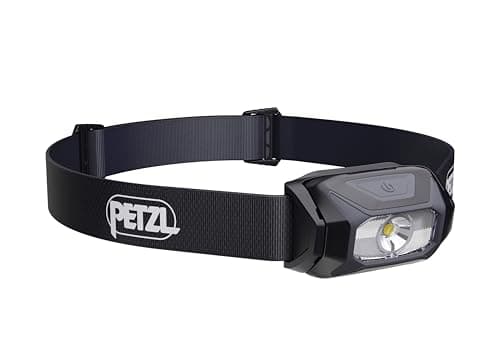 Petzl TikkinaTop pick300 lumens on AAA cells with a published ANSI figure. It does one thing and does not pretend to do more. | The cheapest lamp we would actually recommend | 300 lm / 92 g |
We earn a commission if you buy through the links on this page, at no extra cost to you. It does not change what we recommend or the order they appear in. Full disclosure. Prices checked October 17, 2026.
Buy the Tikkina if you want a lamp whose numbers you can check, for about the price of a takeaway. Petzl publishes three output levels, a beam distance for each, and a runtime for each on both power sources - six runtime figures on a lamp that costs under twenty dollars - plus 92 g and IPX4. Nothing else we cover at this price publishes half of it.
We have not tested this headlamp. We own none of the products on this site, we have no laboratory, and nothing here is an impression of how it sits on a head. This review takes every figure Petzl publishes, runs the arithmetic those figures allow, and says what they do and do not commit the company to.
It also fills a gap in our own records. Until this review, this site held no runtime figure at all for the Tikkina - the field was simply absent, which on a site that treats a missing number as a finding is worse than recording it as unpublished. Re-reading Petzl's own product page on October 17, 2026 produced the full ANSI FL 1 table for both the alkaline and the rechargeable configuration. Every page that ranked this lamp without it has been corrected in the same change as this one.
The published specification
| Level | Output | Beam distance | Burn time |
|---|---|---|---|
| MAX POWER | 300 lm | 65 m | 2 h 30 min |
| STANDARD | 100 lm | 40 m | 10 h, plus 20 h of reserve lighting |
| MAX BURN TIME | 7 lm | 10 m | 100 h |
| Level | Output | Beam distance | Burn time |
|---|---|---|---|
| MAX POWER | 300 lm | 65 m | 3 h |
| STANDARD | 100 lm | 40 m | 7 h |
| MAX BURN TIME | 7 lm | 10 m | 120 h |
| Specification | Published figure |
|---|---|
| Maximum output | 300 lm (ANSI/PLATO FL 1) |
| Weight | 92 g |
| Ingress protection | IPX4, stated as weather resistant |
| Power | 3 x AAA/LR03 included, or the CORE rechargeable battery |
| Source detection | Automatic; the lamp adjusts performance to the source |
| Levels | Three white, selected by a single button |
| Beam | Stated as uniform proximity lighting |
| Peak beam intensity | Not published |
| Red mode | None |
| Road use | Petzl states the lamp is not certified for it |
Thirteen published figures and two named gaps. The gaps are peak candela, which Petzl omits across its entire range, and a cell capacity for the AAA configuration - though that is the battery maker's job rather than Petzl's, and Petzl does publish 1,250 mAh at 3.6 V for the CORE pack it sells alongside.
The arithmetic: STANDARD is the mode to plan around
Three output-and-runtime pairs let you work out how much total light each level delivers from one set of cells. On this lamp the result is unusually clear, and it contradicts the headline.
That matters because 100 lumens is not a compromise for most of what people do after dark. It is the setting we rank on for walking at night, it is ample for a campsite, and at 40 meters of published beam distance it detects anything you need to know about at walking pace.
The hybrid comparison nobody makes
Because Petzl publishes the whole table twice - once for alkaline cells and once for its CORE pack - the Tikkina is one of very few lamps where you can see what the rechargeable option actually changes. The answer is not what the marketing implies.
| Level | On 3 x AAA | On the CORE pack | Which wins |
|---|---|---|---|
| MAX POWER, 300 lm | 2 h 30 min | 3 h | CORE, by 20 percent |
| STANDARD, 100 lm | 10 h, plus 20 h reserve | 7 h | AAA, by 43 percent |
| MAX BURN TIME, 7 lm | 100 h | 120 h | CORE, by 20 percent |
On the setting you will actually use, the disposable cells beat the rechargeable pack on Petzl's own figures - and that is before the reserve column, which the CORE table does not carry at all. The lithium pack wins at the top and bottom of the range, where either high current or very long duration suits it better. Three dollars of AAA cells wins in the middle.
We cannot tell you why, because Petzl publishes no per-level current draw and we are not going to invent a discharge model. What we can say is that the usual summary - rechargeable is simply better - is not what this maker's own table says. Rechargeable headlamps covers the wider case, including the ones where the pack genuinely does win.
The beam: uniform, and verifiably so
Petzl calls this proximity lighting, and the published distances let that claim be checked rather than taken on trust. Under ANSI FL 1, beam distance is the point where illuminance falls to 0.25 lux, which makes the conversion to intensity exact.
At 3.5 to 4 candela per lumen this is at the flood end of everything on this site, which is correct for a head-mounted lamp - a tight hotspot bobs with every step. Nobody should buy this for reach. Throw versus flood covers the trade, and the brightest headlamps ranks the category on candela rather than lumens.
What ninety-two grams and IPX4 mean in practice
92 grams is middling and entirely a consequence of the three-cell AAA carriage: the Streamlight Bandit Pro publishes 45.4 g and the Petzl Swift LT 43 g, both with sealed lithium packs. Having the figure at all is the point - Nitecore, Olight and Coast publish no weight for any lamp we cover.
IPX4 is the specification to take seriously before buying. Under IEC 60529 the 4 means splashing water from any direction and the X means no dust test was declared. It is a rain rating, not an immersion rating. If the lamp will be dropped in a creek or used around water, the Princeton Tec Vizz publishes IPX7 on the same three AAA cells for roughly double the money, and the Fenix HM65R-T publishes IP68.
What Petzl does not publish, and one warning it does
No peak candela. The distances above work back to intensity exactly, but that is arithmetic from one published figure rather than two published figures agreeing - a weaker form of evidence, and worth saying plainly. Streamlight and Maglite publish both and their numbers reconcile; Petzl publishes distance only, across its whole range.
No red mode, and Petzl does not pretend otherwise. On the Tikka, one step up the range, red is a dedicated press. If the lamp will be used in a shared tent or on a path where you pass people, that omission is the reason to spend the extra. See headlamps for reading, where red is the deciding feature.
And the warning worth repeating, because it is Petzl's own and almost nobody quotes it: the lamp is not certified for road use, and Petzl states its lights are not a substitute for required standardized lights where traffic regulations apply. A headlamp helps you see. It is not a bike light.
Who should buy something else
Skip it if the lamp will be used near anyone at night. No red mode is the single real functional gap. The Petzl Tikka adds it and keeps everything else, including the AAA compatibility.
Skip it if it will get properly wet. IPX4 is rain. The Vizz publishes IPX7 immersion on the same cell format.
Skip it if you need reach or real output. 300 lumens over 65 m is a proximity lamp. For hunting, work at distance or anything requiring identification rather than detection, see the brightest headlamps and expect to pay several times as much.
Skip it if you want to stop buying batteries. Three AAA cells per fill is a running cost, and the CORE pack is an extra purchase. Rechargeable headlamps covers lamps that ship with the cell in the box.
The verdict, stated as what it commits to
Petzl commits to 300, 100 and 7 lumens; 65, 40 and 10 meters; and six runtime figures across two power sources - all of it ANSI FL 1, all of it on a lamp under twenty dollars. On this site, where a published figure beats an unpublished one every time, that makes the Tikkina the cheapest lamp we would recommend without a caveat about disclosure, and the right answer for a kit bag, a glovebox, a shed or a first headlamp.
What it does not commit to is a red mode, an immersion rating or a candela figure, and its headline 300-lumen setting delivers less total light than its middle one. Every one of those is visible in the numbers before you spend anything, which is the entire argument for buying from a company that prints them. For the category ranked on exactly that, see headlamp brands compared.
The picks, in full
Top pick · The cheapest lamp we would actually recommend
Petzl Tikkina
300 lumens on AAA cells with a published ANSI figure. It does one thing and does not pretend to do more.
No red mode, no reactive sensor, no charge port. Three brightness levels and a battery door.
The 65 m distance and the 300-lumen output are both ANSI FL 1 figures published alongside the rest of Petzl's table, which is more than most lamps at this price manage.
The figure that matters is the middle one: 100 lumens over 40 meters for 10 hours on three AAA cells. That is a week of dog walks or a long night of reading, and it is the level anyone actually leaves the lamp on.
For a kit bag, a car, or a first lamp for someone unsure they will use it, this is the honest recommendation.
What works
- Published ANSI figures at the bottom of the price range, for both power sources
- 100 lumens for 10 hours on cells you can buy anywhere
- Nothing to break and nothing to charge
- Takes the same CORE pack as the rest of the Petzl range if you upgrade
What does not
- No red mode
- No rechargeable option in the box
- IPX4
Skip this ifyou are out after dark regularly. The missing red mode gets old fast in a shared tent.
Published specification
- Output
- 300 lmANSI/PLATO FL 1Petzl Tikkina — manufacturer spec page (retrieved September 1, 2026)
- Peak intensity
- not published
- Beam distance
- 65 mMAX POWER. 40 m on STANDARD, 10 m on MAX BURN TIME.Petzl Tikkina — manufacturer spec page (retrieved September 1, 2026)
- Runtime
- 2 h 30 min at 300 lm / 10 h at 100 lm / 100 h at 7 lm, on AAAPetzl publishes the full ANSI FL 1 table for both power sources. On the CORE pack the same three levels run 3 h / 7 h / 120 h. STANDARD also carries a further 20 h of reserve lighting on AAA.Petzl Tikkina — manufacturer spec page (retrieved October 17, 2026)
- Battery
- 3 x AAA (included), or the CORE rechargeable packPetzl Tikkina — manufacturer spec page (retrieved September 1, 2026)
#ad · how this is funded · price as of October 17, 2026
Questions people actually ask
How long does the Petzl Tikkina run?
Petzl publishes six figures. On three AAA cells: 2 hours 30 minutes at 300 lumens, 10 hours at 100 lumens with a further 20 hours of reserve lighting, and 100 hours at 7 lumens. On the CORE rechargeable battery: 3 hours, 7 hours and 120 hours for the same three levels.
Which Tikkina mode gives the most light per set of batteries?
The middle one. Multiplying output by published runtime gives 1,000 lumen-hours on STANDARD against 750 on MAX POWER and 700 on MAX BURN TIME - and STANDARD is also the only level with reserve lighting listed. By Petzl's own figures this is a 100-lumen headlamp with a 300-lumen boost.
Is the Petzl Tikkina waterproof?
No - it is weather resistant. Petzl publishes IPX4, which under IEC 60529 means splashing water from any direction, with the X meaning no dust rating was declared. Rain is fine; immersion is not. The Princeton Tec Vizz publishes IPX7 on the same three AAA cells if the lamp will get properly wet.
Petzl Tikkina or Tikka?
The Tikka, if the lamp will ever be used near other people. It adds a red mode on its own press and publishes 350 lumens, 70 m and 12 hours at 100 lumens, against the Tikkina's 300 lumens, 65 m and 10 hours. If nobody else is in the room and price is the deciding factor, the Tikkina publishes the same quality of specification for less.
Is the Tikkina bright enough?
For walking, camp tasks, reading, dog walks and anything inside a house, comfortably. Its 100-lumen setting publishes 40 meters of beam distance, which under ANSI FL 1 is where the beam falls to roughly full-moon brightness - ample warning at walking pace. It is not bright enough for identifying things at distance, and it is not sold as being.
Does the Tikkina take rechargeable batteries?
Yes, two ways. It accepts Petzl's CORE rechargeable battery as an accessory and detects the source automatically, adjusting the published performance accordingly. It will also physically accept NiMH AAA cells, but Petzl publishes no runtimes for those, so we cannot tell you what you would get and will not estimate.
How much does the Petzl Tikkina weigh?
92 grams, as published. That is double the lightest lamps we cover - the Streamlight Bandit Pro at 45.4 g and the Petzl Swift LT at 43 g - because a three-cell AAA carriage is bulkier than a flat lithium pack. It is the price of being able to buy power anywhere.
Does the Tikkina have a red light?
No. Petzl does not fit one at this point in the range, and it is the lamp's one real functional gap: red preserves night adaptation and keeps you from dazzling people on a shared path or in a tent. The Tikka, one step up, puts red on a dedicated press.
Sources
Every figure on this page came from one of the documents below, read on the date shown. We do not cite other review sites, forum posts or video reviews as sources of fact.
- Petzl Tikkina — manufacturer spec page (retrieved October 17, 2026)
- Petzl Tikka — manufacturer spec page (retrieved September 1, 2026)
- Princeton Tec Vizz — manufacturer spec page (retrieved October 15, 2026)
- Streamlight Bandit Pro — manufacturer spec page (retrieved September 1, 2026)
- Petzl — ANSI/PLATO FL 1 technical information for its headlamp range
- ANSI/PLATO FL 1 flashlight performance standard — definitions of lumens, peak beam intensity, beam distance, runtime, impact and water resistance
- IEC 60529 — the IP (ingress protection) rating system
Read next
Best headlamps, ranked on the watt-hours behind the lumens
The full headlamp ranking: output, weight, battery energy and beam distance, every figure sourced to the maker.
Best headlamps under $50
Seven headlamps in the sub-$50 bracket, ranked on what their makers actually publish, with the gaps named and live prices on every pick.
Best headlamps for camping
Camping headlamps ranked on red-mode access, replaceable cells and honest runtime figures.
Best headlamps for reading
Reading lamps ranked on the lowest usable setting, how easily you reach it and what sits on your forehead for an hour - with the arithmetic that shows what those long runtimes really mean.

Best headlamps for walking at night
Headlamps for night walks and dog walks, ranked on the middle setting you will actually use - plus the warning Petzl prints that nobody reads.
Petzl Tikka review
A specification-first review of the Petzl Tikka: two full published runtime tables, a genuinely useful red mode, and what the hybrid battery actually trades.
Headlamp brands, ranked on what they tell you
Every headlamp brand we cover, ranked on specification disclosure — from the one publishing watt-hours to the three publishing only a lumen figure.
Best rechargeable headlamps
Rechargeable headlamps sorted by cell strategy: sealed, swappable standard cell, or hybrid.
Best flashlights for a car emergency kit
What to keep in a glovebox, ranked on cell chemistry and published temperature limits rather than output - with the one sentence that rules out most rechargeable lights.
Flashlight runtime, computed
How runtime is defined, why thermal step-down happens, and the arithmetic to compute a real figure yourself.
Throw vs flood
How reflector geometry produces throw or flood, what each suits, and where the middle ground lives.
Found a number that is wrong? Tell us and we will fix it and say so. Our methodology shows every formula on this page.