Headlamps
Nitecore NU43 review
The best energy-to-weight ratio of any light we cover, on a sheet this site had recorded as almost empty - and one pair of Nitecore's own figures that does not add up.
By Scooter M. · Published · Updated
| # | Product | Best for | Output / weight | Price |
|---|---|---|---|---|
| 1 | 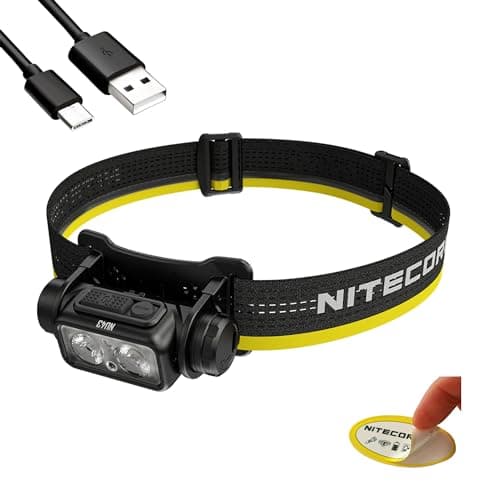 Nitecore NU43Top pick1,400 lumens with a spotlight and floodlight pair, USB-C, and a price well under the European brands. | Bright output at low weight for the money | 1,400 lm / 116 g |
We earn a commission if you buy through the links on this page, at no extra cost to you. It does not change what we recommend or the order they appear in. Full disclosure. Prices checked October 25, 2026.

Buy the NU43 if you want the most stored energy per gram you can carry on your head. Nitecore publishes a 3,400 mAh cell in a 116 g lamp, which works out to 10.8 watt-hours per 100 grams - the best ratio of any product on this site, ahead of the Fenix HM75R's 9.4. It also publishes 1,400 lumens, 130 m, 3,800 candela, IP68 and a 2 m drop rating. What it does not publish is a runtime for the 1,400 lumens it is sold on, and two of its figures disagree with each other.
We have not tested this headlamp. We own none of the products on this site, we have no laboratory, and nothing here is an impression of how it sits on a head. This review takes every figure Nitecore publishes, runs the arithmetic those figures allow, and says what they do and do not commit the company to.
It also corrects us, and the reason is embarrassing in a useful way. Until today this site recorded the NU43's beam distance, candela, runtime, weight and ingress rating as not published, and said in several places that Nitecore states "output and charging" and nothing else. All five are published, and have been, on Nitecore's own product page. We found it by reading nitecore.com/sitemap.xml - the habit we picked up correcting the P30i a week ago, when the same mistake turned out to be a guessed URL rather than a silent manufacturer. Every page that described those figures as gaps has been corrected in the same change as this one.
The published specification
| Specification | Published figure |
|---|---|
| Maximum output | 1,400 lm |
| Max beam distance | 130 m |
| Max beam intensity | 3,800 cd |
| Maximum runtime | 165 h, at the 8 lm ULTRALOW level |
| Second published runtime | 29 h at 100 lm |
| Battery | Integrated 3,400 mAh Li-ion, described as an integrated 18650 |
| Stored energy | 12.6 Wh (computed from 3,400 mAh at 3.7 V) |
| Charging | USB-C, about 2 h at 5 V / 2 A |
| Weight | 116 g (4.09 oz), bracket and headband included |
| Dimensions | 79.8 x 46.1 x 43.9 mm |
| Light sources | White and red, spot and flood |
| Modes | 5 brightness levels, 3 special modes |
| Ingress protection | IP68, stated as 2 m submersible |
| Impact resistance | 2 m |
| Housing | PC rear, stamped aluminum alloy front |
| Lockout | Yes, MODE plus Power held together |
| Per-mode runtime table | Not published |
| Color rendering | Not published |
| Charge-cycle life | Not published |
Sixteen published figures and three named gaps. That is a better sheet than this site credited Nitecore with for any headlamp, and it puts the brand in a different position in our headlamp brand ranking than its reputation here suggested.
The number that makes this lamp interesting
Nitecore publishes a cell capacity, which most headlamp makers do not, and that makes the lamp comparable on the measure this site uses across the whole category: how much stored energy you carry for each gram on your forehead.
That is a genuine engineering result rather than a marketing one, and it is the reason to consider this lamp over the obvious European alternatives. It is also the figure that makes the 1,400-lumen headline plausible in a body this size: the emitter is being fed by a cell with real capacity behind it rather than by the small pack a 116 g lamp usually carries.
Two published figures that do not reconcile
Under ANSI FL 1, beam distance is defined as the point where illuminance falls to 0.25 lux. That fixes an exact relationship between distance and peak intensity, so when a maker publishes both, the two numbers check each other. Nitecore publishes both here, and they do not check out.
What makes this worth a section rather than a footnote is that the same company gets it exactly right elsewhere. Nitecore publishes 1,000 m and 250,000 cd for the P30i, and those reconcile to the digit. So this is not a company that cannot measure candela - it is one product's sheet with a loose number on it. If you are choosing between these two figures, the conservative one is 123 m, and nothing on this page depends on the difference.
The beam: the widest we compute anywhere
Whichever candela figure you take, the ratio that describes the beam is unambiguous, and it is at the extreme end of everything on this site.
So the 1,400 lumens are being spread, not aimed. That is the correct choice for a head-mounted lamp - a tight hotspot bobs with every step and leaves the verges black - and it is the wrong choice if you need to identify something at the end of a field. A Fenix HM75R publishes 223 m from 1,600 lumens, at 7.8 candela per lumen, and is the lamp to want if reach matters. Throw versus flood sets out the trade, and the brightest headlamps ranks the whole category on this figure rather than on output.
Runtime: two honest points, and the one that is missing
Nitecore publishes no per-mode runtime table, which on a five-level lamp is the real gap on this sheet. What it does publish, between the spec block and its own FAQ, is two output-and-runtime pairs - and two points are enough to learn something.
And the gap: there is no published runtime for 1,400 lumens. Nitecore's own FAQ names 8 lumens and 100 lumens and stops, which is the politest possible version of the omission this site complains about across the category. A 1,400-lumen headline with no duration beside it describes a burst, not a working level, and on a 12.6 Wh cell it cannot be a long one. How runtime is defined covers the standard both published figures are measured under.
Durability, and the one line that matters in winter
Nitecore publishes IP68, stated as 2 m submersible, plus a 2 m drop rating. Under IEC 60529 the 6 is dust tight and the 8 is continuous immersion to a depth the maker specifies, which makes this the joint-strongest ingress rating of any headlamp we cover alongside the Fenix HM65R-T - and stronger than the IPX4 that Petzl publishes across the Tikkina, Tikka and Actik Core.
Nitecore also describes the housing as a PC rear shell with a stamped aluminum alloy front, and calls it low-temperature resistant. That last phrase is a claim rather than a figure - no operating-temperature range is published - so we record it as what it is. If cold is the deciding factor, the thing that actually governs a sealed lithium-ion lamp in winter is that it must not be charged below freezing, which is a chemistry constraint no housing fixes; flashlights in the cold sets out the published cell data behind that.
The integrated cell is the real catch
Nitecore is unusually direct about this in its own FAQ: the NU43 "uses an integrated 18650 battery", which it frames as breaking the design limitations of conventional 18650 headlamps. The engineering argument is fair - that is how 12.6 watt-hours fits in 116 grams - but the consequence for a buyer is the same as every sealed lamp. When the cell degrades, the lamp is finished, and Nitecore publishes no charge-cycle figure to tell you when that is.
That is worth weighing against makers who do state it: Petzl publishes three years or 300 cycles for the Swift LT, and Maglite publishes 1,000 cycles for the ML150LRX. It is also the argument for a hybrid lamp if your use case is multi-day - the Petzl Actik Core takes three AAA cells when its pack dies, at the cost of less than half the energy density.
What Nitecore still does not publish
No per-mode runtime table. Five brightness levels, two published durations. No CRI figure, which matters on a lamp with a dedicated flood for close work - only two lights on this site publish one. No charge-cycle life, on a lamp whose battery is not replaceable. No candela or runtime for the red mode, so it is listed as a feature rather than a measured output.
None of those is unusual, and all of them are the difference between this and a Streamlight sheet. What is unusual is how much Nitecore does publish here, and the practical lesson for anyone reading spec sheets is the one this review started with: a missing figure is often a missing page rather than a silent manufacturer.
Who should buy something else
Skip it if you need reach. 2.7 candela per lumen is the widest beam we compute. The Fenix HM75R publishes 223 m and 7.8 candela per lumen on comparable output, and the Fenix HM65R-T 170 m.
Skip it if the lamp must survive a flat battery. There is no cell to swap. The Petzl Actik Core, the Petzl Tikka and the Petzl Tikkina all take three AAA cells and publish full tables for them.
Skip it if you want to know what the headline costs. No runtime is published for 1,400 lumens. If that figure is the reason you are buying, the honest position is that nobody has told you how long you get it for.
Skip it if grams are the only criterion. 116 g is light for the energy, and it is not light in absolute terms: the Streamlight Bandit Pro publishes 45.4 g and the Petzl Swift LT 43 g. This lamp wins the ratio, not the raw number. See headlamps for running, where raw weight decides it.
The verdict, stated as what it commits to
Nitecore commits to 1,400 lumens, 130 meters, 3,800 candela, a 3,400 mAh cell, 116 grams, IP68, a 2 m drop rating, a 2-hour USB-C charge, 165 hours at 8 lumens and 29 hours at 100 - and the arithmetic on top of that gives the best energy-to-weight ratio on this site, at 10.8 watt-hours per 100 grams. For a general-purpose rechargeable lamp for camping, trail walking or anything where you want a wide, bright flood and a long low mode, that is a strong sheet at a price well under the European brands.
What it does not commit to is a duration for its own headline output, a per-mode table, a CRI figure or a cycle life - and its published distance and candela do not agree with each other, which the same company manages correctly on the P30i. Buy it for energy density, weather sealing and a wide beam. Buy something else if you need reach, a battery you can replace, or a number for the 1,400 lumens. For the category ranked on what each maker actually prints, see headlamp brands compared.
The picks, in full
Top pick · Bright output at low weight for the money
Nitecore NU43
1,400 lumens with a spotlight and floodlight pair, USB-C, and a price well under the European brands.
1,400 lumens at this price is the whole pitch, and it is a real pitch: nothing from Petzl at the same money publishes a number that high.
The figure that actually distinguishes it is energy per gram. 3,400 mAh at 3.7 V is 12.6 watt-hours in a 116 g lamp, or 10.8 Wh per 100 g - the best ratio of any product on this site, ahead of the Fenix HM75R's 9.4.
At 2.7 candela per lumen this is the widest beam we compute anywhere on the site. That is the right shape for a camp and a path and the wrong one for identifying anything at distance.
One blemish on an otherwise good sheet: Nitecore publishes 130 m and 3,800 cd, and those two numbers disagree. The same company publishes a pair for the P30i that reconciles to the digit.
What works
- The highest published output per dollar in this roundup
- 10.8 watt-hours per 100 g - the best energy-to-weight ratio on this site
- IP68, a 2 m drop rating and a published 116 g
- Separate spot and flood emitters, plus red, and USB-C with a stated 2 h charge
What does not
- Its published beam distance and candela do not reconcile with each other
- No runtime published for the 1,400-lumen mode - the two pairs it gives are 8 lm and 100 lm
- Integrated cell: when it degrades the lamp is finished, and no cycle life is published
Skip this ifyou need reach. At 2.7 candela per lumen it is a flood, and the 130 m it claims is the one figure on its sheet we cannot check against a second.
Published specification
- Peak intensity
- 3,800 cd2.7 candela per lumen - the widest beam we compute for any lamp on this site.Nitecore NU43 — manufacturer spec page (retrieved October 24, 2026)
- Beam distance
- 130 mPublished alongside 3,800 cd, and the two figures do not reconcile: 3,800 cd works back to 123 m, not 130.Nitecore NU43 — manufacturer spec page (retrieved October 24, 2026)
- Runtime
- 165 h at 8 lm / 29 h at 100 lmTwo pairs, both from Nitecore's own page; the 165 h is the ULTRALOW level. No runtime is published for the 1,400-lumen mode.Nitecore NU43 — manufacturer spec page (retrieved October 24, 2026)
- Battery
- Integrated 3,400 mAh Li-ion, USB-C12.6 Wh at a 3.7 V nominal cell. Nitecore describes it as an integrated 18650 and states a 2 h charge at 5 V / 2 A.Nitecore NU43 — manufacturer spec page (retrieved October 24, 2026)
- Weight
- 116 g4.09 oz, bracket and headband included. 79.8 x 46.1 x 43.9 mm.Nitecore NU43 — manufacturer spec page (retrieved October 24, 2026)
- Ingress
- IP68Stated as 2 m submersible, with a 2 m drop rating and a stamped aluminum front housing.Nitecore NU43 — manufacturer spec page (retrieved October 24, 2026)
#ad · how this is funded · price as of October 25, 2026
Questions people actually ask
How long does the Nitecore NU43 last?
Nitecore publishes two figures: 165 hours at the 8-lumen ULTRALOW level, and 29 hours at 100 lumens. It publishes no runtime at all for the 1,400-lumen maximum. Run the arithmetic and the 165-hour claim implies about 105 lumen-hours per watt-hour, which is believable, while the 29-hour claim implies 231, which is not - so the second figure is the ANSI FL 1 measure and includes a long dimming tail.
Is the Nitecore NU43 worth it?
For energy per gram, yes, and measurably: 3,400 mAh at 3.7 V is 12.6 watt-hours in a 116 g lamp, or 10.8 watt-hours per 100 grams - the best ratio of any light we cover, ahead of the Fenix HM75R's 9.4. The reservations are that no runtime is published for its headline output, its 130 m and 3,800 cd figures do not reconcile, and the cell is not replaceable.
How much does the Nitecore NU43 weigh?
116 grams, or 4.09 oz, with the bracket and headband included - Nitecore states the dimensions as 79.8 x 46.1 x 43.9 mm. That is light for the energy it carries but not light in absolute terms: the Streamlight Bandit Pro publishes 45.4 g and the Petzl Swift LT 43 g, both with far smaller cells.
Can you replace the battery in the Nitecore NU43?
No. Nitecore describes it as an integrated 18650 Li-ion cell, which is how 12.6 watt-hours fits into 116 grams, and it is not user-replaceable. Nitecore publishes no charge-cycle figure either, so there is no stated point at which the lamp is expected to lose capacity - where Petzl states three years or 300 cycles for the Swift LT.
Is the Nitecore NU43 waterproof?
Yes, and strongly: Nitecore publishes IP68 and states 2 m submersible, along with a 2 m drop rating. Under IEC 60529 the 6 means dust tight and the 8 means continuous immersion to a depth the maker specifies. That is the joint-strongest ingress rating of any headlamp we cover, alongside the Fenix HM65R-T.
How far does the Nitecore NU43 shine?
Nitecore publishes 130 meters and 3,800 candela, and those two figures do not agree - 3,800 cd works back to 123 m under the ANSI FL 1 definition, and 130 m implies 4,225 cd. The gap is about 10 percent. Either way it is a flood rather than a thrower: 2.7 candela per lumen is the widest beam we compute for any light on this site.
Does the Nitecore NU43 have a red light?
Yes - Nitecore lists white and red light sources across five brightness levels and three special modes, with a lockout activated by holding the MODE and Power buttons together. It publishes no output or runtime figure for the red mode, so we record it as a feature rather than a measured specification.
How long does the Nitecore NU43 take to charge?
About two hours over USB-C with a 5 V / 2 A adapter, per Nitecore. That is consistent with the published 12.6 watt-hour cell. One caution that applies to every sealed lithium-ion lamp: do not charge it below freezing, which permanently reduces capacity and is a genuine hazard.
Nitecore NU43 or Fenix HM65R-T?
The Fenix for reach and documentation, the Nitecore for energy per gram and price. Fenix publishes 1,600 lumens, 170 m, IP68, 140 g and a 3,400 mAh 18650 you can replace, plus a CR123A fallback. Nitecore publishes 1,400 lumens, 130 m, IP68 and 116 g with the same cell capacity sealed in. The Fenix carries 8.7 watt-hours per 100 g against the Nitecore's 10.8, but you can put a fresh cell in it.
Sources
Every figure on this page came from one of the documents below, read on the date shown. We do not cite other review sites, forum posts or video reviews as sources of fact.
- Nitecore NU43 — manufacturer spec page (retrieved October 24, 2026)
- Nitecore P30i — manufacturer spec page (retrieved October 17, 2026)
- Fenix HM75R — manufacturer spec page (retrieved September 1, 2026)
- Fenix HM65R-T V2.0 — manufacturer spec page (retrieved September 1, 2026)
- Petzl Swift LT — manufacturer spec page (retrieved September 1, 2026)
- ANSI/PLATO FL 1 flashlight performance standard — definitions of lumens, peak beam intensity, beam distance, runtime, impact and water resistance
- IEC 60529 — the IP (ingress protection) rating system
Read next
Best headlamps, ranked on the watt-hours behind the lumens
The full headlamp ranking: output, weight, battery energy and beam distance, every figure sourced to the maker.

The brightest headlamps, and what the lumens actually buy
Nine of the highest-output headlamps we cover, ranked on published lumens with the reach and runtime figures that contradict the ranking.
Best rechargeable headlamps
Rechargeable headlamps sorted by cell strategy: sealed, swappable standard cell, or hybrid.
Best headlamps for camping
Camping headlamps ranked on red-mode access, replaceable cells and honest runtime figures.
Best headlamps for backpacking
Backpacking headlamps ranked on the grams-per-watt-hour trade, computed from published figures.
Headlamp brands, ranked on what they tell you
Every headlamp brand we cover, ranked on specification disclosure — from the one publishing watt-hours to the three publishing only a lumen figure.
Fenix HM75R review
A specification-first review of the Fenix HM75R: what 30.2 watt-hours and a rear battery case actually buy, and who should wear something lighter.
Fenix HM65R-T V2.0 review
A specification-first review of the Fenix HM65R-T V2.0: what the published figures mean, what they do not cover, and who should buy something else.
Petzl Actik Core review
A specification-first review of the Petzl Actik Core: the full per-mode table, what the AAA fallback actually costs you, and who should buy something else.
Nitecore vs Black Diamond headlamps
Nitecore against Black Diamond on published headlamp output and features — the least documented matchup on this site, and what you can still decide from it.
Nitecore vs Fenix
Nitecore against Fenix: output per dollar against specification completeness, across headlamps and handhelds.
Nitecore P30i review
A specification-first review of the Nitecore P30i: what 250,000 published candela buys, what it costs in usable spill, and who should buy a general-purpose light instead.
Throw vs flood
How reflector geometry produces throw or flood, what each suits, and where the middle ground lives.
Flashlight runtime, computed
How runtime is defined, why thermal step-down happens, and the arithmetic to compute a real figure yourself.
Flashlights in the cold: the cell decides, not the light
What cold does to a flashlight, from the cell manufacturers' own datasheets - the published temperature limits, the charging hazard, and the lights that take the right cells.
Found a number that is wrong? Tell us and we will fix it and say so. Our methodology shows every formula on this page.