Headlamps
Nitecore HC75 UHE review
The best-documented Nitecore product on this site, and the only one of its lamps whose battery you can replace - with a candela figure that matches its own beam distance to the digit.
By Scooter M. · Published · Updated
| # | Product | Best for | Output / weight | Price |
|---|---|---|---|---|
| 1 | 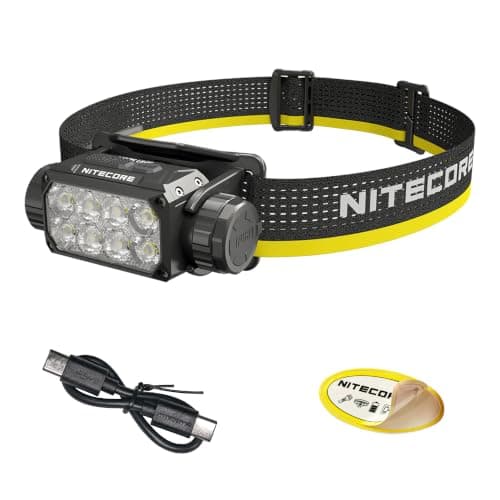 Nitecore HC75 UHETop pick3,000 lumens with a zoomable head, white and red beams, and 192 m of stated reach. The brightest headlamp on the site. | Industrial work where you need to change the beam | 3,000 lm / 209 g |
We earn a commission if you buy through the links on this page, at no extra cost to you. It does not change what we recommend or the order they appear in. Full disclosure. Prices checked November 1, 2026.
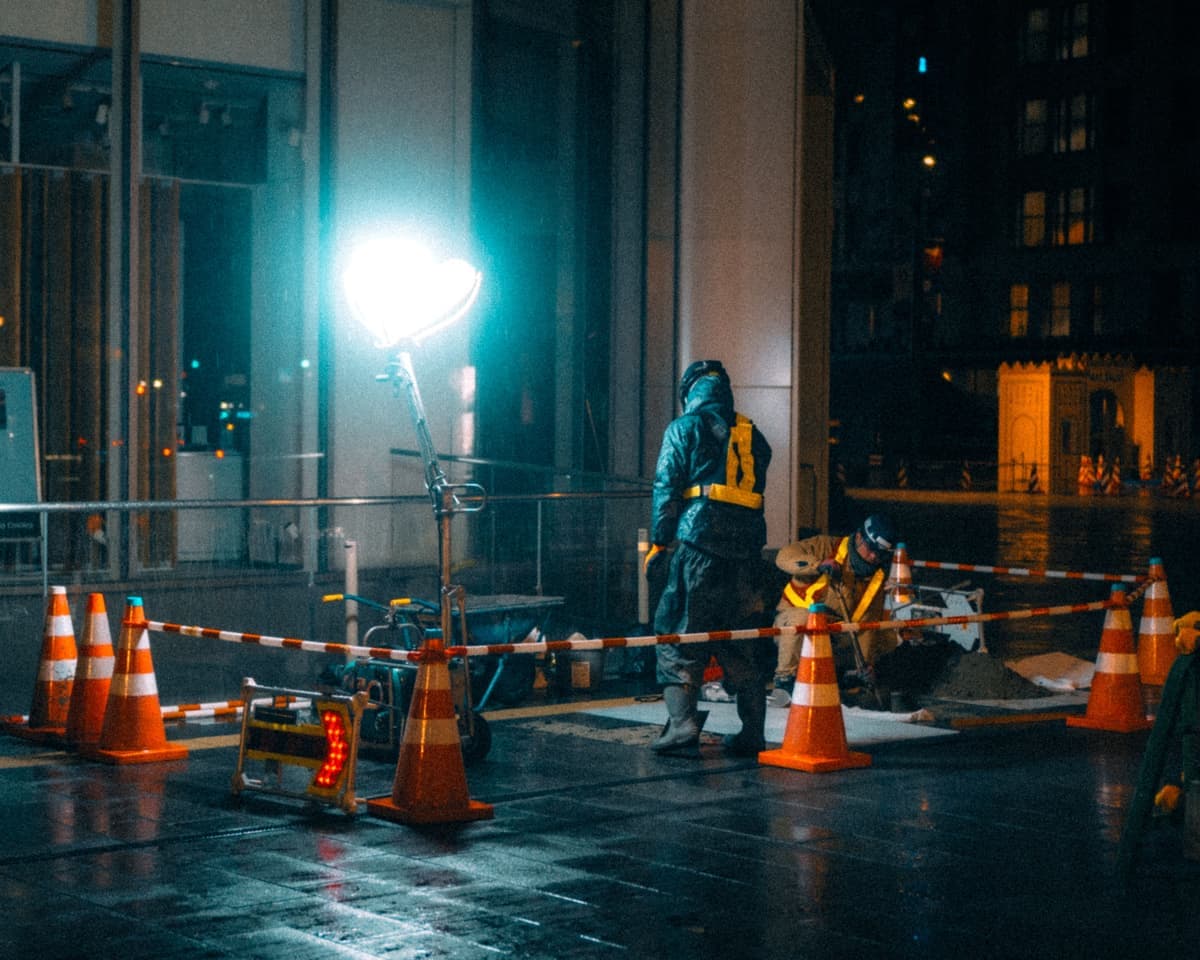
Buy the HC75 UHE if you work by a headlamp for a full shift and want one lamp that floods a panel and then throws down a yard. Nitecore publishes 3,000 lumens, 192 meters, 9,216 candela that matches that distance exactly, three output-and-runtime pairs, a replaceable 5,500 mAh 21700 worth 20.4 watt-hours, 209 g with the battery and headband in, IP68 and a 2 m drop rating. It is the best-documented Nitecore product on this site and the only one of its lamps whose cell is a swap rather than a death sentence. What it still will not tell you is how long the 3,000 lumens lasts.
We have not tested this headlamp. We own none of the products on this site, we have no laboratory, and nothing here is an impression of how it sits on a hard hat for eight hours. This review takes every figure Nitecore publishes, runs the arithmetic those figures allow, and says what they do and do not commit the company to.
It also closes out a four-page correction, and the mistake was ours. Until this week this site described Nitecore as the brand of "the biggest numbers and the thinnest sheets" - no runtime, no weight, no ingress rating on any lamp. That was wrong four times over. Nitecore's own page for this lamp is the fourth we have found by reading nitecore.com/sitemap.xml after an earlier pass guessed a URL wrongly, following the P30i, the NU43 and the NU25 UL. The brand entry on our headlamp brand ranking has been rewritten in the same change as this page.
The published specification
| Specification | Published figure |
|---|---|
| Maximum output | 3,000 lm |
| Max beam distance | 192 m |
| Max beam intensity | 9,216 cd |
| Color temperature | 4,500 K neutral white, plus auxiliary red |
| Runtime | 12 h at 600 lm, 32 h at 200 lm, 84 h at 40 lm |
| Battery | Replaceable 5,500 mAh 21700 (NL2155HP, included) |
| Stored energy | 20.4 Wh (computed from 5,500 mAh at 3.7 V) |
| Charging | USB-C, 18 W, about 2 h 10 min at 9 V / 2 A |
| Weight | 209 g (7.37 oz), battery, bracket and headband included |
| Dimensions | 92.4 x 46.8 x 45.5 mm, bracket included |
| Emitters | 32 NiteLab UHE LEDs, as 8 quad-core units |
| Beam control | Patented e-focus: spot, flood, mixed, electronically adjustable |
| Modes | 5 brightness levels, 3 special modes, 2 red brightness options |
| Ingress protection | IP68, stated as 2 m submersible |
| Impact resistance | 2 m |
| Body | PC and aero-grade aluminum, HA III hard-anodized |
| Thermal management | ATR module, patent ZL201510534543.6 |
| Lockout | Two ways: rotate the head up, or hold ZOOM plus Power |
| In the box | Battery, USB-C to USB-C cable, bracket, headband, top strap, storage case, spare O-ring |
| Runtime at 3,000 lm | Not published |
| Color rendering | Not published |
| Charge-cycle life | Not published |
Nineteen published figures and three gaps. That is the fullest sheet of any Nitecore product we cover and comfortably better than most of the category - and three of those nineteen are things almost nobody publishes at all: a candela figure, a per-level runtime set, and a named thermal-regulation system.
The candela figure, and what it confirms
Under ANSI FL 1, beam distance is the point where illuminance falls to 0.25 lux, which fixes an exact relationship between distance and peak intensity. When a maker publishes both, the pair checks itself.
What 3.07 candela per lumen then tells you is that the 3,000 lumens buys width rather than reach. For comparison the Fenix HM75R manages 7.8 and the Nitecore NU25 UL 10.9 - so the 400-lumen NU25 UL concentrates its light three and a half times harder than this lamp does, and reaches 132 m against 192 m on a seventh of the output. That is the lumens-versus-candela trade in two products from one catalog, and it is set out properly in throw versus flood.
Three runtime figures, and the one that is missing
Nitecore's own FAQ gives three output-and-runtime pairs: 600 lumens for 12 hours, 200 lumens for 32 hours, and 40 lumens for 84 hours. That is more than any other Nitecore product we cover and more than most of this category manages. It also lets the arithmetic say something.
And the gap that matters: no runtime is published for 3,000 lumens. The highest level with a duration attached is 600 lumens - a fifth of the headline. On any lamp sold on a peak output, that is the figure a buyer most needs, and it is the one piece of this otherwise complete sheet Nitecore withholds. The NU43 has the same gap at 1,400 lumens. How runtime is defined sets out the standard all of these are measured under.
A maker that documents its own step-down
Here is the part that genuinely distinguishes this sheet. Nitecore's FAQ contains the question "Why does the brightness of the HC75 UHE decrease after extended use?" - and answers it: the lamp carries an Advanced Temperature Regulation module, patent number stated, which automatically reduces output during prolonged high-brightness operation according to the working conditions and ambient temperature.
This site complains constantly that high-output lights step down within minutes and that almost no maker says so. Nitecore says so, in its own words, on its own product page, with a patent number. It does not quantify the step-down - there is no curve, no temperature threshold, no after-ten-minutes figure - so it is a disclosure of the mechanism rather than of the behavior. But a company explaining why its headline number does not last is doing something the rest of this category does not, and it deserves to be recorded as a point in the lamp's favor rather than buried.
It also explains the missing 3,000-lumen runtime more honestly than silence would. A figure measured under ATR would depend on ambient temperature, which is precisely why it is hard to publish one number. We would still rather have a figure with conditions attached.
The replaceable cell is the real argument
Nitecore ships an NL2155HP 5,500 mAh 21700 and states plainly that when the battery is depleted it can be replaced or recharged in the lamp. That single word - replaceable - separates this from every other Nitecore lamp we cover and from most of the category.
For shift work that is the whole proposition. Our work headlamps page judges lamps on whether they cover an eight-hour shift, and at 20.4 watt-hours this one does so with margin at any sane working level - then takes a fresh 21700 when it does not. The Fenix HM65R-T is the other lamp here with a replaceable cell, at 12.2 Wh with a CR123A fallback; the Fenix HM75R carries more energy but at 321 g complete.
E-focus: the feature that justifies the weight
Nitecore describes a patented electronic focus system rather than a mechanical zoom: spotlight, floodlight, a mixed beam, or an adjustable ratio between them, switched one-handed. The stated use cases are long-distance search in spot and close-range area work in flood.
On a headlamp that is genuinely unusual, and it is the honest reason to accept 209 grams. One lamp doing panel work at arm's length and then identifying something 150 meters away replaces two, and the alternative on this site is carrying a wide lamp plus a thrower. What we cannot tell you is how much light the zoom optics lose against a fixed reflector - no maker publishes that, and we are not going to estimate it.
Two other published details matter for work use. The color temperature is 4,500 K neutral white, and Nitecore's stated reason is that it sits closer to daylight than cool white and reduces eye strain over long periods - a claim about comfort rather than a measurement, and a sensible choice for inspection. And there are two independent lockouts: rotate the head upward for transport, or hold the ZOOM and Power buttons together.
What Nitecore still does not publish
No CRI figure. On a lamp Nitecore itself recommends for industrial inspection, equipment servicing and power-line maintenance, color rendering is a working specification rather than a nicety - reading insulation colors or spotting corrosion depends on it. The company publishes the color temperature and not the rendering, which answers half the question. Only two products on this whole site publish a CRI figure.
No charge-cycle life, though this matters far less here than on a sealed lamp: when the cell degrades you buy a 21700. No runtime at 3,000 lumens, as above. And no quantified step-down curve behind the ATR disclosure.
Who should buy something else
Skip it if you are counting grams. 209 g is the second-heaviest headlamp we cover. The Nitecore NU25 UL publishes 47 g, the Petzl Swift LT 43 g and the Streamlight Bandit Pro 45.4 g - and the NU25 UL reaches 132 m, which is not far off this lamp's 192.
Skip it if you want reach for its own sake. 3.07 candela per lumen is a wide beam. The brightest headlamps page ranks the category on exactly this figure, and a dedicated thrower reaches far further on a fraction of the output.
Skip it if you need a duration for the headline. The highest level with a published runtime is 600 lumens. If you are buying 3,000 lumens expecting to use them, nobody has told you for how long.
Skip it if the lamp must work without a socket for days. A 21700 is replaceable but it is not a cell you buy at a gas station. For that, the Petzl Tikka and Tikkina run on three AAA cells with full published tables, and the Fenix HM65R-T takes CR123A primaries.
The verdict, stated as what it commits to
Nitecore commits to 3,000 lumens, 192 meters, 9,216 candela that matches that distance exactly, 600 lm for 12 h, 200 lm for 32 h, 40 lm for 84 h, a replaceable 5,500 mAh 21700 worth 20.4 watt-hours, 18 W charging, 209 grams with the battery in, IP68, a 2 m drop rating and a named thermal-regulation module. For industrial inspection, maintenance work or search where one lamp has to flood and throw, that is the most complete sheet in this category outside Petzl and Fenix - and it is the only lamp here that pairs it with a cell you can swap.
What it does not commit to is a runtime for the output it is sold on, a CRI figure on a lamp aimed at inspection, or any quantification of the step-down it openly admits to. Buy it for the zoom, the energy and the replaceable cell. Buy something lighter if you walk rather than work. For the category ranked on what each maker actually prints - a ranking this lamp has just changed - see headlamp brands compared.
The picks, in full
Top pick · Industrial work where you need to change the beam
Nitecore HC75 UHE
3,000 lumens with a zoomable head, white and red beams, and 192 m of stated reach. The brightest headlamp on the site.
A zoomable head is unusual on a headlamp and it is the point of this one: Nitecore's patented e-focus moves between spot, flood and a mixed beam electronically, so you can flood a panel at arm's length and then throw the same output 192 m down a yard.
This is the best-documented Nitecore product on the site. It publishes 9,216 candela that matches its own 192 m exactly, three output-and-runtime pairs, a 20.4 watt-hour cell, 209 g with the battery in, IP68 and a 2 m drop rating.
The cell is replaceable, and a standard 21700 at that - the only Nitecore lamp we cover where a flat battery is a swap rather than the end of the lamp.
Nitecore also documents its own thermal step-down, answering in its FAQ why brightness falls during long use. Almost no maker on this site volunteers that, and it is the reason the 3,000 lumens has no runtime attached.
What works
- A published candela figure that reconciles exactly with its published beam distance
- Three output-and-runtime pairs, where most lamps here publish one or none
- A replaceable 5,500 mAh 21700 - 20.4 Wh, the second-largest store we cover
- IP68, a 2 m drop rating, and e-focus zoom that genuinely does two jobs
What does not
- No runtime for the 3,000 lumens it is sold on; the highest figure with a duration is 600 lm for 12 h
- 209 g is the heaviest headlamp we cover apart from the Fenix HM75R
- Zoom optics lose light compared with a fixed reflector
- No CRI figure, on a lamp aimed at inspection work
Skip this ifyou want reach specifically. 192 m from 3,000 lumens is 3.1 candela per lumen, a wide beam; a dedicated thrower gets further on a quarter of the output.
Published specification
- Output
- 3,000 lmNeutral white at 4,500 K, plus redNitecore HC75 UHE — manufacturer spec page (retrieved October 31, 2026)
- Peak intensity
- 9,216 cdPublished, and it matches the 192 m exactly: 0.25 x 192 x 192 = 9,216. 3.1 candela per lumen.Nitecore HC75 UHE — manufacturer spec page (retrieved October 31, 2026)
- Beam distance
- 192 mNitecore HC75 UHE — manufacturer spec page (retrieved October 31, 2026)
- Runtime
- 12 h at 600 lm / 32 h at 200 lm / 84 h at 40 lmThree pairs, from Nitecore's own FAQ. No runtime is published for the 3,000-lumen maximum.Nitecore HC75 UHE — manufacturer spec page (retrieved October 31, 2026)
- Battery
- Replaceable 5,500 mAh 21700 (NL2155HP, included), USB-C20.4 Wh at a 3.7 V nominal cell. 18 W fast charging, about 2 h 10 min full at 9 V / 2 A.Nitecore HC75 UHE — manufacturer spec page (retrieved October 31, 2026)
- Weight
- 209 g7.37 oz, battery, bracket and headband included. 92.4 x 46.8 x 45.5 mm.Nitecore HC75 UHE — manufacturer spec page (retrieved October 31, 2026)
- Ingress
- IP68Stated as 2 m submersible, with a 2 m impact rating and an HA III hard-anodized aluminum body.Nitecore HC75 UHE — manufacturer spec page (retrieved October 31, 2026)
#ad · how this is funded · price as of November 1, 2026
Questions people actually ask
How long does the Nitecore HC75 UHE last?
Nitecore publishes three figures: 12 hours at 600 lumens, 32 hours at 200 lumens and 84 hours at 40 lumens. It publishes no runtime for the 3,000-lumen maximum. All three are ANSI FL 1 measurements, running until output falls to a tenth of its starting value, so treat them as maximums with a dimming tail rather than hours at the stated brightness.
Can you replace the battery in the Nitecore HC75 UHE?
Yes, and that is one of the best things about it. Nitecore ships an NL2155HP 5,500 mAh 21700 and states that when it is depleted you can either swap it or recharge it in the lamp over USB-C. It is the only Nitecore lamp we cover with a replaceable cell - the NU43 and NU25 UL both have theirs sealed in.
How far does the Nitecore HC75 UHE shine?
Nitecore publishes 192 meters and 9,216 candela, and those two figures reconcile exactly - 0.25 x 192 x 192 is 9,216. That works out to 3.07 candela per lumen, which is a wide beam: the company's own 400-lumen NU25 UL concentrates its light three and a half times harder and still reaches 132 m.
Why does the HC75 UHE get dimmer when you use it?
Nitecore answers this on its own product page: the lamp carries an Advanced Temperature Regulation module, with a stated patent number, which automatically reduces output during prolonged high-brightness use according to the working conditions and ambient temperature. It does not publish how much or how quickly, so the mechanism is disclosed and the behavior is not.
How much does the Nitecore HC75 UHE weigh?
209 grams, or 7.37 oz, and Nitecore states that this includes the battery, the bracket and the headband. That makes it the second-heaviest headlamp we cover, behind the Fenix HM75R at 321 g complete. Nitecore also lists a near-center-of-gravity bracket, a rear cushioning pad and an optional top strap, which is how a lamp this heavy stays wearable.
Is the Nitecore HC75 UHE waterproof?
Yes: IP68, which Nitecore states as 2 m submersible, with a 2 m impact rating and an HA III hard-anodized aerospace-grade aluminum body. Under IEC 60529 the 6 means dust tight and the 8 means continuous immersion to a depth the maker specifies. That is the joint-strongest ingress rating of any headlamp we cover.
How long does the Nitecore HC75 UHE take to charge?
About 2 hours 10 minutes for a full charge, per Nitecore, over USB-C at 18 W with a 9 V / 2 A adapter. That is fast for a 20.4 watt-hour cell. As with any lithium-ion lamp, do not charge it below freezing.
Nitecore HC75 UHE or Fenix HM75R?
The Fenix for absolute endurance, the Nitecore for versatility and weight. Fenix publishes 1,600 lumens, 223 m and 30.2 computed watt-hours at 321 g complete; Nitecore publishes 3,000 lumens, 192 m and 20.4 watt-hours at 209 g, with a candela figure that reconciles and an e-focus zoom. The Fenix carries about half again the energy for about half again the weight.
Is the HC75 UHE good for work?
It is built for it, and the figures support that: 20.4 watt-hours covers an eight-hour shift with margin at any sane working level, the cell is replaceable, it is IP68 with a 2 m drop rating, and the e-focus zoom means one lamp does panel work and distance. The gap for inspection work specifically is CRI - Nitecore publishes a 4,500 K color temperature but no color-rendering figure.
Sources
Every figure on this page came from one of the documents below, read on the date shown. We do not cite other review sites, forum posts or video reviews as sources of fact.
- Nitecore HC75 UHE — manufacturer spec page (retrieved October 31, 2026)
- Nitecore NU25 UL — manufacturer spec page (retrieved October 30, 2026)
- Fenix HM75R — manufacturer spec page (retrieved September 1, 2026)
- Fenix HM65R-T V2.0 — manufacturer spec page (retrieved September 1, 2026)
- ANSI/PLATO FL 1 flashlight performance standard — definitions of lumens, peak beam intensity, beam distance, runtime, impact and water resistance
- IEC 60529 — the IP (ingress protection) rating system
Read next
Best headlamps, ranked on the watt-hours behind the lumens
The full headlamp ranking: output, weight, battery energy and beam distance, every figure sourced to the maker.
Best headlamps for work
Work headlamps ranked on shift runtime, color rendering and hard-hat compatibility.

The brightest headlamps, and what the lumens actually buy
Nine of the highest-output headlamps we cover, ranked on published lumens with the reach and runtime figures that contradict the ranking.
Headlamp brands, ranked on what they tell you
Every headlamp brand we cover, ranked on specification disclosure — from the one publishing watt-hours to the three publishing only a lumen figure.
Best headlamps for HVAC and mechanical trades
Headlamps for HVAC, machinists and night maintenance, ranked on close-range beam shape, hard-hat compatibility and what each maker actually publishes.
Best rechargeable headlamps
Rechargeable headlamps sorted by cell strategy: sealed, swappable standard cell, or hybrid.

Nitecore NU43 review
A specification-first review of the Nitecore NU43: 12.6 watt-hours in 116 grams, the widest beam we compute anywhere, and the two published numbers that contradict each other.
Nitecore NU25 UL review
A specification-first review of the Nitecore NU25 UL: the published 47 g that settles an old argument, the reach that beats a 1,400-lumen lamp, and the 2.6 watt-hours that limit all of it.
Fenix HM75R review
A specification-first review of the Fenix HM75R: what 30.2 watt-hours and a rear battery case actually buy, and who should wear something lighter.
Fenix HM65R-T V2.0 review
A specification-first review of the Fenix HM65R-T V2.0: what the published figures mean, what they do not cover, and who should buy something else.
Nitecore vs Fenix
Nitecore against Fenix: output per dollar against specification completeness, across headlamps and handhelds.
Nitecore vs Black Diamond headlamps
Nitecore against Black Diamond on published headlamp output and features — the least documented matchup on this site, and what you can still decide from it.
Nitecore vs Olight
Nitecore against Olight on output per dollar, charging ecosystem, and the specifications neither publishes.
Throw vs flood
How reflector geometry produces throw or flood, what each suits, and where the middle ground lives.
Flashlight runtime, computed
How runtime is defined, why thermal step-down happens, and the arithmetic to compute a real figure yourself.
Found a number that is wrong? Tell us and we will fix it and say so. Our methodology shows every formula on this page.