Headlamps
Petzl NAO RL review
Petzl publishes two complete performance tables for this lamp - one reactive, one fixed - which makes it the only product on this site where you can measure what its signature feature actually buys.
By Scooter M. · Published · Updated
| # | Product | Best for | Output / weight | Price |
|---|---|---|---|---|
| 1 | 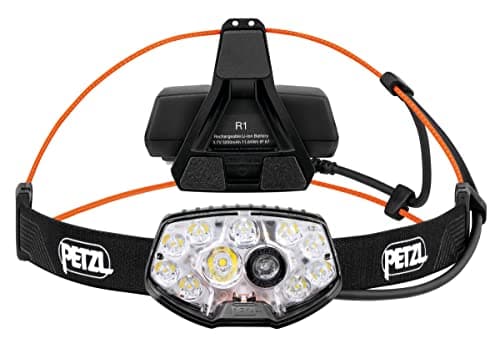 Petzl NAO RLTop pick1,500 lumens and 11.84 watt-hours in a rear-battery layout. The most stored energy on this list, and the weight that comes with it. | Ultra distance, where the battery has to last the night | 1,500 lm / 145 g |
We earn a commission if you buy through the links on this page, at no extra cost to you. It does not change what we recommend or the order they appear in. Full disclosure. Prices checked November 4, 2026.
Buy the NAO RL if your nights are long enough that reactive lighting pays for itself, and if you will never put it underwater. Petzl publishes two complete tables for this lamp - one for reactive lighting and one for fixed output - plus 11.84 watt-hours, 145 g, a 3.5-hour charge, a 300-cycle battery guarantee and IPX4. It is the most completely documented headlamp on this site, and the only one whose published runtimes survive an arithmetic check. The cost is that at this price it carries a rain rating rather than an immersion one.
We have not tested this headlamp. We own none of the products on this site, we have no laboratory, and nothing here is an impression of how reactive lighting feels on a trail. This review takes every figure Petzl publishes, runs the arithmetic those figures allow, and says what they do and do not commit the company to.
It also corrects us. Until today this site recorded the NAO RL's beam distance and ingress rating as "not stated on the page we read", and the brightest headlamps page said in so many words that it was "the one Petzl lamp that states neither". Both are published: 200 m in reactive mode, 140 m in fixed mode, and IPX4. Re-reading Petzl's own product page on November 3, 2026 also produced a second complete runtime table we did not have. Every page that described those as gaps has been corrected in the same change as this one.
The published specification: two tables, not one
This is the part that makes the lamp interesting to a site like this one. Petzl publishes the full performance table twice - once for its reactive sensor mode and once for fixed output - so the thing every other maker asks you to take on trust can be read off the sheet.
| Level | Brightness | Distance | Burn time |
|---|---|---|---|
| MAX POWER | 50 to 1,500 lm | 200 m | 2 to 24 h |
| STANDARD | 30 to 550 lm | 100 m | 5 to 40 h |
| MAX BURN TIME | 15 to 250 lm | 70 m | 10 to 64 h, plus 10 lm for 2 h in reserve |
| Level | Brightness | Distance | Burn time | Computed candela |
|---|---|---|---|---|
| MAX POWER | 900 lm | 140 m | 2 h | 4,900 cd |
| STANDARD | 250 lm | 70 m | 5 h | 1,225 cd |
| MAX BURN TIME | 10 lm | 10 m | 80 h | 25 cd |
| Specification | Published figure |
|---|---|
| Weight | 145 g |
| Battery | R1 lithium-ion, 3,200 mAh / 3.7 V / 11.84 Wh |
| Charging | USB-C, 3.5 h |
| Doubles as a power bank | Yes - Petzl states it can charge phones or watches |
| Ingress protection | IPX4, stated as weather resistant |
| Rear red light | 2 lm continuous, 2.5 m, 78 h |
| Rear red strobe | Visible at 150 m for 400 h |
| Beam pattern | Wide or mixed |
| Guarantee | Lamp 5 years; battery 2 years or 300 charging cycles |
| Peak candela | Not published |
| Color rendering | Not published |
One precision point before the arithmetic. Petzl footnotes the FL 1 protocol against the fixed table only. The reactive figures are the company's own measure of a mode the standard was never written for - a sensor that changes output continuously does not have a single runtime - so we compute candela from the fixed distances and treat the reactive 200 m as Petzl's claim rather than a protocol figure. That distinction is Petzl's own, and it is the sort of thing most makers blur.
What reactive lighting actually buys
Put the two MAX POWER rows side by side and the answer is not the one the marketing implies. Reactive mode does not simply trade brightness for endurance - it raises the ceiling and extends the floor at the same time.
| Reactive | Fixed | |
|---|---|---|
| Brightness | 50 to 1,500 lm | 900 lm |
| Distance | 200 m | 140 m |
| Burn time | 2 to 24 h | 2 h |
So reactive mode peaks 67 percent brighter and reaches 60 meters further than the lamp's fixed maximum, and at the other end of its range it can run twelve times longer. The reason is thermal and electrical rather than magical: a lamp that spends most of its time dimmed can afford a higher burst than one asked to hold a level indefinitely. The fixed 900 lumens is what this hardware sustains; the 1,500 is what it can reach when the sensor is managing the duty cycle.
The honest part is the range itself. "2 to 24 h" is a twelvefold spread, and Petzl prints it rather than picking a flattering number. That is the company saying it cannot tell you the runtime because the runtime depends on what you look at - which is true, and which almost nobody else in this category admits about any feature. Our headlamps for running page covers why reactive behavior suits a trail and irritates on a road.
The first runtimes on this site that survive the arithmetic
We run the same check on every lamp we review: multiply published output by published runtime, divide by the stored energy, and see whether the implied efficiency is something an LED and driver can actually deliver. Almost nothing passes. The NAO RL does.
We are not going to claim this proves Petzl measures differently from everyone else - the FL 1 definition applies to its fixed table too, and a figure can be both FL 1 and conservative. What we can say is that on this lamp the published hours are close to hours at the stated output, where on most lamps we review they demonstrably are not. For a buyer planning a night, that is the single most valuable property a runtime figure can have. How runtime is defined sets out the standard.
The beam: wide, and now measurable
Petzl publishes distance and not candela, so the intensity has to be computed - and on the fixed table, where FL 1 applies, that conversion is exact, because beam distance is defined as the point where illuminance falls to 0.25 lux.
What that means practically: the reactive 200 m is a detection figure on a sensor-managed burst, and the number to plan a trail around is 140 m fixed or 100 m reactive at STANDARD. Throw versus flood covers the trade, and the brightest headlamps ranks the category on this exact figure.
Eleven point eight four watt-hours, and what it costs to carry
Petzl states battery energy in watt-hours directly, which no other headlamp maker on this site does - everyone else publishes milliamp-hours at best, and most publish nothing. That makes the comparison below possible without a single assumption.
The weight is also split front and rear, which is the real reason to accept 145 g on a run - moving sixty-odd grams behind your head stops the lamp pivoting down on every footstrike. That is ergonomics rather than specification, and we cannot verify it, but it is the stated design intent and it is why the NAO sits where it does on headlamps for running.
Two further published details worth having. The R1 battery charges other devices - Petzl states phones or watches - which on a long event is a second reason to carry the energy. And the battery guarantee is 2 years or 300 charging cycles, against 5 years on the lamp. Petzl is one of only two makers on this site that publish a cycle count at all; Maglite states 1,000 for the ML150LRX. A sealed lamp with no published cycle life tells you nothing about when it stops being the lamp you bought.
IPX4, on the most expensive headlamp here
This is the weakness, and it is worth being blunt about it because the rest of the sheet is so strong. Petzl publishes IPX4 - under IEC 60529, splashing water from any direction, with the X meaning no dust test was declared. It is a rain rating. It is not immersion, and it is not dust-tight.
Petzl publishes IPX4 across every lamp we cover, so this is a range decision rather than a corner cut on one product. But the consequence lands hardest here: this is the most expensive headlamp on the site, and lamps at a third of the price publish more. The Nitecore HC75 UHE and Fenix HM65R-T publish IP68 with 2 m submersion; the Black Diamond Spot 400-R publishes IP67; the Princeton Tec Vizz publishes IPX7 on three AAA cells. If the lamp will go in water, none of this lamp's other virtues help.
The rear light, and how to read its 400 hours
The NAO RL has a rear red light, and Petzl publishes two figures for it: 2 lumens continuous at 2.5 m for 78 hours, and a strobe visible at 150 m for 400 hours.
The 400 hours is a be-seen claim, not a working runtime - it describes how long other people can detect you, at an output that lights nothing for you. We apply the same reading to Petzl's strobe figures across the range, and it is the single most misread number in this maker's catalog: people see 400 hours on a spec sheet and plan a trip around it. The figure to plan around on this lamp is 80 hours at 10 lumens, or 5 hours at 250.
What Petzl does not publish
No peak candela, as across the whole range - so the distances above are arithmetic from one figure rather than two figures agreeing. Streamlight, Maglite, SureFire, Nitecore and Acebeam each publish both for at least one product we cover.
No CRI figure, which on a lamp used for hours at a time has a real comfort dimension. And no runtime for the reactive mode's single levels - only ranges, which is honest but does leave planning to you.
Who should buy something else
Skip it if the lamp will get properly wet. IPX4 is rain. Three lamps linked above publish immersion ratings at lower prices.
Skip it if your longest night is under five hours. You would be carrying 11.84 watt-hours for a duration you never reach. The Petzl Swift LT publishes 43 g, and the Swift RL carries 8.47 Wh at 92 g with the same reactive technology and a better energy-to-weight ratio.
Skip it if you want absolute endurance. The Fenix HM75R publishes 30.2 computed watt-hours - two and a half times this lamp - though at 321 g complete it is a work decision rather than a running one.
Skip it if reactive lighting is not what you want. On a road, past lit windows and car headlights, a sensor that keeps adjusting is a nuisance rather than a feature, and you can buy a lot of fixed-output lamp for this money. See headlamps for walking at night.
The verdict, stated as what it commits to
Petzl commits to two complete performance tables, six output-and-runtime pairs across them, distances for every level, 11.84 watt-hours stated in watt-hours, 145 g, a 3.5-hour charge, a battery that charges a phone, a 300-cycle battery guarantee and IPX4 - and its fixed-mode runtimes are the only ones on this site that survive an efficiency check at every level. For a long night on a trail, where you want to plan rather than hope, that combination is not available anywhere else we cover.
What it does not commit to is a candela figure, a CRI figure, or any water protection beyond rain - and it is beaten on energy density by its own smaller sibling and by two lamps costing far less. Buy it for the documentation, the reactive range and the split weight. Buy something else if it will be submerged, if your nights are short, or if you simply want fixed output. For the category ranked on what each maker actually prints, see headlamp brands compared.
The picks, in full
Top pick · Ultra distance, where the battery has to last the night
Petzl NAO RL
1,500 lumens and 11.84 watt-hours in a rear-battery layout. The most stored energy on this list, and the weight that comes with it.
11.84 watt-hours is 3.6 times the Swift LT's tank and 1.4 times the Swift RL's. That is the entire reason to carry 145 g on your head.
Petzl publishes the whole table twice, reactive and fixed, which makes this the only lamp here where you can measure what the sensor buys: reactive MAX POWER peaks at 1,500 lm over 200 m against the fixed mode's 900 lm over 140 m, and runs 2-24 h against a flat 2.
The rear battery is not styling. It moves sixty-odd grams off the front of your skull, which is why the NAO does not bounce on a descent the way a front-heavy lamp does.
It charges a phone. On a hundred-miler that is a second reason to carry it.
What works
- The most stored energy in this roundup, by a wide margin
- Weight split front and rear, so it stays put on rough ground
- Swappable spare pack turns a battery change into a 20-second job at an aid station
What does not
- 145 g is 53 g more than a Swift RL for the same reactive technology, and a worse energy-to-weight ratio: 8.2 Wh per 100 g against 9.2
- IPX4 only - rain, not immersion - on the most expensive headlamp we cover
- No published candela figure, so the distances rest on one number rather than two that agree
Skip this ifyour longest night is under five hours. You would be carrying a battery for a duration you never reach.
Published specification
- Peak intensity
- not published(Petzl publishes distance, not intensity. The fixed 140 m computes to 4,900 cd, or 5.4 cd/lm.)
- Beam distance
- 200 m reactive / 140 m fixedPer level: reactive 200/100/70 m, fixed 140/70/10 m. The FL 1 footnote covers the fixed table only.Petzl NAO RL — manufacturer spec page (retrieved November 3, 2026)
- Runtime
- Fixed: 2 h at 900 lm / 5 h at 250 lm / 80 h at 10 lm. Reactive: 2-24 h, 5-40 h, 10-64 h.Two complete tables. The reactive figures are ranges because output tracks what you look at. Its fixed figures are the only runtimes on this site that survive an efficiency check at every level.Petzl NAO RL — manufacturer spec page (retrieved November 3, 2026)
- Battery
- 3,200 mAh / 3.7 V / 11.84 Wh Li-ion, USB-C, doubles as a power bankPetzl NAO RL — manufacturer spec page (retrieved September 1, 2026)
- Ingress
- IPX4Weather resistant, not immersion rated - the same rating Petzl publishes across its range, on the most expensive headlamp we cover.Petzl NAO RL — manufacturer spec page (retrieved November 3, 2026)
$199.95 · 7% off
#ad · how this is funded · price as of November 4, 2026
Questions people actually ask
How long does the Petzl NAO RL last?
It depends on the mode, and Petzl publishes both. In fixed output: 2 hours at 900 lumens, 5 hours at 250, and 80 hours at 10. In reactive lighting it publishes ranges rather than single figures - 2 to 24 hours at MAX POWER, 5 to 40 at STANDARD, 10 to 64 at MAX BURN TIME - because the runtime depends on what you look at. The 400-hour figure you may see is the rear red strobe's visibility claim, not a working runtime.
Is the Petzl NAO RL worth it?
For long nights where you want to plan rather than hope, yes - it is the most completely documented headlamp we cover, with two full performance tables and 11.84 watt-hours stated directly. Its fixed-mode runtimes are also the only ones on this site that survive an efficiency check at every level. The reservations are IPX4 water protection on the most expensive lamp here, no candela figure, and a worse energy-to-weight ratio than the cheaper Swift RL.
What does reactive lighting actually do?
Petzl's sensor meters reflected light and adjusts output continuously, dimming when you look at something close or pale. The measurable effect is on the published figures: reactive MAX POWER peaks at 1,500 lumens over 200 m against the fixed mode's 900 lumens over 140 m, and runs 2 to 24 hours against a flat 2. So it raises the ceiling and extends the floor at once - a lamp that spends most of its time dimmed can afford a brighter burst.
Petzl NAO RL or Swift RL?
The Swift RL for most people. It carries 8.47 watt-hours at 92 g - a better energy-to-weight ratio, 9.2 against the NAO's 8.2 - with the same reactive technology, for less money. The NAO RL wins on absolute energy (11.84 Wh), on reach, and on having its weight split front and rear, which matters on rough ground. If your longest night is under five hours, the Swift RL is the lamp.
Is the Petzl NAO RL waterproof?
No - it is weather resistant. Petzl publishes IPX4, which under IEC 60529 means splashing water from any direction, with the X meaning no dust test was declared. Rain is fine; immersion is not covered. Petzl publishes IPX4 across every lamp we cover, so this is a range decision - but lamps at a third of the price publish IP67 or IP68 with stated submersion depths.
How far does the Petzl NAO RL shine?
Petzl publishes 200 meters in reactive MAX POWER and 140 meters in fixed MAX POWER. The fixed figures are measured under ANSI FL 1, so they convert exactly to intensity: 140 m is 4,900 candela, or 5.4 candela per lumen - a wide, flood-biased beam, which is the right shape for running. Petzl publishes no candela figure directly.
Can the NAO RL battery charge a phone?
Yes. Petzl states that the R1 rechargeable battery can be used to charge other devices such as phones or watches. The battery is 3,200 mAh at 3.7 V, which is 11.84 watt-hours, and the lamp charges over USB-C in a stated 3.5 hours.
How long does the NAO RL battery last before it degrades?
Petzl publishes a guarantee of 2 years or 300 charging cycles on the battery, against 5 years on the lamp itself. That is unusually forthcoming - only two makers on this site publish a cycle count at all, the other being Maglite at 1,000 cycles for the ML150LRX. The battery is also a swappable pack rather than a sealed cell, so a degraded one is a replacement rather than a new lamp.
Is the NAO RL good for running?
It is built for it, and two published facts support that: the beam is wide at about 5 candela per lumen, which suits a trail rather than a distant target, and the weight is split front and rear so the lamp does not pivot down on every footstrike. The reactive mode's published ranges are also most useful on a trail, where what you look at keeps changing. On a road, past lit windows and traffic, the sensor is more nuisance than help.
Sources
Every figure on this page came from one of the documents below, read on the date shown. We do not cite other review sites, forum posts or video reviews as sources of fact.
- Petzl NAO RL — manufacturer spec page (retrieved November 3, 2026)
- Petzl Swift RL — manufacturer spec page (retrieved September 1, 2026)
- Fenix HM75R — manufacturer spec page (retrieved September 1, 2026)
- Petzl — ANSI/PLATO FL 1 technical information for its headlamp range
- ANSI/PLATO FL 1 flashlight performance standard — definitions of lumens, peak beam intensity, beam distance, runtime, impact and water resistance
- IEC 60529 — the IP (ingress protection) rating system
Read next
Best headlamps, ranked on the watt-hours behind the lumens
The full headlamp ranking: output, weight, battery energy and beam distance, every figure sourced to the maker.
Best headlamps for running
Running headlamps ranked on weight, stored energy and beam stability rather than on peak output.

The brightest headlamps, and what the lumens actually buy
Nine of the highest-output headlamps we cover, ranked on published lumens with the reach and runtime figures that contradict the ranking.
Headlamp brands, ranked on what they tell you
Every headlamp brand we cover, ranked on specification disclosure — from the one publishing watt-hours to the three publishing only a lumen figure.
Best headlamps for hiking
Hiking headlamps ranked on hybrid power, published runtime and weight — not on peak output.

Best headlamps for backpacking
Backpacking headlamps ranked on the grams-per-watt-hour trade, computed from published figures.
Petzl Swift LT review
A specification-first review of the Petzl Swift LT: what 43 grams and 3.27 watt-hours actually cover, and the three things that weight costs you.
Petzl Actik Core review
A specification-first review of the Petzl Actik Core: the full per-mode table, what the AAA fallback actually costs you, and who should buy something else.
Fenix HM75R review
A specification-first review of the Fenix HM75R: what 30.2 watt-hours and a rear battery case actually buy, and who should wear something lighter.
Nitecore HC75 UHE review
A specification-first review of the Nitecore HC75 UHE: three published output-and-runtime pairs, 20.4 watt-hours in a replaceable 21700, and a maker that documents its own thermal step-down.
Petzl vs Fenix headlamps
Petzl against Fenix on published battery energy, beam distance, weight and ingress rating — four matched pairs where both makers actually show their work.
Petzl vs Black Diamond
Petzl against Black Diamond on published beam distance, runtime, battery energy and weight, with three matched pairs at the prices people actually shop.
Throw vs flood
How reflector geometry produces throw or flood, what each suits, and where the middle ground lives.
Flashlight runtime, computed
How runtime is defined, why thermal step-down happens, and the arithmetic to compute a real figure yourself.
Found a number that is wrong? Tell us and we will fix it and say so. Our methodology shows every formula on this page.