Tactical Flashlights
SureFire G2X Pro review
This site had the G2X Pro recorded as a light whose maker publishes almost nothing. Re-reading SureFire's own page proved that wrong, and the corrected sheet is the most interesting thing about it.
By Scooter M. · Published · Updated
| # | Product | Best for | Reach | Price |
|---|---|---|---|---|
| 1 | 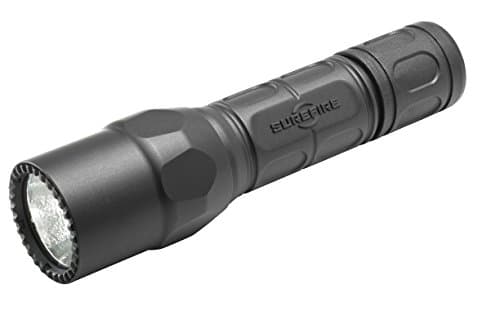 SureFire G2X ProTop pick600 lumens, 8,700 candela, 1.5 hours, and two modes. The specification is modest; the point is that nothing on it can go wrong. | A simple two-mode light that will outlive you | 187 m |
We earn a commission if you buy through the links on this page, at no extra cost to you. It does not change what we recommend or the order they appear in. Full disclosure. Prices checked October 7, 2026.
We have not tested this flashlight. We own none of the products on this site, we have no laboratory, and nothing here is an impression of how it feels in a hand. This review takes every figure SureFire publishes, runs the arithmetic those figures allow, and says what they do and do not commit the company to.
It also corrects us. Until this review, this site recorded the G2X Pro's beam distance, weight and ingress rating as not published, and said in several places that SureFire prints a candela figure and then stops. Re-reading SureFire's own product page on October 6, 2026 showed that was wrong on four counts: the company publishes a 187 m beam distance, a fifty-two-hour low-mode runtime, a 125 g weight and an IPX7 rating. Every page that said otherwise has been corrected in the same change as this one.
That matters more than it sounds, because of what the 187 m figure does. It gives this light two independently published beam numbers that can be checked against each other — and they agree. On the test that runs through this entire site, the G2X Pro passes, and it is the only light outside Streamlight and Maglite that does.
The published specification
| Specification | Published figure |
|---|---|
| Output | 600 lm high / 15 lm low |
| Peak beam intensity | 8,700 cd |
| Beam distance | 187 m |
| Runtime | 1.5 h high / 52 h low |
| Battery | Two CR123A lithium primaries, included |
| Weight | 125 g (4.4 oz), cells installed |
| Length and bezel | 13.2 cm (5.2 in), 3.2 cm (1.25 in) bezel |
| Body | Polymer and aluminum |
| Ingress protection | IPX7 |
| Impact resistance | Not published |
Nine figures and one gap. That is a fuller sheet than the reputation suggests, and fuller than this site credited it with for five weeks. It is still short of Streamlight, which publishes a runtime and a candela figure for every mode plus an impact rating, and it is far ahead of Nitecore, Olight and Acebeam, which publish no runtime at all for the lights we cover.
The two beam figures check each other
Eight lights on this site publish both figures and have them agree. Four are Streamlights, three are Maglites, and this is the eighth. Every other maker we cover publishes one of the two, which cannot be checked, or neither.
A low candela-per-lumen number means a wide beam with a soft hotspot and a lot of usable spill. That is a deliberate choice and it is the right one for the job this light is sold for: at the distances where you actually use a hand-held light indoors or across a yard, you want to see the whole scene rather than a bright circle with darkness around it. Throw versus flood covers the trade in full.
Fifty-two hours on low is the figure nobody quotes
The headline is 600 lumens for an hour and a half. The more useful number is 15 lumens for fifty-two hours, and it is the figure this site was previously missing entirely.
Fifty-two hours is more than two full days of continuous light. Fifteen lumens is not much — it is enough to read by, to find a breaker panel, to walk a corridor without becoming night-blind — and that is exactly the output you want when the question has stopped being how far you can see and become how long the light lasts. A two-mode light that publishes both ends of its range is telling you it expects to be used at both ends.
What SureFire does not publish is the capacity of the CR123A cells it ships, so the watt-hour arithmetic this site normally runs cannot be applied here. You can see the hours; you cannot check them against the energy behind them. That is the same gap Streamlight leaves on its SL-B26 pack. How runtime is defined covers the computation where the inputs exist.
Two CR123A primaries, and the ten-year argument
This light runs on two CR123A lithium primaries and nothing else. There is no rechargeable pack, no USB port and no alternative cell format. In 2026 that reads like an omission, and for most buyers it is.
For one specific buyer it is the entire reason to own it. CR123A lithium primaries hold their charge for roughly a decade on a shelf. A light that lives in a drawer, a vehicle or a go-bag and gets touched twice a year is a light whose battery chemistry matters far more than its lumen count — and a sealed rechargeable in that role is a paperweight the one night you need it. This is why the G2X Pro appears on our emergency and home lighting pages as well as the tactical ones.
The honest counterweight is running cost. A light used a couple of hours a week burns through primaries at a rate that makes it an expensive thing to own, and there is no way to opt out of that on this model. If you use a light daily, buy something rechargeable; the arithmetic is not close. Streamlight vs SureFire sets the two power strategies against each other properly.
IPX7, and the rating it does not carry
Under IEC 60529 the digits are read separately, and the X is not a zero — it means no solid-particle test was declared. So IPX7 is a water rating with no dust rating attached: protection against immersion in one meter of water for thirty minutes, and silence on ingress of dust and grit.
For context, the Streamlight ProTac HL-X publishes IP68, where the 6 is dust-tight and the 8 is continuous immersion beyond a meter, plus a 2 m impact rating. The Streamlight PolyTac publishes IPX7 and a 3 m impact rating. The G2X Pro publishes IPX7 and no impact figure at all, which on a light sold substantially on durability is the one conspicuous hole in the sheet. A reputation for surviving drops is not the same as a published drop test, and we are not going to treat it as one.
What the numbers do not contain
People do not buy this light for its specification, and it would be dishonest to review it as though they did. They buy it for the belief that it will work — that the two-mode interface cannot be misconfigured, that the tail switch will not fail, and that the thing will still be functioning in fifteen years.
We have no way to measure that. We have not owned one, we have no failure-rate data, and a reputation is not evidence we can put in a table. What we can say is narrow and real: the interface genuinely is two modes with no programming and no strobe to land on by accident, and every figure the company prints about this light now checks out against every other figure it prints. Those are the parts of the claim that are verifiable, and they are both true.
Who should buy something else
Skip it if you buy on specification. Almost everything in this price region beats it on paper, often by a multiple. The Fenix PD36R Pro publishes 2,800 lumens and 380 m, the Olight Warrior X 4 2,600 lumens and 630 m. See the brightest tactical flashlights.
Skip it if reach is the job. 187 m is short. The Nitecore P30i publishes 1,000 m and the Acebeam L19 1,300 m, both on less output than you might expect, because they concentrate far harder. See best flashlight throwers.
Skip it if you will use it daily. The primaries will cost you more than the light over a few years. A rechargeable duty light with a published per-mode runtime — the Streamlight ProTac HL-X, which also takes CR123A when the pack is flat — does both jobs.
Skip it if you want a published impact rating. Streamlight prints one for every light we cover and SureFire prints none for this one. On the disclosure test this site runs, that is the gap that remains after the corrections above.
The verdict, stated as what it commits to
On published evidence this is a modest light with an unusually honest sheet. Its candela and beam distance reconcile, it publishes a runtime for both of its modes, it states a weight and IPX7, and it runs on cells that will still be charged in ten years. Four checkable facts, and together they describe a light built to be relied on rather than to win a comparison it was never entered in.
It is not bright, it does not throw, it costs real money to feed, and its maker will not tell you how far it can be dropped. Every one of those is visible in the numbers before you spend anything — which is the argument this site exists to make. For the wider category ranked on candela rather than lumens, see tactical flashlights, and for what the word actually means, what makes a flashlight tactical.
The picks, in full
Top pick · A simple two-mode light that will outlive you
SureFire G2X Pro
600 lumens, 8,700 candela, 1.5 hours, and two modes. The specification is modest; the point is that nothing on it can go wrong.
SureFire publishes both 8,700 candela and a 187 m beam distance, and the two reconcile: the square root of 8,700 divided by 0.25 is 186.5 m. That makes this the only light on this site outside Streamlight and Maglite whose two beam figures can be checked against each other. It is still well short of the ProTac's 374 m on similar output, because SureFire deliberately builds a wider beam with more usable spill.
Two modes, low then high, with no strobe and no programming. On a light you might need in a hurry, that is a feature.
CR123A primaries hold their charge for a decade on a shelf. For a light that lives in a drawer against the worst night of your life, that matters more than rechargeability.
What works
- Two modes, no menu, nothing to misconfigure
- CR123A lithium cells with a ten-year shelf life
- The most durable reputation in the category, earned over decades
What does not
- 600 lumens and 8,700 candela are modest for the price in 2026
- IPX7 is immersion-only - no dust digit - and SureFire states no impact rating
- CR123A cells cost real money to run
Skip this ifyou buy on specification. Almost everything here beats it on paper; you are paying for reliability and simplicity instead.
Published specification
- Output
- 600 lmHigh. Low is 15 lm.SureFire G2X Pro — manufacturer spec page (retrieved October 6, 2026)
- Peak intensity
- 8,700 cdSureFire G2X Pro — manufacturer spec page (retrieved October 6, 2026)
- Beam distance
- 187 mPublished, and it reconciles with the 8,700 cd figure.SureFire G2X Pro — manufacturer spec page (retrieved October 6, 2026)
- Runtime
- 1.5 h on highLow is 52 h.SureFire G2X Pro — manufacturer spec page (retrieved October 6, 2026)
- Battery
- 2 x CR123A lithiumSureFire G2X Pro — manufacturer spec page (retrieved October 6, 2026)
- Weight
- 125 g4.4 oz, cells installed.SureFire G2X Pro — manufacturer spec page (retrieved October 6, 2026)
- Ingress
- IPX7No dust digit; no impact rating stated.SureFire G2X Pro — manufacturer spec page (retrieved October 6, 2026)
#ad · how this is funded · price as of October 7, 2026
Questions people actually ask
Is the SureFire G2X Pro worth it?
It depends entirely on how often you will use it. For a light that lives in a drawer or a vehicle and must work after a year untouched, the CR123A primaries and the two-mode interface make a genuine case, and every figure SureFire publishes for it now checks out. For daily use it is poor value: lights at similar money publish four times the output, and the primaries cost more than the light over a few years.
How many lumens is the SureFire G2X Pro?
600 lumens on high and 15 on low, as SureFire publishes. The more informative figure is the 8,700 candela behind the 600 lumens, which works out to 14.5 candela per lumen — a wide beam with a soft hotspot and generous spill, rather than a tight thrower.
How far does the SureFire G2X Pro shine?
SureFire publishes 187 meters, and that figure reconciles with its published 8,700 candela: the square root of 8,700 divided by 0.25 is 186.5 m. It is one of only eight lights on this site whose two beam figures can be checked against each other. For comparison the Streamlight ProTac HL-X publishes 374 m on 1,300 lumens.
How long does the SureFire G2X Pro run?
1.5 hours on high and 52 hours on low. Publishing a figure for both modes is better disclosure than most of this category manages — Nitecore, Olight and Acebeam publish no runtime at all for the lights we cover. SureFire does not publish the capacity of the CR123A cells, so the hours cannot be checked against stored energy.
Is the SureFire G2X Pro waterproof?
It publishes IPX7, which under IEC 60529 means protection against immersion in one meter of water for thirty minutes. The X matters: it means no dust rating was declared, so the sheet is silent on grit. SureFire also publishes no impact resistance figure for this light, where Streamlight publishes 2 m for the ProTac HL-X and 3 m for the PolyTac.
Does the SureFire G2X Pro use rechargeable batteries?
No. It runs on two CR123A lithium primaries, included, with no rechargeable option on this model. Those cells hold their charge for roughly a decade, which is the point for a light kept against an emergency, and they are expensive to replace, which is the problem for a light used every day.
SureFire G2X Pro or Streamlight ProTac HL-X?
The Streamlight publishes 1,300 lumens, 35,000 candela, 374 m, IP68, a 2 m impact rating and three per-mode runtimes, and it runs on either a rechargeable pack or CR123A primaries. The SureFire publishes 600 lumens, 187 m, IPX7, two runtimes and a 125 g weight. Both have beam figures that reconcile. Buy the Streamlight for more light and more disclosure; buy the SureFire only if a two-mode interface with nothing to misconfigure is worth more to you than the specification gap.
Sources
Every figure on this page came from one of the documents below, read on the date shown. We do not cite other review sites, forum posts or video reviews as sources of fact.
- SureFire G2X Pro — manufacturer spec page (retrieved October 6, 2026)
- Streamlight ProTac HL-X — manufacturer spec page (retrieved September 1, 2026)
- Streamlight PolyTac — manufacturer spec page (retrieved September 1, 2026)
- Olight Warrior X 4 — the brand's own listing on Amazon.com (retrieved September 1, 2026)
- ANSI/PLATO FL 1 flashlight performance standard — definitions of lumens, peak beam intensity, beam distance, runtime, impact and water resistance
- IEC 60529 — the IP (ingress protection) rating system
Read next
Best tactical flashlights, ranked on candela rather than lumens
The tactical ranking: published candela, beam distance, sustained runtime and ingress rating, all sourced.
What actually makes a flashlight tactical
What the word tactical actually describes, feature by feature, and what to judge a light on instead.
Best flashlights for police and law enforcement
Duty lights ranked on shift-length sustained runtime, impact rating and charging strategy.
Best tactical flashlights for self defense
Self-defense flashlight picks, ranked on instant access and reliability rather than on marketing claims.
Streamlight ProTac HL-X review
A specification-first review of the Streamlight ProTac HL-X: the arithmetic behind its figures, the dual power arrangement, and who should buy something brighter.
Streamlight PolyTac review
A specification-first review of the Streamlight PolyTac: a 3 m drop rating, a full per-mode sheet that reconciles, and lithium primaries that keep for years.
Streamlight vs SureFire
The two American duty brands compared on documentation, power strategy and interface philosophy.
Olight vs SureFire
Olight against SureFire: modern output and charging against simplicity and shelf-stable primaries.
Lumens vs candela
The distinction that decides reach, with the conversion formula and a table of real published figures.
Flashlight runtime, computed
How runtime is defined, why thermal step-down happens, and the arithmetic to compute a real figure yourself.
Throw vs flood
How reflector geometry produces throw or flood, what each suits, and where the middle ground lives.
Found a number that is wrong? Tell us and we will fix it and say so. Our methodology shows every formula on this page.