Tactical Flashlights
Streamlight PolyTac review
The light we cite on more pages than any other we had never reviewed. Its case rests on three things, and none of them is brightness.
By Scooter M. · Published · Updated
| # | Product | Best for | Reach | Price |
|---|---|---|---|---|
| 1 | 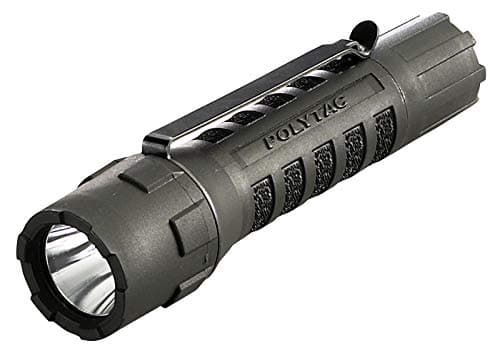 Streamlight PolyTacTop pick600 lumens, 214 m, 2.75 hours, IPX7 and 3 m impact resistance in a nylon polymer body. The one you leave in a truck. | A polymer duty light you will not worry about | 214 m |
We earn a commission if you buy through the links on this page, at no extra cost to you. It does not change what we recommend or the order they appear in. Full disclosure. Prices checked September 27, 2026.
We have not tested this flashlight. We own none of the products on this site and have no laboratory. This review works from Streamlight's own product page, read on September 27, 2026, and the arithmetic those figures allow.
The PolyTac appears as a pick on eighteen pages of this site — more than any other product we had never given a page of its own. That is not because it is bright. It is because it keeps turning out to be the right answer to a question that has nothing to do with output: what light do you put somewhere and forget about?
What Streamlight publishes
| Mode | Output | Peak beam intensity | Beam distance | Runtime |
|---|---|---|---|---|
| High | 600 lm | 11,500 cd | 214 m | 2.75 h |
| Medium | 260 lm | 4,900 cd | 140 m | 5.5 h |
| Low | 35 lm | 675 cd | 52 m | 34 h |
| Strobe | not stated | not stated | not stated | 5.5 h |
| Specification | Published figure |
|---|---|
| Battery | 2 x CR123A lithium, included |
| Weight | 119.07 g (4.20 oz) with batteries |
| Length | 13.56 cm (5.34 in) |
| Water resistance | IPX7, waterproof to 1 m for 30 minutes |
| Impact resistance | 3 m, tested |
| Interface | TEN-TAP, three programmable mode orders |
| Warranty | Limited lifetime |
| Body | Nylon polymer |
That is a complete sheet. Output, intensity, distance and runtime for all three modes, plus a strobe runtime, weight, length, an immersion rating, a drop rating, the interface and a lifetime warranty. Only Streamlight and Maglite publish at this level across the nine brands we cover.
The figures check each other, in all three modes
This matters more than the numbers themselves. A maker who publishes one unverifiable figure is asking to be trusted; a maker who publishes two that can be checked against each other has made a claim you could falsify. The PolyTac is one of only seven lights on this site that pass that test, and every one of the seven is a Streamlight or a Maglite.
The derived ratio is 19.2 candela per lumen — moderate. The ProTac HL-X concentrates 27, the Fenix PD36R Pro 13. See throw versus flood for what that spread means in the hand.
Polymer is the reason to buy it
So the 600-lumen ceiling and the 3-meter drop rating are the same decision seen from two sides. If you want more output you buy a metal light and accept a lower drop figure; if you want to stop worrying about the light you buy this one and accept 600 lumens.
Lithium primaries change what the light is for
Two CR123A lithium cells, included. Lithium primaries hold their charge in storage for roughly a decade, which is a property no rechargeable has, and it is what makes this the right light for a glovebox, a go-bag, a boat or a drawer you open twice a year.
A rechargeable light in that role has one failure mode and it is the common one: flat when you reach for it. Our outage kit page treats that as the organizing problem rather than a footnote.
The cost is running cost. CR123A cells are meaningfully more expensive per hour than charging a lithium-ion pack, so for daily carry this is the wrong economics. Streamlight publishes 34 hours on low, which softens it — a light used occasionally on its 35-lumen setting will go years on one pair — but if you use a light every day, buy a rechargeable.
TEN-TAP, and why a programmable order matters here
Streamlight publishes three selectable mode orders: high/strobe/low as shipped, high only, or low/medium/high. That last one is the reason this feature is worth mentioning rather than skipping.
A light that starts on 600 lumens destroys your dark adaptation every time you switch it on indoors. Programmed low-first, the PolyTac starts at 35 lumens and steps up — which is what you want in a tent, a loft or a vehicle at night. High-only is the other useful one: for a light kept for emergencies, removing the mode cycle entirely means nobody fumbles through strobe in the dark.
What it costs you
- 600 lumens. Modest by current standards, and the direct consequence of the polymer body. Eight lights in our tactical set are brighter.
- IPX7, not IP68. Immersion to one meter for thirty minutes, with no dust digit. Streamlight's own ProTac HL-X publishes IP68, for close to double the price.
- No rechargeable option. Unlike the ProTac HL-X, which takes either its pack or two CR123A primaries, this is primaries only.
- No published candela for strobe, though a 5.5-hour strobe runtime is more than most makers state at all.
- 19.2 candela per lumen is a middling beam. For reach, the compact throwers page ranks what actually concentrates.
Who should buy something else
Skip it if you carry a light daily. CR123A running costs add up and a rechargeable is cheaper per hour. The Streamlight MacroStream is the documented pocket alternative.
Skip it if you want output. 600 lumens is the ceiling here. The Fenix PD36R Pro publishes 2,800 and 380 m, with a 3 h 30 min runtime at full output.
Skip it if it will be submerged or dusty. IPX7 is one meter for thirty minutes and says nothing about dust. The ProTac HL-X publishes IP68 and runs on a pack or primaries.
Skip it if you want one light for everything. This is a light for a specific job — sitting unattended for years and working on the first press — and it is close to ideal at that and unremarkable at anything else.
The verdict, stated as what it commits to
Streamlight commits to 600 lumens at 11,500 candela and 214 meters for 2.75 hours, 260 at 140 m for 5.5, 35 at 52 m for 34, a 5.5-hour strobe, 119 g, 13.56 cm, IPX7, a 3 m drop rating, three programmable mode orders and a lifetime warranty — with every distance figure reconciling against its own candela figure.
It wins no column on a spec comparison and it is the light we keep recommending anyway, because the job it is best at is the one buyers under-weight: being found working. Buy it for the vehicle, the go-bag and the cupboard. For the field ranked on evidence rather than output, see police and duty flashlights.
The picks, in full
Top pick · A polymer duty light you will not worry about
Streamlight PolyTac
600 lumens, 214 m, 2.75 hours, IPX7 and 3 m impact resistance in a nylon polymer body. The one you leave in a truck.
2.75 hours at 600 lumens from two CR123A cells is a very efficient result — that is roughly 6 watt-hours doing real work rather than being thrown away as heat.
3 m of impact resistance is the highest figure in this roundup. Polymer absorbs a drop that would dent an aluminum body.
119 g with cells installed makes this the lightest full-size duty light here.
What works
- Full per-mode table published, all three modes
- 3 m impact resistance and IPX7
- 119 g, with a ten-year shelf life on its cells
What does not
- 600 lumens is modest against the rechargeable competition
- CR123A running costs add up
- We could not pin a current ASIN for it, so the buy link is a tagged Amazon search
Skip this ifyou use a light daily. CR123A primaries are the wrong economics for frequent use; buy a rechargeable instead.
Published specification
- Output
- 600 lmHigh. Medium 260 lm, low 35 lm.Streamlight PolyTac — manufacturer spec page (retrieved September 1, 2026)
- Peak intensity
- 11,500 cdHigh. Medium 4,900 cd, low 675 cd. Each reconciles with the published distance for its mode.Streamlight PolyTac — manufacturer spec page (retrieved September 27, 2026)
- Beam distance
- 214 mHigh. 140 m medium, 52 m low.Streamlight PolyTac — manufacturer spec page (retrieved September 1, 2026)
- Runtime
- 2.75 h high / 5.5 h medium / 34 h lowStreamlight PolyTac — manufacturer spec page (retrieved September 1, 2026)
- Battery
- 2 x CR123A lithium (included)Streamlight PolyTac — manufacturer spec page (retrieved September 1, 2026)
- Weight
- 119 g (4.2 oz) with batteriesStreamlight PolyTac — manufacturer spec page (retrieved September 1, 2026)
- Ingress
- IPX7Waterproof to 1 m for 30 minutes; 3 m impact resistance testedStreamlight PolyTac — manufacturer spec page (retrieved September 1, 2026)
#ad · how this is funded · price as of September 27, 2026
Questions people actually ask
Is the Streamlight PolyTac worth it?
For a light kept in a vehicle, go-bag or drawer, yes. It publishes a full per-mode sheet that reconciles, a 3 m drop rating - the highest of any handheld we cover - and it runs on lithium primaries that hold charge for roughly a decade. For daily carry the CR123A running cost makes a rechargeable the better buy.
How long does the Streamlight PolyTac run?
Streamlight publishes 2.75 hours at 600 lumens, 5.5 hours at 260, 34 hours at 35, and 5.5 hours on strobe. Under ANSI FL 1 those figures run until output falls to 10 percent of the 30-second reading, so they already account for step-down.
How far does the Streamlight PolyTac throw?
214 m on high, 140 m on medium and 52 m on low. Streamlight separately publishes 11,500, 4,900 and 675 candela for those modes, and each converts back to the stated distance within rounding - which is the strongest evidence available that the figures were measured.
Is a polymer flashlight less durable than aluminum?
Not on drops. The polymer PolyTac publishes a 3 m tested impact rating against 2 m for Streamlight's aluminum ProTac HL-X and Stinger 2020, because polymer flexes and absorbs energy that metal transmits to the internals. Metal wins on heat, which is why high-output lights are aluminum.
Why does the PolyTac use CR123A batteries instead of rechargeable?
Because lithium primaries keep their charge in storage for roughly a decade, which no rechargeable can match. That makes it the right light for something you use twice a year. The trade is running cost, so for daily use a rechargeable is cheaper per hour.
What is TEN-TAP on a Streamlight?
A programmable mode order. Streamlight publishes three options for the PolyTac: high/strobe/low as shipped, high only, or low/medium/high. Low-first is genuinely useful indoors, because a light that starts at 600 lumens ruins your dark adaptation every time you switch it on.
Streamlight PolyTac or ProTac HL-X?
The PolyTac for a light you store and forget: a 3 m drop rating, primaries that keep for a decade, and less money. The ProTac HL-X for a light you use: more than double the output, 374 m of reach, IP68 instead of IPX7, and it takes either a rechargeable pack or CR123A primaries.
Is the Streamlight PolyTac waterproof?
It is rated IPX7 - waterproof to 1 meter for 30 minutes. That is immersion protection rather than splash resistance, but the X means Streamlight publishes no dust rating for it. The ProTac HL-X publishes IP68, which covers both.
Sources
Every figure on this page came from one of the documents below, read on the date shown. We do not cite other review sites, forum posts or video reviews as sources of fact.
- Streamlight PolyTac — manufacturer spec page (retrieved September 1, 2026)
- Streamlight ProTac HL-X — manufacturer spec page (retrieved September 1, 2026)
- Fenix PD36R Pro — manufacturer spec page (retrieved September 1, 2026)
- ANSI/PLATO FL 1 flashlight performance standard — definitions of lumens, peak beam intensity, beam distance, runtime, impact and water resistance
- IEC 60529 — the IP (ingress protection) rating system
Read next
Best tactical flashlights, ranked on candela rather than lumens
The tactical ranking: published candela, beam distance, sustained runtime and ingress rating, all sourced.
Best flashlights for police and law enforcement
Duty lights ranked on shift-length sustained runtime, impact rating and charging strategy.
Best tactical flashlights under $100
Sub-$100 tactical picks, and an honest account of which specifications survive the price band.
Streamlight ProTac HL-X review
A specification-first review of the Streamlight ProTac HL-X: the arithmetic behind its figures, the dual power arrangement, and who should buy something brighter.
What to keep in a power outage lighting kit
A practical outage lighting kit, with battery storage rules and a check schedule that takes ten minutes a year.
Best compact thrower flashlights
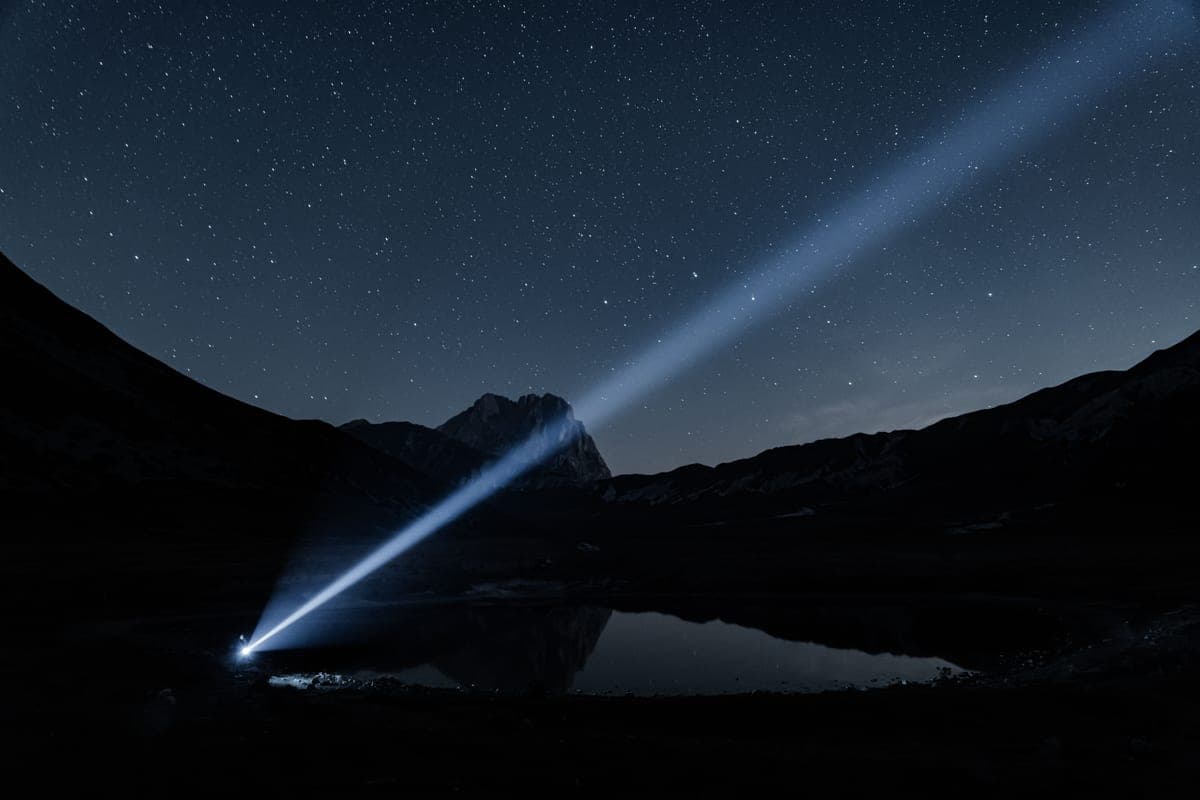
Pocketable lights ranked on how tightly they concentrate each lumen, with every candela figure either published by the maker or computed from a published beam distance.
Found a number that is wrong? Tell us and we will fix it and say so. Our methodology shows every formula on this page.