Tactical Flashlights
Fenix PD36R Pro review
The biggest battery in any tactical light we cover, and a Turbo runtime that means something quite different from what the box implies.
By Scooter M. · Published · Updated
| # | Product | Best for | Reach | Price |
|---|---|---|---|---|
| 1 | 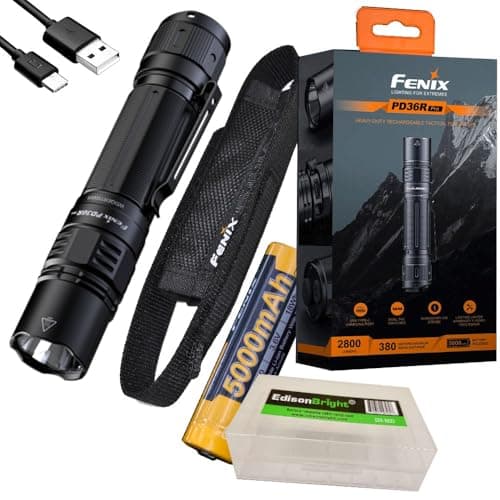 Fenix PD36R ProTop pick2,800 lumens from a 21700 cell holding 18 watt-hours, at 169 grams. The biggest energy store in the tactical set. | The most output and energy in a tactical body | 380 m |
We earn a commission if you buy through the links on this page, at no extra cost to you. It does not change what we recommend or the order they appear in. Full disclosure. Prices checked September 17, 2026.
We have not tested this flashlight. We own none of the products on this site and have no laboratory. This review takes every figure Fenix publishes on its own product page — read on September 17, 2026 — runs the arithmetic those figures allow, and states plainly what they do not cover.
The PD36R Pro is one of the lights this site cites most, as the energy leader in the tactical ranking and one half of Streamlight vs Fenix. Writing this review meant re-reading Fenix's page line by line, and that re-read corrected two things we had been saying about it elsewhere on the site. Both corrections are in this review, and the pages that made the earlier claims have been fixed.
What Fenix publishes
| Specification | Published figure |
|---|---|
| Maximum output | 2,800 lm |
| Modes | Five brightness levels plus Strobe |
| Runtime on Turbo | 3 h 30 min |
| Maximum runtime | 42 h |
| Beam distance | 380 m (1,247 feet) |
| Battery | 5,000 mAh 21700 Li-ion, included |
| Charging | USB-C, about 3 h |
| Weight | 169 g (5.96 oz) including battery |
| Length | 145.8 mm |
| Water resistance | Waterproof underwater to 2 m (no IP code given) |
| Impact resistance | Stated as impact resistant (no drop height given) |
| Peak candela | not published |
That is a strong sheet by the standards of this category. Fenix states battery capacity, which Streamlight does not on any light we cover, and it states a Turbo runtime, which most makers of 2,000-lumen-plus lights do not. The remaining modes are published as a runtime chart image rather than as text, so they are harder to quote and search, but they are there.
The 3.5-hour Turbo figure, read correctly
This is the single most misread number on the box, and it is worth being precise about, because it sounds like a claim this light cannot make.
None of this is a criticism of Fenix specifically. Every high-output light in a pocketable body steps down as it heats, because an LED turns most of its input into heat and a 26.5 mm head cannot shed it fast enough. What distinguishes makers is whether they tell you. Fenix tells you more than most; Streamlight's per-mode table in plain text tells you more still.
Reach: 380 meters, and what it costs in output
The comparison that matters is the Streamlight ProTac HL-X, which publishes 35,000 candela and 374 m from 1,300 lumens — roughly 27 candela per lumen. The two lights reach within six meters of each other. The Fenix spends more than twice the output to get there, because its reflector spreads the beam wider rather than concentrating it.
That is a design choice, not a flaw. A 13-candela-per-lumen beam lights a broad field with a usable hotspot, which suits searching a yard or a building. It just means the 2,800-lumen headline buys width, not distance. If reach is the whole job, best flashlight throwers ranks lights built for it, including several that reach two to three times further on less output.
The 21700 cell is the actual reason to buy it
Strip away the lumen figure and the case for this light is its battery. 18 watt-hours is the largest single-cell energy store on this site. For comparison, the ProTac HL-X does not publish its pack's capacity at all, and a typical 18650-based light carries around 12 Wh.
- It is a standard 21700. Fenix's is included, but the format is common, so a charged spare is easy to carry and swap in the dark.
- It charges on the light over USB-C, in about 3 hours according to Fenix. No proprietary cradle to lose.
- 169 g including the cell is a genuine achievement for 18 Wh. The ProTac HL-X publishes 162 g on CR123A primaries — seven grams lighter, for a battery that holds a fraction of the energy.
What the cell does not give you is a primary-cell fallback. The ProTac HL-X runs on two CR123A lithium primaries when its pack is flat, and those store for a decade. The PD36R Pro is rechargeable only, so a flat cell and no power is a flat light. 18650 vs 21700 covers the cell formats in detail.
Waterproofing: stated, but not coded
Fenix states the PD36R Pro is waterproof underwater to 2 meters and impact resistant. Those are real claims, and we had previously described this light as publishing no ingress rating, which was wrong; it is corrected here and on the pages that said it.
What Fenix does not give is an IP code or a drop height. That matters for comparison rather than for the claim itself. An IP68 rating under IEC 60529 refers to a defined test; a plain-language statement of 2 m submersion describes a depth without telling you the duration or conditions it was tested to. It is a meaningful claim that is harder to place on the same scale as Streamlight's coded IP68 on the ProTac HL-X. Treat it as good evidence the light survives rain and a dunking, rather than as an equivalent to a published IP68.
A note on the listing we link to
The Amazon listing this page links to is sold as a bundle with a charging cable and a carry case, so the product photograph shows the bundle rather than the light alone. The light inside is the PD36R Pro as specified above. We link to it because it was in stock with a live price when we checked; the button shows whatever the price layer currently reads, or Check price if it has nothing fresh.
Who should buy something else
Skip it if you need to know every mode's runtime in text. Fenix states Turbo and the maximum in words and charts the rest. The Streamlight ProTac HL-X and Stinger 2020 state a runtime for every mode in plain text.
Skip it if you need reach per lumen. At about 13 candela per lumen, the ProTac HL-X reaches essentially as far on less than half the output. See the full ProTac HL-X review.
Skip it if it has to work with no power available. Rechargeable only, no primary fallback. For a light kept against emergencies, a CR123A or AA light is the safer choice — see emergency and home lighting.
Skip it if you want a coded IP rating to compare against. The stated 2 m waterproofing is real but not on the IEC 60529 scale.
The verdict, stated as what it commits to
On published evidence the PD36R Pro is the tactical light we would choose for endurance. It carries 18 watt-hours in a standard removable 21700, weighs 169 g with the cell, reaches 380 m, and Fenix states both a Turbo runtime and a maximum. That is more disclosure than most of the category, and the battery is a genuine class-leading figure.
Read its two headline numbers correctly and there is no contradiction: 2,800 lumens is a burst, 3.5 hours on Turbo is measured to 10 percent output, and the energy behind both is real. What it does not do is concentrate its beam as tightly as a ProTac, publish every mode in text, or run on primaries. If those matter more to you than 18 watt-hours, the tactical ranking sets out the alternatives.
The picks, in full
Top pick · The most output and energy in a tactical body
Fenix PD36R Pro
2,800 lumens from a 21700 cell holding 18 watt-hours, at 169 grams. The biggest energy store in the tactical set.
A 5,000 mAh 21700 at 3.6 V is 18.0 watt-hours — nearly three times what the ProTac HL-X carries. That is the case for the 21700 format in one number.
380 m of reach on 2,800 lumens works back to about 36,100 candela, almost identical to the ProTac's 35,000 from 1,300 lumens. The Fenix is spending its extra output on spill, not on distance.
169 g including the cell is only 7 g more than a ProTac on CR123A, for nearly triple the energy. That is what four years of cell development buys.
What works
- 18 Wh of stored energy, the most in the tactical set
- 2,800 lumens with 380 m of published reach
- Standard 21700 cell, USB-C on the light
What does not
- Waterproofing stated as 2 m submersion, with no IP code to compare against
- No published candela, so the throw figure cannot be cross-checked
- 2,800 lumens will step down quickly in a body this size
Skip this ifyou need a shelf-stable light. A rechargeable cell self-discharges; for a drawer light, CR123A primaries are the right answer.
Published specification
- Peak intensity
- not published
- Beam distance
- 380 mFenix states 1,247 feet (380 m)Fenix PD36R Pro — manufacturer spec page (retrieved September 17, 2026)
- Runtime
- 3 h 30 min on Turbo / 42 h maximumTurbo is measured to 10% output under ANSI FL 1, so it includes step-down; 42 h is the lowest mode. Other modes are published as a chart imageFenix PD36R Pro — manufacturer spec page (retrieved September 1, 2026)
- Battery
- 5,000 mAh 21700 Li-ion (included), USB-CFenix PD36R Pro — manufacturer spec page (retrieved September 1, 2026)
- Weight
- 169 g (5.96 oz)Including batteryFenix PD36R Pro — manufacturer spec page (retrieved September 1, 2026)
- Ingress
- Waterproof underwater to 2 mFenix states this without giving an IP codeFenix PD36R Pro — manufacturer spec page (retrieved September 17, 2026)
#ad · how this is funded · price as of September 17, 2026
Questions people actually ask
Is the Fenix PD36R Pro worth it?
On published figures it makes the strongest case of any tactical light we cover for endurance: an 18 Wh 21700 cell, 2,800 lumens, 380 m of reach and 169 g including the battery, with both a Turbo runtime and a maximum stated. It is not the most concentrated beam, it has no primary-cell fallback, and it gives no IP code.
How long does the Fenix PD36R Pro last on Turbo?
Fenix states 3 hours 30 minutes on Turbo. Under ANSI FL 1, runtime is measured until output falls to 10 percent, so that figure includes the light stepping down from 2,800 lumens. It is not three and a half hours at full output. Fenix states a 42-hour maximum for the lowest mode.
How far does the Fenix PD36R Pro shine?
Fenix publishes 380 m, or 1,247 feet. That works back to about 36,100 candela, which is roughly 13 candela per lumen. The Streamlight ProTac HL-X reaches 374 m on 1,300 lumens, so the Fenix spends more than twice the output for six extra meters, because its beam is wider.
Is the Fenix PD36R Pro waterproof?
Fenix states it is waterproof underwater to 2 meters and impact resistant. It does not give an IP code or a drop height, so the claim is harder to compare directly against a coded rating such as Streamlight's IP68. It is good evidence the light survives rain and submersion to that depth.
What battery does the Fenix PD36R Pro use?
A 5,000 mAh 21700 lithium-ion cell, which Fenix includes. At 3.6 V that is 18.0 watt-hours, the largest single-cell figure on this site. It charges on the light over USB-C in about 3 hours. There is no CR123A or AA fallback.
Fenix PD36R Pro or Streamlight ProTac HL-X?
The Fenix for stored energy and output: 18 Wh and 2,800 lumens. The Streamlight for a tighter beam, a coded IP68, every runtime stated in text, and CR123A fallback: it reaches 374 m on 1,300 lumens. Our Streamlight vs Fenix comparison works through the whole range.
Does the PD36R Pro get hot or step down?
Every high-output light in a pocketable body steps down as it heats, and the PD36R Pro's own published figures reflect that: 18 Wh across a 3.5-hour Turbo run averages about 5.1 W, which is only possible if the light spends most of that run well below 2,800 lumens. We have not measured it and do not publish a step-down time.
Sources
Every figure on this page came from one of the documents below, read on the date shown. We do not cite other review sites, forum posts or video reviews as sources of fact.
- Fenix PD36R Pro — manufacturer spec page (retrieved September 17, 2026)
- Streamlight ProTac HL-X — manufacturer spec page (retrieved September 1, 2026)
- ANSI/PLATO FL 1 flashlight performance standard — definitions of lumens, peak beam intensity, beam distance, runtime, impact and water resistance
- IEC 60529 — the IP (ingress protection) rating system
Read next
Best tactical flashlights, ranked on candela rather than lumens
The tactical ranking: published candela, beam distance, sustained runtime and ingress rating, all sourced.
Streamlight vs Fenix
Streamlight against Fenix on published candela, reach and runtime — one brand wins the headline, the other wins the spec sheet.
Streamlight ProTac HL-X review
A specification-first review of the Streamlight ProTac HL-X: the arithmetic behind its figures, the dual power arrangement, and who should buy something brighter.
The brightest tactical flashlights, and what brightness actually buys
Seven of the highest-output tactical lights we cover, ranked on published lumens with the beam distance that contradicts the order.

Flashlight runtime, computed
How runtime is defined, why thermal step-down happens, and the arithmetic to compute a real figure yourself.
18650 vs 21700, and every other cell format
Cell formats compared on capacity, current rating and dimensions, with the safety rules that matter.
Found a number that is wrong? Tell us and we will fix it and say so. Our methodology shows every formula on this page.