Tactical Flashlights
Streamlight Stinger 2020 review
The only light we cover that publishes candela, beam distance and a runtime for all three modes — and whose two published figures check each other. That is rarer than any number on the box.
By Scooter M. · Published · Updated
| # | Product | Best for | Reach | Price |
|---|---|---|---|---|
| 1 | 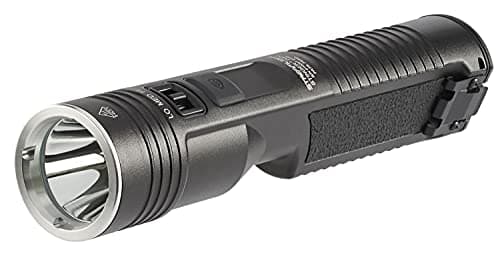 Streamlight Stinger 2020Top pick2,000 lumens, 315 m, two hours on high, and a charger in the box. Built for a shift, not for a pocket. | A patrol light that lives in a charging cradle | 315 m |
We earn a commission if you buy through the links on this page, at no extra cost to you. It does not change what we recommend or the order they appear in. Full disclosure. Prices checked September 23, 2026.
We have not tested this flashlight. We own none of the products on this site and have no laboratory. This review works from Streamlight's own product page, read on September 22, 2026, and from the arithmetic those figures allow.
Most of the reviews on this site spend their length explaining what a maker has left out. This one does not. Streamlight publishes output, peak beam intensity, beam distance and runtime for every mode, plus weight, length, an ingress rating, an impact rating and a warranty — and the intensity and distance figures reconcile against each other. It is the most completely documented light we cover, alongside Streamlight's own ProTac HL-X.
What Streamlight publishes
| Mode | Output | Peak beam intensity | Beam distance | Runtime |
|---|---|---|---|---|
| High | 2,000 lm | 25,000 cd | 315 m | 2 h |
| Medium | 850 lm | 10,000 cd | 200 m | 4 h |
| Low | 100 lm | 1,200 cd | 70 m | 24 h |
| Strobe | not stated | not stated | not stated | 3.25 h |
| Specification | Published figure |
|---|---|
| Battery | SL-B26 rechargeable Li-ion pack, quantity 2 |
| Charging | Existing Stinger chargers, USB cord, or the SL-B26 bank charger |
| Weight | 350 g (12.3 oz) |
| Length | 19.48 cm (7.67 in) |
| Water resistance | IPX7 |
| Impact resistance | 2 m, tested |
| Switches | Independent head and tail switches, plus a mode selector |
| Warranty | Limited lifetime |
| Cell capacity | not published in mAh or watt-hours |
The two figures that check each other
Almost every maker publishes either an intensity figure or a distance figure, never both — which means there is nothing to test the number against. Streamlight publishes both, and under ANSI/PLATO FL 1 they are two views of the same measurement.
This matters more than any single number on the page. A maker who publishes one unverifiable figure is asking to be trusted. A maker who publishes two that can be checked against each other, three times over, has made a claim you can falsify. Only Streamlight and Maglite do this among the brands we cover — see Streamlight vs Maglite.
The beam is deliberately broad
It would be easy to read 12.5 as a weakness. It is a decision. A patrol light spends most of its life inside ten meters — a vehicle interior, a stairwell, a back yard, a face — and a tightly concentrated beam in that space is a bright disc surrounded by darkness. The Stinger's wide hotspot lights the whole of what you are looking at.
The cost is reach per lumen. The ProTac HL-X publishes 374 m from 1,300 lumens where the Stinger publishes 315 m from 2,000 — more than half again the output for sixty fewer meters, because the ProTac concentrates more than twice as hard. If your work is a treeline rather than a room, that is the light. Throw versus flood covers the trade properly.
Two hours at full output is the headline figure
| Light | Output at high | Published runtime at high |
|---|---|---|
| Fenix PD36R Pro | 2,800 lm | 3 h 30 min |
| Streamlight Stinger 2020 | 2,000 lm | 2 h |
| Streamlight ProTac HL-X | 1,300 lm | 1 h 30 min |
| Nitecore P20iX | 4,000 lm | not published |
| Olight Warrior X 4 | 2,600 lm | not published |
| Nitecore P30i | 2,000 lm | not published |
Read the bottom three rows. Three of the six brightest tactical lights we cover publish no runtime at any level, so there is no way to know whether their output is a working level or a thirty-second burst. On that column the Fenix beats the Stinger outright and deserves the credit — see the PD36R Pro review. What the Fenix does not publish is an IP code, an impact rating or a candela figure — it states only that the light is waterproof to 2 m.
Two battery packs, which changes the usual objection
A proprietary cell is normally the thing we count against a duty light, because a flat proprietary pack a long way from its charger is a dead light. Streamlight publishes a quantity of 2 for the SL-B26 pack, which is not a detail to skip past: the spare is in the box. Swap it at the start of a shift and the endurance question mostly goes away.
The charging is also less narrow than the light's reputation suggests. Streamlight lists three routes — existing Stinger chargers, a USB cord, or the SL-B26 bank charger — so a vehicle cradle is one option among several rather than a dependency. If you already run Stingers, your existing chargers work.
What Streamlight does not publish is the pack's capacity, in either milliamp-hours or watt-hours. That is the one real gap in an otherwise complete sheet, and it means the stored energy — the figure this site normally computes for every rechargeable — cannot be derived. We will not estimate it.
The interface, and why duty lights are built this way
Streamlight publishes independently functioning head and tail switches plus a mode selector. That arrangement exists for a specific reason: a tail switch can be worked with the light held in a fist beside your head, a head switch with the light held conventionally, and the mode selector sets what the switches do before you ever need them.
The consequence is that you choose your mode at the start of a shift rather than cycling through three levels in front of whatever you are looking at. On a general-purpose light that is over-engineering. On a duty light it is the whole point, and it is one of the things what makes a flashlight tactical actually comes down to.
What it costs you
- 350 grams and 19.48 cm. This is the heaviest light in our tactical set and it does not go in a pocket. On a duty belt or in a vehicle door, the mass is irrelevant; anywhere else it is the first thing you notice.
- IPX7, not IP68. Immersion to one meter for thirty minutes, and no dust digit at all. Streamlight's own ProTac HL-X publishes IP68, which is dust-tight and rated deeper. For a light this expensive that is a conspicuous step down inside one catalog.
- No primary-cell fallback. The ProTac HL-X takes two CR123A lithium primaries when its pack is flat, and those store for roughly a decade. The Stinger has a spare pack and no such escape hatch.
- No published cell capacity, so watt-hours and cost-to-run cannot be computed.
- No published candela for strobe, though Streamlight does give it a 3.25-hour runtime, which is more than most makers say about strobe at all.
Who should buy something else
Skip it if you carry it rather than wear it. 350 g is a belt-or-vehicle decision. For pocket carry at real output, the EDC field is the right place to start.
Skip it if you need reach. 315 m is respectable and it is not what this light is for. The Nitecore P30i publishes 1,000 m and the Olight Warrior X 4 630 m.
Skip it if you want dust protection or a primary-cell fallback. The ProTac HL-X publishes IP68, runs on CR123A primaries as well as its pack, weighs roughly half as much and costs less.
Skip it if raw output is the point. The Nitecore P20iX publishes twice the lumens. It also publishes no runtime, so what those 4,000 lumens cost you is unknown — which is exactly the trade this light exists to avoid.
The verdict, stated as what it commits to
Streamlight commits to 2,000 lumens for two hours, 25,000 candela, 315 meters, 350 grams, 19.48 centimeters, IPX7, 2 meters of impact resistance and a lifetime warranty — with a full table for medium and low, a strobe runtime, two battery packs in the box and three charging routes. Every distance figure reconciles with its own intensity figure.
That is not a light that wins a spec-sheet comparison on any single row. It is the light whose spec sheet you can actually check, which is a different and rarer thing, and on a tool somebody may depend on it is the one that matters. The gaps are real and small: no cell capacity, IPX7 rather than IP68, and no primary-cell fallback. For the wider field ranked on evidence rather than headline output, see the brightest tactical flashlights and police and duty flashlights.
The picks, in full
Top pick · A patrol light that lives in a charging cradle
Streamlight Stinger 2020
2,000 lumens, 315 m, two hours on high, and a charger in the box. Built for a shift, not for a pocket.
Two hours at 2,000 lumens is the standout number: that is a whole traffic stop at full output rather than the ninety-second burst most 2,000-lumen lights give you.
350 grams is heavy in the hand and irrelevant on a belt. This light is designed around a duty rig and a vehicle charger, and the mass buys the runtime.
Streamlight publishes 25,000 candela alongside the 315 m, and they reconcile: the square root of 25,000 divided by 0.25 is 316.2 m. That is 12.5 candela per lumen — a broader beam than the ProTac's 27, which is the right call for searching a room rather than a treeline.
What works
- Two hours at full 2,000 lumens, which almost nothing else here can claim
- Full per-mode output, candela, distance and runtime table published, and the candela and distance figures check each other
- Ships with a charger designed for a vehicle cradle
What does not
- 350 g, so pocket carry is out
- IPX7 rather than the ProTac's IP68
- Proprietary battery pack, and no capacity published in mAh or watt-hours
Skip this ifyou carry a light rather than wear one. At 350 g it is a duty-belt and vehicle tool, and the ProTac HL-X does most of the same job at half the weight with a CR123A fallback.
Published specification
- Output
- 2,000 lmHigh. Medium 850 lm, low 100 lm.Streamlight Stinger 2020 — manufacturer spec page (retrieved September 1, 2026)
- Peak intensity
- 25,000 cdHigh. Medium 10,000 cd, low 1,200 cd. Each reconciles with the published beam distance for its mode.Streamlight Stinger 2020 — manufacturer spec page (retrieved September 22, 2026)
- Beam distance
- 315 mHigh. 200 m medium, 70 m low.Streamlight Stinger 2020 — manufacturer spec page (retrieved September 1, 2026)
- Runtime
- 2 h high / 4 h medium / 24 h lowStreamlight Stinger 2020 — manufacturer spec page (retrieved September 1, 2026)
- Battery
- 2 x SL-B26 rechargeable Li-ion packStreamlight publishes a quantity of 2, so the spare is in the box. Charges with existing Stinger chargers, a USB cord, or the SL-B26 bank charger. Capacity is not published in mAh or watt-hours.Streamlight Stinger 2020 — manufacturer spec page (retrieved September 1, 2026)
- Weight
- 350 g (12.3 oz)Streamlight Stinger 2020 — manufacturer spec page (retrieved September 1, 2026)
- Ingress
- IPX7Waterproof; 2 m impact resistance testedStreamlight Stinger 2020 — manufacturer spec page (retrieved September 1, 2026)
#ad · how this is funded · price as of September 23, 2026
Questions people actually ask
Is the Streamlight Stinger 2020 worth it?
For duty, patrol or vehicle use, on published evidence, yes. It states 2,000 lumens for a full two hours, 25,000 candela, 315 m, IPX7, a 2 m impact rating and a lifetime warranty, and its intensity and distance figures reconcile in all three modes. It is the wrong light for a pocket at 350 g.
How long does the Streamlight Stinger 2020 last?
Streamlight publishes 2 hours at 2,000 lumens, 4 hours at 850 and 24 hours at 100, plus 3.25 hours on strobe. Under ANSI FL 1 those figures run until output falls to 10 percent, so they already account for thermal step-down - two hours at high is a working figure, not a burst.
How far does the Streamlight Stinger 2020 throw?
315 m on high, 200 m on medium and 70 m on low. Streamlight separately publishes 25,000, 10,000 and 1,200 candela for those modes, and each one converts back to the stated distance within rounding - which is the strongest evidence available that the figures were measured.
Does the Streamlight Stinger 2020 need a charging cradle?
No. Streamlight lists three routes: existing Stinger chargers, a USB cord, or the SL-B26 bank charger. A vehicle cradle is the most convenient option for shift work rather than a requirement, and if you already run Stingers your current chargers work.
How many batteries does the Streamlight Stinger 2020 come with?
Streamlight publishes a quantity of two SL-B26 rechargeable packs. That spare is the answer to the usual objection about proprietary cells - you can swap at the start of a shift instead of finding a charger mid-way through one.
Streamlight Stinger 2020 or ProTac HL-X?
The Stinger for output and endurance: 2,000 lumens for two hours against 1,300 for an hour and a half. The ProTac for everything else - IP68 instead of IPX7, roughly half the weight, CR123A primaries as a fallback, and a lower price. Both publish a complete, checkable sheet.
Why is the Stinger 2020 only 12.5 candela per lumen?
Because it is built to light a room rather than a treeline. A patrol light spends most of its life inside ten meters, where a tightly concentrated beam is a bright disc in the dark. The wide hotspot is a design decision, and the cost is reach - the ProTac HL-X gets 374 m from far fewer lumens.
How heavy is the Streamlight Stinger 2020?
350 g, or 12.3 oz, and 19.48 cm long - the heaviest light in our tactical set. On a duty belt or in a vehicle door that is irrelevant. In a jacket pocket it is the first thing you will notice, and the reason this is not a general-purpose light.
Sources
Every figure on this page came from one of the documents below, read on the date shown. We do not cite other review sites, forum posts or video reviews as sources of fact.
- Streamlight Stinger 2020 — manufacturer spec page (retrieved September 1, 2026)
- Streamlight ProTac HL-X — manufacturer spec page (retrieved September 1, 2026)
- Fenix PD36R Pro — manufacturer spec page (retrieved September 1, 2026)
- Nitecore P30i — the brand's own listing on Amazon.com (retrieved September 1, 2026)
- ANSI/PLATO FL 1 flashlight performance standard — definitions of lumens, peak beam intensity, beam distance, runtime, impact and water resistance
- IEC 60529 — the IP (ingress protection) rating system
Read next
Best tactical flashlights, ranked on candela rather than lumens
The tactical ranking: published candela, beam distance, sustained runtime and ingress rating, all sourced.
Best flashlights for police and law enforcement
Duty lights ranked on shift-length sustained runtime, impact rating and charging strategy.
The brightest tactical flashlights, and what brightness actually buys
Seven of the highest-output tactical lights we cover, ranked on published lumens with the beam distance that contradicts the order.
Streamlight ProTac HL-X review
A specification-first review of the Streamlight ProTac HL-X: the arithmetic behind its figures, the dual power arrangement, and who should buy something brighter.
Streamlight vs Fenix
Streamlight against Fenix on published candela, reach and runtime — one brand wins the headline, the other wins the spec sheet.
Flashlight runtime, computed
How runtime is defined, why thermal step-down happens, and the arithmetic to compute a real figure yourself.
Found a number that is wrong? Tell us and we will fix it and say so. Our methodology shows every formula on this page.