Compare
Acebeam L19 vs Nitecore P30i
The two longest-reaching handhelds we cover. One publishes a bigger number; the other publishes the number that proves it.
By Scooter M. · Published · Updated
| # | Product | Best for | Output | Price |
|---|---|---|---|---|
| 1 | 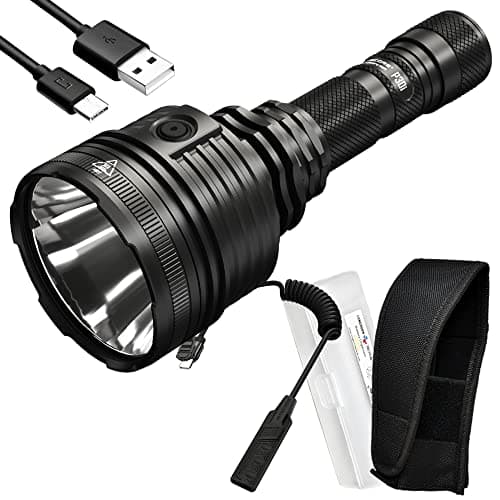 Nitecore P30iTop pick2,000 lumens and 1,000 m of stated throw. The furthest-reaching light on the site, and a genuinely specialized one. | Maximum distance | 2,000 lm | |
| 2 | 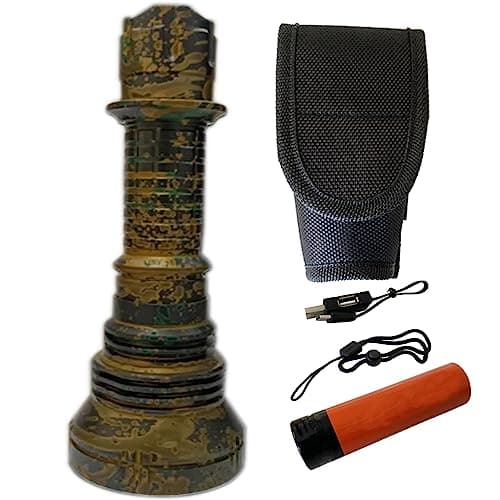 Acebeam L191,650 lumens and 1,300 m of stated throw. The most efficient distance-per-lumen figure on the site, by a wide margin. | The longest reach per lumen here | 1,650 lm | |
| 3 | 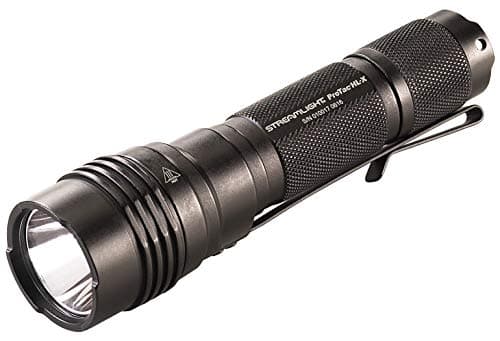 Streamlight ProTac HL-X1,300 lumens, 35,000 candela, 374 m, 1.5 hours, IP68, on either a rechargeable pack or two CR123A cells. Every figure published per mode. | Duty use, and the best-documented light on this site | 1,300 lm |
We earn a commission if you buy through the links on this page, at no extra cost to you. It does not change what we recommend or the order they appear in. Full disclosure. Prices checked October 17, 2026.
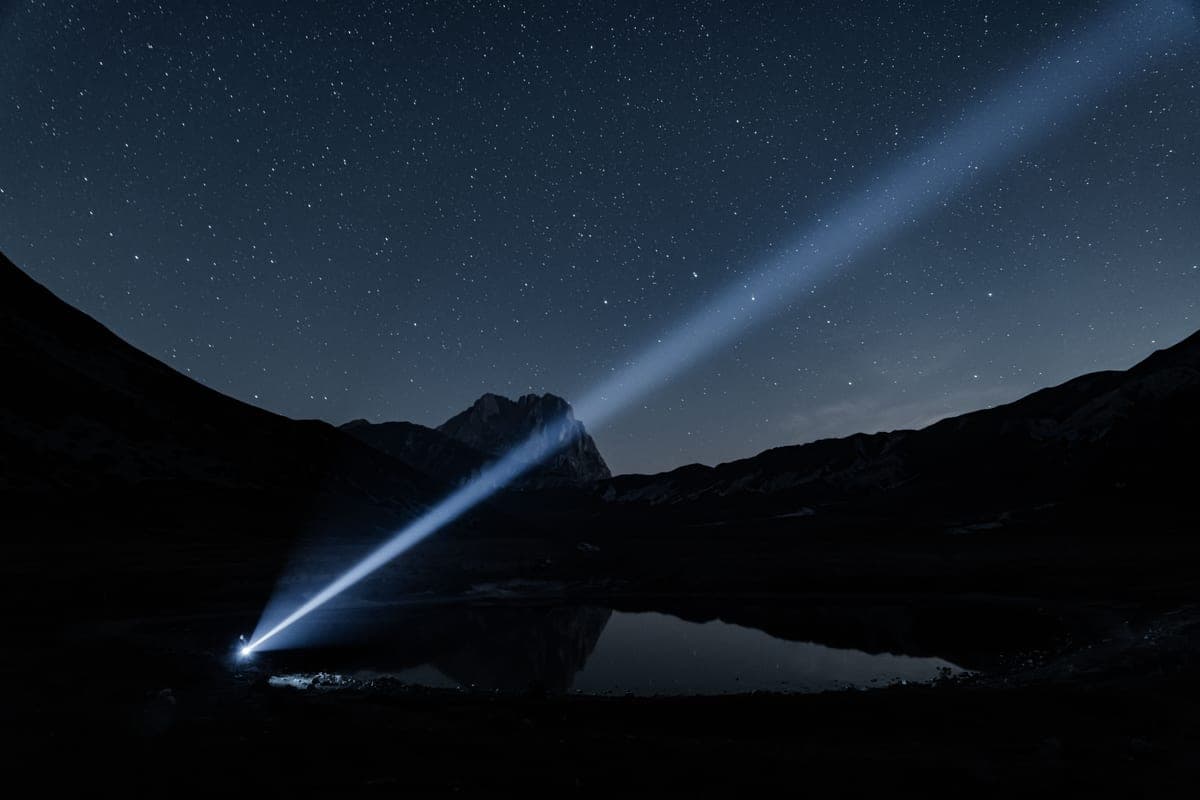
Buy the Nitecore P30i unless you specifically need the last 300 meters, in which case buy the Acebeam L19. The Acebeam publishes a longer throw - 1,300 m against 1,000 m - and nothing else to support it. Nitecore publishes 1,000 m and the 250,000 candela that reconciles with it exactly, plus a maximum runtime, a weight, a head size and IP68. Both are specialist tools that are close to useless inside ten meters.
We have not handled either light. We own none of the products on this site and have no laboratory, so there is no verdict here on how either beam looks. Everything below is read from each maker's own product page on October 17, 2026, plus the arithmetic ANSI FL 1 allows - see our methodology.
Both sheets, side by side
| Specification | Acebeam L19 (PM1 white) | Nitecore P30i |
|---|---|---|
| Maximum output | 1,650 lm | 2,000 lm |
| Beam distance | 1,300 m | 1,000 m |
| Peak beam intensity | Not published | 250,000 cd |
| Candela per lumen | 256 (computed) | 125 (published) |
| Maximum runtime | Not published | 100 h, lowest mode only |
| Per-mode runtime | Not published | Not published |
| Battery | 21700 USB-C included; 18650 or 2 x CR123A accepted | 21700i 5,000 mAh included; 2 x CR123 accepted |
| Stored energy | Not published | 18.5 Wh (computed from 5,000 mAh at 3.7 V) |
| Weight | 196 g without a cell | 255.5 g |
| Length | 163.8 mm | 177.5 mm |
| Head diameter | 60 mm | 65 mm |
| Ingress protection | IP68, stated as 2 m for 30 min | IP68, stated as 2 m |
| Impact resistance | 1.5 m drop tested | 1 m |
| Emitter | PM1 white | CREE XHP35 HI |
Twelve rows where both makers answer, and two where only one does. Nitecore publishes the candela and a runtime; Acebeam publishes neither. Everything else on this page follows from those two absences.
The number that can be checked, and the number that cannot
Under ANSI FL 1, beam distance is defined as the point where illuminance falls to 0.25 lux - roughly full moonlight. Because illuminance is candela divided by distance squared, that definition fixes an exact relationship between the two figures, and a maker who publishes both is offering you a way to check their work.
So the honest summary of the headline is: Nitecore states that its light makes 250,000 candela and backs it with a second, consistent figure. Acebeam states a distance that would require 422,500 candela and does not state the candela. We are not calling the Acebeam claim false; we have no laboratory and no basis for that. We are saying one of these two numbers is checkable and the other is not, and on a site that ranks lights by what can be verified, that is the ranking.
The aperture argument, which cuts against the bigger claim
There is a second reason to be careful with the 1,300 m figure, and it is physical rather than editorial. Throw comes from reflector area and depth and from how small the emitter die is - that is the whole of it. Both makers now publish their head diameters, and the numbers run the wrong way for the Acebeam.
| Light | Head diameter | Output | Intensity claimed or implied |
|---|---|---|---|
| Acebeam L19 | 60 mm | 1,650 lm | 422,500 cd (computed from distance) |
| Nitecore P30i | 65 mm | 2,000 lm | 250,000 cd (published) |
The Acebeam is asked to produce 69 percent more beam intensity from a smaller aperture and less total output. That is not impossible - a different emitter, a deeper reflector or a tighter die will all move the figure - but it is the kind of claim a candela measurement would settle in one line, and Acebeam does not provide one. We note the tension and leave it there. Throw versus flood sets out the optics, and best flashlight throwers ranks the whole category on this figure.
Runtime: one thin figure against none
Neither maker publishes a per-mode runtime table, which on lights driven this hard is the most important gap on both sheets. Nitecore publishes a single 100-hour maximum, and that belongs to the lowest of its five levels - it tells you nothing about the 2,000-lumen mode you bought the light for. Acebeam publishes nothing at all.
Both lights accept CR123A or RCR123 primaries as a fallback, which is worth more on a thrower than it sounds - a search light is used away from sockets by definition. Energizer rates CR123A for storage and operation from -40 C to 60 C, and that is the chemistry argument the car emergency kit page is built on.
What a kilometer of rated distance actually gets you
Neither of these numbers is a working range, and buying on them without understanding that is the commonest disappointment in this category. ANSI FL 1 sets beam distance where illuminance falls to 0.25 lux, which is roughly the light of a full moon. At that level you can detect that something is there. You cannot tell what it is.
Identification needs several times that illuminance, which means the practical identification range of either light is a fraction of its rated figure - we put it at roughly half on our throwers page, and that is reasoning from the inverse-square law rather than a measurement of ours. Applied here, the honest comparison is not 1,300 m against 1,000 m. It is something closer to 650 against 500, and at that point the 300-meter gap in the headline is a 150-meter gap in use.
That matters because it changes what the extra money buys. If your job is spotting livestock across a valley or checking a far fence line, both of these lights do it and the Acebeam does it slightly further out. If your job is identifying a person or an animal at distance, neither light's headline figure is the number to plan with.
What they have in common, and why it matters
Both publish IP68. Acebeam states 2 m for 30 minutes, Nitecore states 2 m. Under IEC 60529 that is dust tight plus immersion to a stated depth, and it is a genuine point in both makers' favor - Olight publishes no rating at all for the Warrior X 4, the next light along in this category.
Both are big. 60 mm and 65 mm of head diameter do not clip to a waistband, and 196 g and 255.5 g are not pocket weights - note that Acebeam's figure excludes the cell and Nitecore's includes it, so the real gap is smaller than it looks. The honest way to own either is as a second light, which is the argument made in full on compact thrower flashlights.
Both have almost no spill. At 125 and 256 candela per lumen these are bright circles in black fields. Inside ten meters that is worse than a 200-lumen pocket light, and neither company pretends otherwise.
Which to buy
Buy the Nitecore P30i for long-range searching. Best for anyone who wants a verifiable thrower: 2,000 lumens, a published 250,000 candela that agrees with its published 1,000 m, IP68, a 1 m impact rating, 255.5 g, a 65 mm head, an 18.5 Wh cell in the box and CR123 as a fallback. Its honest downsides are one runtime figure for five levels, a beam with no usable spill, and a head that makes it awkward to carry. The full review goes through the sheet.
Buy the Acebeam L19 if you need the absolute maximum reach and accept a thinner sheet. Best for anyone whose job is identifying something at the far end of a field: a published 1,300 m, IP68 with a 1.5 m drop rating, 196 g before the cell, a 60 mm head, and a 21700 included with 18650 and CR123A both accepted. Its honest downsides are no published candela to support the headline, no runtime at any level, and a 20-amp cell requirement that a generic replacement will not meet.
If neither is quite right: the Streamlight ProTac HL-X publishes 35,000 candela, 374 m and a runtime for every mode on two power sources, and is a light you can actually carry - it is the answer for anyone who wants reach as one property among several rather than as the only one. Nitecore vs Streamlight sets out that brand-level trade.
The picks, in full
Top pick · Maximum distance
Nitecore P30i
2,000 lumens and 1,000 m of stated throw. The furthest-reaching light on the site, and a genuinely specialized one.
Nitecore publishes 250,000 candela, and that is exactly what the 1,000 m distance works back to through the FL 1 definition. The two figures agree, which is the strongest evidence a spec sheet can offer that someone measured the light.
250,000 cd is seven times the ProTac HL-X's intensity from 1.5 times the lumens, and it is only achievable with a large, deep reflector - Nitecore publishes a 65 mm head to go with it.
A beam this tight is close to useless for anything within ten meters. It is a search-and-identify tool for open country.
21700 is the right cell for it - a beam this intense needs current, and an 18650 would sag. The 5,000 mAh i-series cell in the box is 18.5 watt-hours.
What works
- 1,000 m of published throw and a published 250,000 cd that agrees with it
- IP68, a 1 m impact rating, a published weight and a published head size
- 21700 i-series cell included, with CR123 as a fallback
- The specialist tool the category actually needs, rather than another 3,000-lumen flood
What does not
- One runtime figure for five brightness levels, and it belongs to the dimmest
- The 65 mm head that buys the throw makes it awkward to carry
- Almost no usable spill
Skip this ifyou want one light for everything. This one does distance and does nothing else well.
Published specification
- Output
- 2,000 lmCREE XHP35 HINitecore P30i — manufacturer spec page (retrieved October 17, 2026)
- Peak intensity
- 250,000 cdPublished, and it reconciles exactly with the 1,000 m: 0.25 x 1,000 x 1,000 = 250,000.Nitecore P30i — manufacturer spec page (retrieved October 17, 2026)
- Beam distance
- 1,000 mNitecore P30i — manufacturer spec page (retrieved October 17, 2026)
- Runtime
- 100 h maximumLowest mode. Nitecore publishes no per-mode table for the other four levels.Nitecore P30i — manufacturer spec page (retrieved October 17, 2026)
- Battery
- 1 x 21700i (NL2150HPi 5,000 mAh, included); 2 x CR123 or RCR123 compatibleNitecore P30i — manufacturer spec page (retrieved October 17, 2026)
- Weight
- 255.5 g177.5 mm long, 65 mm across the headNitecore P30i — manufacturer spec page (retrieved October 17, 2026)
- Ingress
- IP68Stated as 2 m submersible; impact resistant to 1 mNitecore P30i — manufacturer spec page (retrieved October 17, 2026)
#ad · how this is funded · price as of October 17, 2026
Pick 2 · The longest reach per lumen here
Acebeam L19
1,650 lumens and 1,300 m of stated throw. The most efficient distance-per-lumen figure on the site, by a wide margin.
1,300 m implies roughly 422,500 candela. From 1,650 lumens that is an extraordinarily concentrated beam — this light puts a higher fraction of its output into the hotspot than anything else on the site.
It is the clearest possible demonstration of why lumens are the wrong metric for reach: this light reaches nearly twice as far as the Nitecore P30i on 82 percent of its output.
The 20A cell requirement is not a detail. A beam this intense draws hard, and a standard protected 21700 will trip its own protection circuit.
What works
- 1,300 m of published throw, the longest here
- Best distance-per-lumen ratio on the site by a distance
- IP68 and a 1.5 m drop rating, both published
- Ships with the high-drain cell it actually needs
What does not
- No published candela and no published runtime, so the implied 422,500 cd cannot be checked
- Requires a 20A-rated cell, so a generic replacement will underperform
- A 60 mm head is the price of the reach, and it does not pocket
- Effectively no spill
Skip this ifyou do not have a genuine long-distance need. Inside 50 m it is worse than a 500-lumen pocket light.
Published specification
- Output
- 1,650 lmThe White LED PM1 emitter, which is the variant this listing sells. Acebeam's SFT40 Hi option is 2,200 lm at a shorter 1,082 m.Acebeam L19 Camo — manufacturer spec page (retrieved October 17, 2026)
- Peak intensity
- not published(Acebeam publishes throw but no peak intensity for it)
- Beam distance
- 1,300 mPM1 white. The green NM1 option is quoted at 1,520 m.Acebeam L19 Camo — manufacturer spec page (retrieved October 17, 2026)
- Runtime
- not published(No per-mode runtime on the maker's page)
- Battery
- 21700 USB-C (included); 1 x 18650 or 2 x CR123A compatibleAcebeam L19 Camo — manufacturer spec page (retrieved October 17, 2026)
- Weight
- 196 g without a cell163.8 mm long, 60 mm across the head. The head width is what buys the throw.Acebeam L19 Camo — manufacturer spec page (retrieved October 17, 2026)
- Ingress
- IP68Stated as submersible to 6.5 ft for 30 minutes; 1.5 m drop testedAcebeam L19 Camo — manufacturer spec page (retrieved October 17, 2026)
#ad · how this is funded · price as of October 17, 2026
Pick 3 · Duty use, and the best-documented light on this site
Streamlight ProTac HL-X
1,300 lumens, 35,000 candela, 374 m, 1.5 hours, IP68, on either a rechargeable pack or two CR123A cells. Every figure published per mode.
35,000 candela and 374 m reconcile exactly: the square root of 35,000 divided by 0.25 is 374.2 m. Streamlight's numbers are internally consistent across all three modes, which is the strongest signal of a maker publishing real measurements rather than marketing figures.
1.5 hours at 1,300 lumens implies roughly 6 to 7 watt-hours of usable energy — consistent with a single 18650-class pack and with the CR123A alternative.
IP68 with 2 m impact resistance is the toughest rating in this roundup, and the reason this light shows up on so many duty belts.
What works
- Full ANSI FL1 table published per mode, and it reconciles
- Runs on a rechargeable pack or on shelf-stable CR123A lithium cells
- IP68 and 2 m impact rating
What does not
- The programming interface takes reading the manual to understand
- 162 to 176 g is heavy for pocket carry
- CR123A cells are expensive if you use it hard
Skip this ifyou want a pocket light. It is a duty-belt tool and the weight and length are built for a holster.
Published specification
- Output
- 1,300 lmHigh. Medium 420 lm, low 70 lm.Streamlight ProTac HL-X — manufacturer spec page (retrieved September 1, 2026)
- Peak intensity
- 35,000 cdHigh. 11,000 cd medium, 1,800 cd low.Streamlight ProTac HL-X — manufacturer spec page (retrieved September 1, 2026)
- Beam distance
- 374 mHigh. 210 m medium, 85 m low.Streamlight ProTac HL-X — manufacturer spec page (retrieved September 1, 2026)
- Runtime
- 1.5 h high / 3.75 h medium / 25 h lowOn the SL-B26 pack. On CR123A: 1.25 h / 3 h / 20 h.Streamlight ProTac HL-X — manufacturer spec page (retrieved September 1, 2026)
- Battery
- SL-B26 rechargeable Li-ion pack, or 2 x CR123A lithiumStreamlight ProTac HL-X — manufacturer spec page (retrieved September 1, 2026)
- Weight
- 162 g with CR123A, 176 g with the packStreamlight ProTac HL-X — manufacturer spec page (retrieved September 1, 2026)
- Ingress
- IP68Dust tight, waterproof to 2 m; 2 m impact resistance testedStreamlight ProTac HL-X — manufacturer spec page (retrieved September 1, 2026)
#ad · how this is funded · price as of October 17, 2026
Questions people actually ask
Acebeam L19 or Nitecore P30i?
The Nitecore P30i, for most buyers. Acebeam publishes a longer throw - 1,300 m against 1,000 m - but no candela figure to support it, and no runtime at any level. Nitecore publishes 250,000 candela that reconciles exactly with its 1,000 m, plus a maximum runtime, a 255.5 g weight, a 65 mm head and IP68. Buy the Acebeam only if the last 300 meters is the job.
Which flashlight throws further, the L19 or the P30i?
The Acebeam L19, on the published figures: 1,300 m against 1,000 m. Whether it throws that far is a different question - the distance implies 422,500 candela and Acebeam publishes no intensity figure, while Nitecore publishes the 250,000 candela that matches its own claim. One number is checkable and the other is not.
Why does the dimmer light reach further?
Because reach depends on beam intensity rather than total output, and intensity comes from reflector size and depth. The L19 puts a computed 256 candela into its hotspot per lumen; the P30i a published 125. So 1,650 lumens out-reaches 2,000. Our throw versus flood guide covers the optics.
Do either of them publish a runtime?
Barely. Nitecore publishes a single 100-hour maximum, which belongs to the lowest of five levels and says nothing about the 2,000-lumen mode. Acebeam publishes no runtime at all. On lights driven hard enough for six-figure candela, that is the most important gap on both sheets, and we will not estimate figures to fill it.
Are they waterproof?
Both publish IP68. Acebeam states submersible to 6.5 feet for 30 minutes; Nitecore states 2 meters submersible with a 1 m impact rating, and Acebeam states a 1.5 m drop test. Under IEC 60529 the 6 is dust tight and the 8 is continuous immersion to a depth the maker specifies.
Can I use these as an everyday flashlight?
No, and neither company suggests it. A 60 or 65 mm head will not pocket, and at 125 to 256 candela per lumen the beam is a tight circle with almost no spill - inside ten meters a 200-lumen pocket light is more useful. Own either as a second light.
What batteries do they take?
Both ship with a 21700 and both accept CR123-format primaries as a fallback - Acebeam also accepts an 18650. Nitecore publishes its cell's capacity at 5,000 mAh, which is 18.5 watt-hours; Acebeam publishes none. Acebeam does state that the L19 needs a 20-amp-rated cell, so a generic protected replacement will sag or trip.
Which is better value?
Check the live prices in the table above rather than a figure typed into an article. On published evidence the Nitecore gives you more verifiable specification per dollar; the Acebeam gives you the longest distance claim of any handheld we cover.
Sources
Every figure on this page came from one of the documents below, read on the date shown. We do not cite other review sites, forum posts or video reviews as sources of fact.
- Nitecore P30i — manufacturer spec page (retrieved October 17, 2026)
- Acebeam L19 Camo — manufacturer spec page (retrieved October 17, 2026)
- Streamlight ProTac HL-X — manufacturer spec page (retrieved September 1, 2026)
- Energizer 123 (CR123A) — product datasheet (lithium manganese dioxide, 3.0 V, 1,500 mAh typical; operating and storage -40 to 60 C, 16.5 g; retrieved October 17, 2026)
- ANSI/PLATO FL 1 flashlight performance standard — definitions of lumens, peak beam intensity, beam distance, runtime, impact and water resistance
- IEC 60529 — the IP (ingress protection) rating system
Read next
Flashlight brand comparisons
Brand-against-brand comparisons on published figures and disclosure quality, not on reputation.
Nitecore vs Streamlight
Nitecore against Streamlight: a 40-fold spread in beam concentration inside one brand, measured against the most complete spec sheets we cover.
Nitecore vs Olight
Nitecore against Olight on output per dollar, charging ecosystem, and the specifications neither publishes.
Best tactical flashlights, ranked on candela rather than lumens
The tactical ranking: published candela, beam distance, sustained runtime and ingress rating, all sourced.
Best flashlight throwers
Throwers ranked on computed candela and published beam distance, with the optics explained.
The brightest tactical flashlights, and what brightness actually buys
Seven of the highest-output tactical lights we cover, ranked on published lumens with the beam distance that contradicts the order.
Nitecore P30i review
A specification-first review of the Nitecore P30i: what 250,000 published candela buys, what it costs in usable spill, and who should buy a general-purpose light instead.
Olight Warrior X 4 review
A specification-first review of the Olight Warrior X 4: 630 m of published reach in a beam you can still use at close range, and the four figures Olight leaves out.
Best compact thrower flashlights
Pocketable lights ranked on how tightly they concentrate each lumen, with every candela figure either published by the maker or computed from a published beam distance.
Throw vs flood
How reflector geometry produces throw or flood, what each suits, and where the middle ground lives.
Lumens vs candela
The distinction that decides reach, with the conversion formula and a table of real published figures.
Found a number that is wrong? Tell us and we will fix it and say so. Our methodology shows every formula on this page.