Tactical Flashlights
Olight Warrior X 4 review
The light that sits between a thrower and a duty light — and for most people, the middle is the part they actually needed.
By Scooter M. · Published · Updated
| # | Product | Best for | Reach | Price |
|---|---|---|---|---|
| 1 | 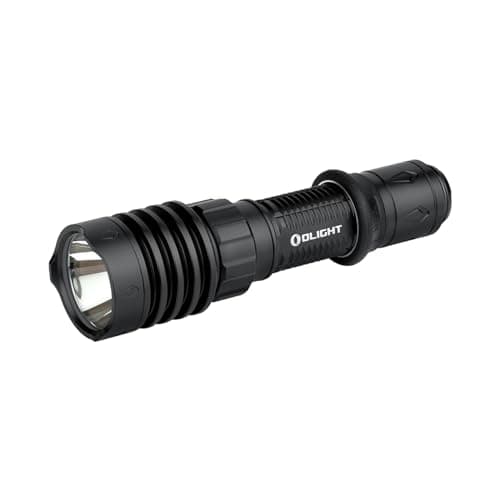 Olight Warrior X 4Top pick2,600 lumens and 630 m of stated throw. The longest published reach of any general-purpose light here. | Reach in a tactical body | 630 m |
We earn a commission if you buy through the links on this page, at no extra cost to you. It does not change what we recommend or the order they appear in. Full disclosure. Prices checked September 21, 2026.
We have not tested this flashlight, own none of the products on this site, and have no laboratory. This review works from what Olight publishes through its retail listing and the ANSI FL 1 arithmetic that follows from it.
The Warrior X 4's published figures put it in an unusual position: 630 meters of reach from 2,600 lumens is the longest published throw of any light we cover that you could still reasonably use in a building. That middle position is the whole argument for it, and it is a better argument than the specification sheet alone suggests.
What Olight publishes
| Specification | Published figure |
|---|---|
| Maximum output | 2,600 lm |
| Beam distance | 630 m |
| Charging | Rechargeable, magnetic charging |
| Peak candela | not published |
| Runtime | not published |
| Weight | not published |
| Ingress protection | not published |
| Impact resistance | not published |
Two numbers and a charging method. Olight is in the same disclosure group as Nitecore on this site — the headline figures are there and nothing underneath them is. Our Olight versus Streamlight comparison sets out how wide that gap is when you put the two spec sheets side by side.
The beam, computed
38 candela per lumen is the interesting number, precisely because it is moderate. A Streamlight ProTac HL-X sits at 27, a dedicated thrower like the Nitecore P30i at 125, and the Acebeam L19 at 256. The Warrior X 4 is tighter than a duty light and far looser than a thrower.
In practice that means a hotspot with real spill around it. You get most of the reach a thrower offers and you keep enough peripheral light to walk down a hallway without the tunnel effect. For most people who think they want a thrower, this is the beam they actually want.
Magnetic charging: a real advantage and a real dependency
Whether that trade is right depends entirely on how you use it. For a light that lives in a vehicle next to its own cable, magnetic charging is strictly better. For a light that travels, it is a single point of failure you are choosing to accept.
2,600 lumens and the heat problem
An LED converts most of the power it draws into heat rather than light, and a flashlight has nowhere to put that heat except its own body and then your hand. Every high-output light therefore steps down, usually within two to five minutes, and the driver does it automatically to protect the emitter.
This is why the missing runtime matters more on a 2,600-lumen light than it would on a 600-lumen one. The question is not whether the Warrior X 4 steps down — it does, they all do — but what level it settles at and how soon. A light that holds 900 lumens indefinitely is a better tool than one that flashes 2,600 for ninety seconds and drops to 400, and the two are indistinguishable on Olight's published sheet.
For contrast, Streamlight publishes 1.5 hours at the ProTac HL-X's 1,300-lumen high and Fenix 3 hours 30 minutes at the PD36R Pro's 2,800. Both of those are measured to the FL 1 threshold, so they include the step-down — which is exactly what makes them useful. How runtime is defined sets out the 10 percent rule that makes those figures comparable.
Where it sits in the tactical field
| Light | Output | Beam distance | Candela per lumen | Runtime at high |
|---|---|---|---|---|
| Olight Warrior X 4 | 2,600 lm | 630 m | 38 | not published |
| Nitecore P20iX | 4,000 lm | 221 m | 3 | not published |
| Fenix PD36R Pro | 2,800 lm | 380 m | 13 | 3 h 30 min |
| Streamlight Stinger 2020 | 2,000 lm | 315 m | 12 | 2 h |
| Streamlight ProTac HL-X | 1,300 lm | 374 m | 27 | 1.5 h |
The Warrior X 4 reaches furthest of the five and is the only one of the top three that publishes nothing about endurance. The Nitecore P20iX is the instructive row: 4,000 lumens, the most output in the set, and 221 meters, the least reach — because at 3 candela per lumen it is a flood wearing a tactical body.
Against the Fenix, the trade is explicit: the PD36R Pro gives up 250 meters of reach and gives you a published 3 hours 30 minutes at 2,800 lumens, a 21700 you can replace, and USB-C. Against the Streamlights, you gain output and distance and lose per-mode runtimes, IP ratings and impact figures. Our tactical field ranks the whole set.
What cannot be said about it
- How long it runs. No runtime at any level and no battery capacity, so neither the figure nor the arithmetic exists. On a 2,600-lumen light, sustained output is the question that most needs answering and it is unanswered.
- Whether it survives weather. No ingress rating. Not evidence that it fails, but an unknown on a light sold as tactical.
- Whether it survives a drop. No impact figure, where ANSI FL 1 specifies a test and Streamlight publishes 2 m on comparable lights.
- What it weighs, which on a light you carry is the specification you notice first.
Four blanks is a lot for a light in this bracket. It is the reason this review cannot tell you the Warrior X 4 is the best light in its class — only that its two published figures describe something unusually well judged.
Who should buy something else
Skip it if you need maximum reach. The Nitecore P30i publishes 1,000 m and the Acebeam L19 1,300, both with far tighter beams and far less usable spill. See throwers.
Skip it if you need documented durability. The Streamlight ProTac HL-X publishes IP68, 2 m impact, a per-mode runtime and a weight range, and runs on its pack or two CR123A primaries.
Skip it if you travel with one light and one cable. The proprietary magnetic charger is the wrong dependency for that, and a USB-C light is the right one.
Skip it if you work only indoors. 2,600 lumens with a concentrated hotspot is more light than a building needs, and a 600-lumen pocket light will be pleasanter to use. Our EDC field covers that end.
The verdict, stated as what it commits to
Olight commits to 2,600 lumens and 630 meters, which computes to about 99,200 candela and 38 candela per lumen. That combination — real distance without surrendering the spill — is the most broadly useful beam in our tactical set, and it is the reason to buy this rather than a dedicated thrower you will find frustrating indoors.
What Olight does not commit to is runtime, weather sealing, impact resistance or weight, and it ties you to a charger only it makes. Buy it for the beam, with your eyes open about the sheet. If published evidence is what you are buying, Streamlight is the brand on this site that provides it.
The picks, in full
Top pick · Reach in a tactical body
Olight Warrior X 4
2,600 lumens and 630 m of stated throw. The longest published reach of any general-purpose light here.
630 m works back to about 99,200 candela. That is a genuine thrower: nearly three times the ProTac HL-X's intensity from twice the lumens, which means a much tighter hotspot.
The trade is spill. At that concentration you get a bright circle and very little else, which is superb across a field and awkward in a corridor.
No published runtime is a real gap on a light this bright. Sustained output is the question a 2,600-lumen thrower most needs to answer.
What works
- 630 m of published throw, the longest in the general-purpose set
- Magnetic charging with no port to flood
- 2,600 lumens alongside the reach, so it is not a narrow-beam-only light
What does not
- No sourced runtime, candela, weight or IP rating
- Very tight hotspot with limited spill
- Proprietary charger
Skip this ifyou work indoors. The beam is built for distance and it is the wrong tool inside a building.
Published specification
- Output
- 2,600 lmOlight Warrior X 4 — the brand's own listing on Amazon.com (retrieved September 1, 2026)
- Peak intensity
- not published
- Beam distance
- 630 mOlight Warrior X 4 — the brand's own listing on Amazon.com (retrieved September 1, 2026)
- Runtime
- not published
- Battery
- Rechargeable, magnetic chargingOlight Warrior X 4 — the brand's own listing on Amazon.com (retrieved September 1, 2026)
- Weight
- not published
- Ingress
- not published
#ad · how this is funded · price as of September 21, 2026
Questions people actually ask
Is the Olight Warrior X 4 worth it?
For a light that reaches a long way without becoming useless up close, yes: 630 m from 2,600 lumens works back to about 38 candela per lumen, which keeps real spill around the hotspot. The cost is disclosure - Olight publishes no runtime, weight, impact or ingress rating for it.
How far does the Olight Warrior X 4 throw?
Olight publishes 630 m. Under ANSI FL 1 that is where the beam falls to 0.25 lux, about full-moon brightness, so it is a measured threshold rather than an identification range. It computes to roughly 99,200 candela.
How long does the Olight Warrior X 4 run?
Olight does not publish a runtime at any level, and publishes no battery capacity either, so there is no figure to quote and nothing to compute from. We will not estimate one. On a 2,600-lumen light, expect the top level to step down as heat builds.
Olight Warrior X 4 or Nitecore P30i?
The P30i for distance - 1,000 m against 630, and 125 candela per lumen against 38. The Warrior X 4 for a beam you can use indoors as well as across a field, and it is the cheaper of the two on current pricing. Neither publishes a runtime, weight or IP rating.
Is Olight's magnetic charging a good thing?
It removes the rubber port flap that eventually fails, which is a real durability gain on a light with no published IP rating. The cost is that the charger is proprietary - a USB-C light charges from any cable anywhere, and this one does not.
Is the Olight Warrior X 4 waterproof?
Olight publishes no ingress rating for it on the listing we read, so we do not state one. The magnetic tailcap means there is no port flap to fail, which helps, but that is reasoning rather than a rating.
Is 2,600 lumens too bright for indoor use?
On its top mode, usually yes - white walls reflect enough of it back to be unpleasant. What makes this light workable indoors is the moderate 38 candela per lumen beam and its lower modes, not its maximum output.
Sources
Every figure on this page came from one of the documents below, read on the date shown. We do not cite other review sites, forum posts or video reviews as sources of fact.
- Olight Warrior X 4 — the brand's own listing on Amazon.com (retrieved September 1, 2026)
- Nitecore P30i — the brand's own listing on Amazon.com (retrieved September 1, 2026)
- Acebeam L19 — the brand's own listing on Amazon.com (retrieved September 1, 2026)
- Streamlight ProTac HL-X — manufacturer spec page (retrieved September 1, 2026)
- ANSI/PLATO FL 1 flashlight performance standard — definitions of lumens, peak beam intensity, beam distance, runtime, impact and water resistance
- IEC 60529 — the IP (ingress protection) rating system
Read next
Best tactical flashlights, ranked on candela rather than lumens
The tactical ranking: published candela, beam distance, sustained runtime and ingress rating, all sourced.
Best flashlight throwers
Throwers ranked on computed candela and published beam distance, with the optics explained.
The brightest tactical flashlights, and what brightness actually buys
Seven of the highest-output tactical lights we cover, ranked on published lumens with the beam distance that contradicts the order.
Olight vs Streamlight
Olight against Streamlight: consumer design and charging against duty-grade documentation.
Nitecore vs Olight
Nitecore against Olight on output per dollar, charging ecosystem, and the specifications neither publishes.
Lumens vs candela
The distinction that decides reach, with the conversion formula and a table of real published figures.
Found a number that is wrong? Tell us and we will fix it and say so. Our methodology shows every formula on this page.