Emergency & Home
Streamlight Siege review
540 lumens, an immersion rating, and cells you can replace. For a power cut those three facts matter more than any figure on a brighter light.
By Scooter M. · Published · Updated
| # | Product | Best for | Output | Price |
|---|---|---|---|---|
| 1 | 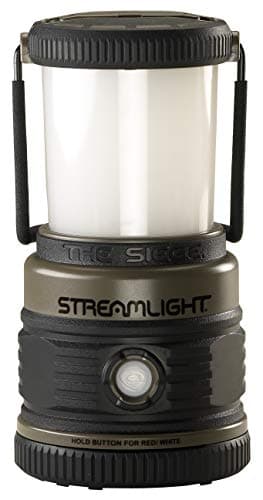 Streamlight SiegeTop pick540 lumens of 360-degree area lighting, IPX7, on replaceable cells. A lantern beats a flashlight indoors and this is the one to own. | Area light in a power cut | 540 lm |
We earn a commission if you buy through the links on this page, at no extra cost to you. It does not change what we recommend or the order they appear in. Full disclosure. Prices checked September 13, 2026.
We have not tested this lantern. We own none of the products on this site and have no laboratory. What follows is what Streamlight publishes, what a lantern is genuinely judged on, and why the specification that usually dominates this site — beam distance — does not apply here at all.
The Siege is on our outage kit and home pages, and it is the only work or emergency light we cover that publishes an ingress rating. For a light bought against a power cut, that combination is the argument.
The published specification
| Specification | Published figure |
|---|---|
| Output | 540 lm |
| Beam pattern | 360-degree area light |
| Ingress protection | IPX7 |
| Battery | Replaceable cells |
| Beam distance | not published, and not meaningful |
| Runtime | not published |
| Weight | not published |
That is a thinner sheet than we would like, and two of the gaps are real. But one of those blank rows is not a gap at all, and it is worth explaining why before anything else.
Why beam distance is the wrong question here
Almost every page on this site ranks lights on candela and beam distance, because those determine how far you can see. A 360-degree lantern has no beam, so it has no meaningful beam distance — the light leaves in every direction at once by design. Asking how far a Siege throws is a category error rather than an unanswered question.
540 lumens spread across a whole room is a genuinely useful amount of light to sit, cook or find things by. The same 540 lumens concentrated into a beam would be a poor flashlight — but it is not trying to be one.
IPX7 on the cheapest light in its category
Under IEC 60529, IPX7 is protection against immersion in one meter of water for thirty minutes. That is a tested, published claim, and across every work light and emergency light we cover the Siege is the only product that carries one.
That matters more than it sounds for an emergency light specifically, because power cuts and bad weather arrive together. A lantern that goes into a flooded basement, sits on a porch in a storm, or gets carried to a generator in driving rain is doing exactly the job it was bought for. Every other light in its price bracket is an unknown in those conditions, which is a disclosure gap rather than proof of failure — but on an emergency purchase, an unknown is the thing you are trying to eliminate.
Replaceable cells are the specification that actually decides this
The Siege runs on replaceable cells rather than a sealed rechargeable pack, and for an emergency light that is close to decisive.
The failure mode in an outage is not a dim light. It is a flat one. A rechargeable lantern that has been in a cupboard since the last storm may be at zero when you reach for it, and there is no socket to fix that — the power is out, which is the entire premise. A lantern on primaries works after two years of storage, and works again ten minutes later when you swap the cells by torchlight.
It is also why we rank the Siege above its own brighter sibling for this job. The Streamlight Super Siege publishes 1,100 lumens and will charge a phone, which is genuinely useful — but it is USB rechargeable, so it inherits exactly the failure mode above. Two very similar lanterns, opposite answers to the question that matters.
The gaps that are real
- No published runtime. This is the significant one. On an emergency light, how long it lasts on a set of cells is the question buyers most want answered, and Streamlight does not answer it for this product — which is conspicuous from the brand that publishes a per-mode table on every handheld it makes.
- No published weight, which matters less for something that sits on a table but is still a figure Streamlight usually states.
- No published cell capacity, so the watt-hour arithmetic this site normally runs cannot be applied. With no runtime and no capacity, there is nothing to check the endurance claim against, because there is no endurance claim.
Who should buy something else
Skip it if you need to see outside. This lights a room, not a yard. If you need to check a fuse box across a garden or identify something at the end of a drive, you want a directional light — the Streamlight ProTac HL-X runs on CR123A primaries and publishes 374 m, which pairs well with a lantern rather than replacing it.
Skip it if you want output. 540 lumens is modest. The Super Siege publishes double and adds a power bank, and if your outages are short and you keep things charged, that is the better lantern.
Skip it if you want a runtime figure before buying. We cannot give you one and neither will Streamlight, and for some buyers that alone is disqualifying. It is a fair objection and we are not going to argue around it with an estimate.
Skip it if you want rechargeable convenience for everyday camping rather than emergencies. Buying primaries for regular use costs more than topping up a battery. See camping flashlights and lanterns.
The verdict, stated as what it commits to
For the specific job of sitting in a cupboard until the power fails, the Siege is the light we would buy. It publishes an immersion rating that nothing else in its category does, it throws light in every direction so it does not cast the shadows people fall over, and it runs on cells you can replace in the dark. Those three facts survive two years of neglect, which is the only performance test an emergency light ever actually faces.
What it does not do is tell you how long it runs, and that is a genuine omission rather than something we can argue away. Buy it for the properties that are published, not for the one that is not — and see building an outage kit for what belongs beside it.
The picks, in full
Top pick · Area light in a power cut
Streamlight Siege
540 lumens of 360-degree area lighting, IPX7, on replaceable cells. A lantern beats a flashlight indoors and this is the one to own.
A flashlight in a dark kitchen produces one bright circle and a room full of hard shadow. A 360-degree lantern at a quarter of the output makes the room usable. That is the whole argument for owning one.
IPX7 on an outage light matters because outages and weather arrive together.
Replaceable cells rather than a sealed pack is the correct choice for something that sits in a cupboard for two years between uses.
What works
- 360-degree area lighting, which is the right beam shape indoors
- IPX7
- Replaceable cells, so storage does not kill it
What does not
- No published runtime in the source we could reach
- 540 lumens is modest if you want to light a whole floor
- No sourced weight
Skip this ifyou need to walk outside with it. A lantern spreads light everywhere, which is exactly wrong on a dark path.
Published specification
- Peak intensity
- not published
- Beam distance
- not published(Not applicable to a 360-degree lantern)
- Runtime
- not published(Not stated in the listing we read)
- Battery
- Replaceable cellsStreamlight Siege — the brand's own listing on Amazon.com (retrieved September 1, 2026)
- Weight
- not published
#ad · how this is funded · price as of September 13, 2026
Questions people actually ask
Is the Streamlight Siege worth it?
For emergency use, yes on published evidence: it is the only work or emergency light we cover that publishes an ingress rating, at IPX7, it throws light 360 degrees so it does not cast hard shadows indoors, and it runs on replaceable cells that survive long storage. Streamlight does not publish a runtime for it, which is a real gap.
How long does the Streamlight Siege run?
Streamlight does not publish a runtime figure for it, so we cannot tell you and will not estimate. It also does not publish the cell capacity, so there is nothing to compute an answer from. That is the clearest weakness in an otherwise well-suited emergency light.
Is the Streamlight Siege waterproof?
It publishes IPX7, which under IEC 60529 is protection against immersion in one meter of water for thirty minutes. Across every work light and emergency light we cover it is the only product with a published ingress rating at all, which matters because outages and bad weather tend to arrive together.
Is a lantern better than a flashlight in a power cut?
Indoors, generally yes. A directional light casts one hard shadow behind every object and those shadows are what people trip on. A 360-degree lantern removes them and lights a whole room to sit, cook or find things by. The ideal outage kit has both: a lantern for rooms and a flashlight for outside.
Streamlight Siege or Super Siege?
The Super Siege publishes 1,100 lumens against 540 and will charge a phone, but it is USB rechargeable — so it can be flat exactly when you need it. The Siege runs on replaceable cells and publishes IPX7. For a light that lives in a cupboard against emergencies, the Siege; for camping where you keep things charged, the Super Siege.
How many lumens do you need for a power outage?
Less than people expect. 540 lumens spread across a room is comfortable for sitting, cooking and moving around safely. Output is not the deciding specification here — whether the light works after two years in a cupboard is, which is why replaceable cells and a waterproofing rating outrank brightness.
Does the Streamlight Siege take rechargeable batteries?
It is designed around replaceable cells, which is the point of it for emergency use. If you want a rechargeable lantern from the same family, the Super Siege is USB rechargeable and doubles as a power bank — at the cost of being the thing most likely to be flat when the power goes out.
Sources
Every figure on this page came from one of the documents below, read on the date shown. We do not cite other review sites, forum posts or video reviews as sources of fact.
- Streamlight Siege — the brand's own listing on Amazon.com (retrieved September 1, 2026)
- Streamlight Super Siege — the brand's own listing on Amazon.com (retrieved September 1, 2026)
- Streamlight ProTac HL-X — manufacturer spec page (retrieved September 1, 2026)
- ANSI/PLATO FL 1 flashlight performance standard — definitions of lumens, peak beam intensity, beam distance, runtime, impact and water resistance
- IEC 60529 — the IP (ingress protection) rating system
Read next
Best flashlights for power outages
Outage lighting ranked on shelf life, area coverage and findability rather than on output.
What to keep in a power outage lighting kit
A practical outage lighting kit, with battery storage rules and a check schedule that takes ten minutes a year.
Best flashlights for home use
Household lighting ranked on coverage: socket lights, lanterns and a handheld that will still work in two years.
Flashlight vs lantern
Directional versus area light, with the illuminance arithmetic for choosing between them.
Best work lights under $100
Eight work lights under $100, ranked on beam shape, mounting and published figures, with the category's disclosure gaps named.
Best flashlights for camping
Camping lights ranked on area coverage, replaceable cells and published water ratings.
Found a number that is wrong? Tell us and we will fix it and say so. Our methodology shows every formula on this page.