Emergency & Home
Streamlight Super Siege review
Six published output-and-runtime pairs, a fortnight of continuous red light, and a lantern that floats. We had almost all of this recorded as not published, which was our error.
By Scooter M. · Published · Updated
| # | Product | Best for | Output | Price |
|---|---|---|---|---|
| 1 | 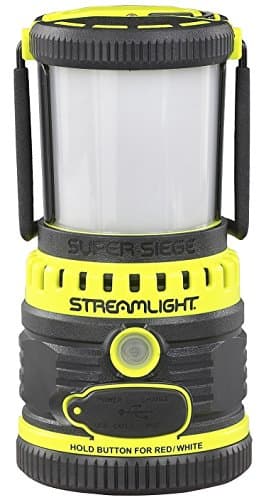 Streamlight Super SiegeTop pick1,100 lumens of area light, USB rechargeable, and it will put charge back into a phone during an outage. | A lantern that also charges a phone | 1,100 lm |
We earn a commission if you buy through the links on this page, at no extra cost to you. It does not change what we recommend or the order they appear in. Full disclosure. Prices checked October 16, 2026.
We have not tested this lantern. We own none of the products on this site, we have no laboratory, and nothing here is an impression of how it feels in a hand. This review takes every figure Streamlight publishes, runs the arithmetic those figures allow, and says what they do and do not commit the company to.
It also corrects us, and this is the fourth product in a row where that has happened. Until this review, this site recorded the Super Siege's runtime, weight and ingress rating as not published, and said in three separate places that Streamlight published no runtime for it - one of them calling that "disappointing from the one brand that publishes per-mode runtimes on its handhelds". Re-reading Streamlight's own product page on October 13, 2026 showed the brand does exactly what we credit it with everywhere else. It publishes six output-and-runtime pairs, IPX7, a 2 m impact rating, a weight, and the fact that it floats. Every page that said otherwise has been corrected in the same change as this one.
With the real sheet in front of you the product reads differently. The 1,100-lumen headline is the least interesting number on it. The one that matters for an outage is 348 hours.
The published specification
| Mode | Output | Run time |
|---|---|---|
| White high | 1,100 lm | 5 h 45 min |
| White medium | 550 lm | 11 h 30 min |
| White low | 125 lm | 36 h 15 min |
| Red high | 2.7 lm | 140 h |
| Red low | 1 lm | 348 h |
| Red flash SOS | 2.7 lm | 320 h |
| Specification | Published figure |
|---|---|
| Battery | Lithium-ion, USB rechargeable |
| Power bank | 4+ charges for most smartphones, 2+ for most tablets |
| Weight | 868 g (1 lb 14.0 oz) |
| Height | 19.05 cm (7.5 in) |
| Ingress protection | IPX7, submersible to 1 m |
| Impact resistance | 2 m |
| Floats | Yes |
| Peak beam intensity | Not published |
| Beam distance | Not published |
| Color rendering | Not published |
Thirteen published figures. The two missing beam numbers are not a gap on a 360-degree lantern - there is no hotspot to measure, and a beam distance figure would be meaningless. The genuine omission is color rendering, which Streamlight publishes on both of its Switchblade work bars and not here.
Three hundred and forty-eight hours
1 lumen for 348 hours is fourteen and a half days of continuous light. The SOS flash runs 320 hours, or thirteen days. The brighter red mode, 2.7 lumens, runs 140 hours - nearly six days.
One lumen sounds like nothing and is the entire point. It is enough to tell you where the room is, enough to find the stairs, enough to stop a dark house feeling like a hazard - and because it costs almost nothing, it turns a lantern with a sealed rechargeable pack into something that still works on day four of an outage. That is the specific weakness of every rechargeable emergency light, and Streamlight's answer to it is published rather than implied.
This is why we would now argue the red modes are the reason to own this rather than a throwaway feature. Building an outage kit covers how the pieces fit together, and the trade against replaceable cells is laid out in the Streamlight Siege review.
The arithmetic the six figures allow
Six output-and-runtime pairs let you do something the category almost never permits: check whether the modes are internally consistent, and work out what each one actually costs you.
So the practical advice inverts the usual. There is no efficiency reason to sit on medium - use high when you want the room bright and accept it ends sooner. The low mode is the odd one out, delivering about 28 percent less total light across its 36 hours, so 125 lumens is a duration setting rather than an economy setting.
What Streamlight does not publish is the cell capacity, so the watt-hour arithmetic this site normally runs cannot be applied and the power-bank claim cannot be checked against stored energy. How runtime is defined covers the computation where the inputs exist.
It floats, and that is a published specification
Under IEC 60529, IPX7 means submersible in one meter of water for thirty minutes; the X means no dust rating was declared. Streamlight pairs that with a 2 m impact rating and states that the lantern floats.
For a camping or flood-adjacent use case that combination is better than it sounds. A sealed light that sinks is a lost light; one that floats and survives a meter of immersion is recoverable. Among the lights we cover, the Streamlight Siege publishes IPX7 as well, the Klein 56416 publishes IP66 and the Stinger Switchblade only IPX4 - so this is at the strong end. Flashlight versus lantern explains why the format matters more than the output indoors.
The power bank, stated in charges rather than milliamp-hours
Streamlight quantifies the USB output as 4+ full charges for most smartphones and 2+ for most tablets, plus 8+ charges for its own smaller lights. That is a more honest way to state it than a bare capacity figure, because it already accounts for conversion losses - but it is also unfalsifiable, since "most smartphones" is not a specification and the cell capacity is not published.
Treat it as an order of magnitude rather than a number: enough to keep one phone alive across a multi-day outage, not enough to run a household. And remember that every charge you draw out is light you are not getting later - the two functions share one pack.
What it is not
At 868 g this is a heavy object, nearly twice the Siege, and 19 cm tall. It is a thing you place, not a thing you carry. There is no replaceable-cell option, so an eighteen-month stint in a cupboard leaves you with whatever charge survived self-discharge - which is exactly why the Siege, on ordinary cells, still outranks it on our home and outage pages despite publishing half the output.
And no CRI figure. On a lantern you cook and read under, color rendering is a comfort specification rather than a safety one, but Streamlight publishes 90 CRI on both Switchblade bars and the silence here is a choice.
Who should buy something else
Skip it if it will sit unused for a year. A sealed rechargeable is the wrong chemistry for that job. The Streamlight Siege runs on replaceable cells and publishes IPX7 too; a D-cell Maglite publishes 298 hours on its lowest mode and needs no charge maintained at all.
Skip it if you need a beam. A lantern lights everything, including your own eyes, and publishes no candela or beam distance because neither would mean anything. For reach, see tactical flashlights.
Skip it if weight matters. 868 g is a car-trunk or cupboard figure. For camping where everything is carried, headlamps do the same job at a tenth of the mass.
Skip it if you want the cheapest adequate outage light. 1,100 lumens and a power bank is more lantern than a single-room blackout needs, and best flashlights for the home ranks the cheaper options on findability rather than output.
The verdict, stated as what it commits to
On published evidence this is the rechargeable lantern to buy if you will actually keep it charged. Streamlight publishes an output and a runtime for all six modes, IPX7 to a meter, a 2 m impact rating, a weight, that it floats, and a power-bank figure in phone charges - and the six runtimes are consistent enough to show that high mode costs you nothing in total light.
It is heavy, it has no replaceable-cell fallback, it publishes no CRI, and its power-bank claim cannot be checked against a capacity figure. Every one of those is visible in the numbers before you spend anything. For the outage case in full see building an outage kit; for the format argument, flashlight versus lantern.
The picks, in full
Top pick · A lantern that also charges a phone
Streamlight Super Siege
1,100 lumens of area light, USB rechargeable, and it will put charge back into a phone during an outage.
1,100 lumens is enough to light a whole room to a level where you can read and cook, which is the difference between coping with an outage and enduring one.
The USB output is the second reason to own it. In a multi-day outage, the phone is the thing that matters.
Rechargeable rather than replaceable cells is a real trade-off for emergency kit: better in a planned outage, worse if it has been in a cupboard for eighteen months. The red LED is the hedge: 1 lumen for a published 348 hours means a flat-ish pack still gives you two weeks of find-the-stairs light.
What works
- Six published output-and-runtime pairs, including 348 h on the 1 lm red
- IPX7 to a meter, a 2 m impact rating, and it floats
- Charges a phone over USB - Streamlight states 4+ phone charges
What does not
- No sourced runtime, weight or IP rating
- Rechargeable cell self-discharges in storage
- Bulkier and heavier than the standard Siege
Skip this ifit will sit untouched for years. For pure standby, replaceable cells beat a rechargeable pack every time.
Published specification
- Output
- 1,100 lmWhite high. Medium 550 lm, low 125 lm, plus a three-mode red LED.Streamlight Super Siege — manufacturer spec page (retrieved October 13, 2026)
- Peak intensity
- not published
- Beam distance
- not published(Not applicable to a 360-degree lantern)
- Runtime
- 5 h 45 min at 1,100 lmSix published pairs: white 550 lm/11.5 h and 125 lm/36.25 h; red 2.7 lm/140 h, 1 lm/348 h and SOS 2.7 lm/320 h.Streamlight Super Siege — manufacturer spec page (retrieved October 13, 2026)
- Battery
- Li-ion, USB rechargeableAlso a USB power bank: Streamlight states 4+ phone charges. Capacity not published.Streamlight Super Siege — manufacturer spec page (retrieved October 13, 2026)
- Weight
- 868 g1 lb 14.0 oz. 19.05 cm tall.Streamlight Super Siege — manufacturer spec page (retrieved October 13, 2026)
- Ingress
- IPX7Submersible to 1 m, 2 m impact rating, and it floats.Streamlight Super Siege — manufacturer spec page (retrieved October 13, 2026)
#ad · how this is funded · price as of October 16, 2026
Questions people actually ask
How long does the Streamlight Super Siege run?
Streamlight publishes six figures: white 1,100 lumens for 5 hours 45 minutes, 550 lumens for 11 hours 30 minutes, 125 lumens for 36 hours 15 minutes; red 2.7 lumens for 140 hours, 1 lumen for 348 hours, and an SOS flash at 2.7 lumens for 320 hours. The cell capacity is not published, so the hours cannot be checked against stored energy.
What is the longest the Super Siege will stay lit?
348 hours - fourteen and a half days - on the 1-lumen red mode. That is the figure that matters in a multi-day outage: one lumen is enough to navigate a dark house, and it costs so little that a lantern with a sealed rechargeable pack still has something useful to give on day four.
Which mode is most efficient?
High and medium are identical. Multiplying output by published runtime gives 6,325 lumen-hours on both 1,100 lumens for 5.75 hours and 550 lumens for 11.5 hours, so there is no efficiency penalty for running high - it simply ends sooner. The 125-lumen low delivers about 28 percent less total light, which makes it a duration setting rather than an economy one.
Is the Streamlight Super Siege waterproof?
It publishes IPX7 - submersible in a meter of water for thirty minutes - plus a 2 m impact rating, and Streamlight states that it floats. The X means no dust rating was declared. Among the lights we cover that is at the strong end: the Klein 56416 publishes IP66 and the Streamlight Stinger Switchblade only IPX4.
Can the Super Siege charge a phone?
Yes. Streamlight quantifies it as 4+ full charges for most smartphones, 2+ for most tablets and 8+ for its own smaller lights. It does not publish the cell capacity, so that claim cannot be checked against stored energy, and every charge you draw is light you will not get later - the lantern and the power bank share one pack.
Streamlight Siege or Super Siege?
The Super Siege publishes double the output, six runtimes, a power bank and that it floats; the Siege publishes 540 lumens, IPX7 and runs on replaceable cells. For a light that lives in a cupboard for a year between uses, the Siege wins on chemistry alone. For camping or any situation where you keep things charged, the Super Siege.
How heavy is the Super Siege?
868 g (1 lb 14.0 oz) and 19.05 cm tall - roughly twice the Siege. It is a lantern you place rather than carry, which is fine for a cupboard, a vehicle or a campsite and wrong for a pack.
Sources
Every figure on this page came from one of the documents below, read on the date shown. We do not cite other review sites, forum posts or video reviews as sources of fact.
Read next
Best flashlights for power outages
Outage lighting ranked on shelf life, area coverage and findability rather than on output.
What to keep in a power outage lighting kit
A practical outage lighting kit, with battery storage rules and a check schedule that takes ten minutes a year.
Best flashlights for home use
Household lighting ranked on coverage: socket lights, lanterns and a handheld that will still work in two years.
Best flashlights for camping
Camping lights ranked on area coverage, replaceable cells and published water ratings.
Flashlight vs lantern
Directional versus area light, with the illuminance arithmetic for choosing between them.
Streamlight Siege review
A specification-first review of the Streamlight Siege: what a 360-degree lantern is actually judged on, and why the brightest light is the wrong tool indoors.
Best work lights for a service truck
Work lights for mobile service work, ranked on power source, beam coverage and mounting — with every published figure sourced.
Klein vs Streamlight work lights
Klein against Streamlight on work-light beam shape, mounting and published figures - including the only ingress rating either brand states.
Flashlight runtime, computed
How runtime is defined, why thermal step-down happens, and the arithmetic to compute a real figure yourself.
Found a number that is wrong? Tell us and we will fix it and say so. Our methodology shows every formula on this page.